Australian Business Sales Insights - March Quarter 2026

Australia's business for sale market on Bsale entered 2026 with buyers returning in force. Buyer enquiries rose about 23% on the December quarter, recovering from the usual holiday slowdown, while the national average asking price reached its highest level of the past three quarters.
The national average asking price rose 3.4% to $703,133, up from $680,266 in December. The number of businesses for sale on Bsale held broadly steady, up 0.3% over the quarter, suggesting the lift in average price reflects a stronger mix of businesses on the market rather than a surge in supply.
South Australia and New South Wales recorded the strongest price rises, while Adelaide overtook every other capital city on average asking price.
Buyers remain active but selective, engaging where businesses demonstrate clear financial performance, operational strength and realistic pricing.
Note: The figures in this report should be used as a general guide to trends only. The data has inherent limitations, outlined in About This Data at the end of this article. This information should not be relied on when making legal, financial or investment decisions.
National Overview
The national average asking price on Bsale rose 3.4% in the March quarter, from $680,266 in December to $703,133.
This continues the gradual upward trend seen through the second half of 2025, with the average up 5.9% since September 2025. The steady climb points to a gradual improvement in the quality and composition of businesses entering the market rather than a sharp increase in pricing.
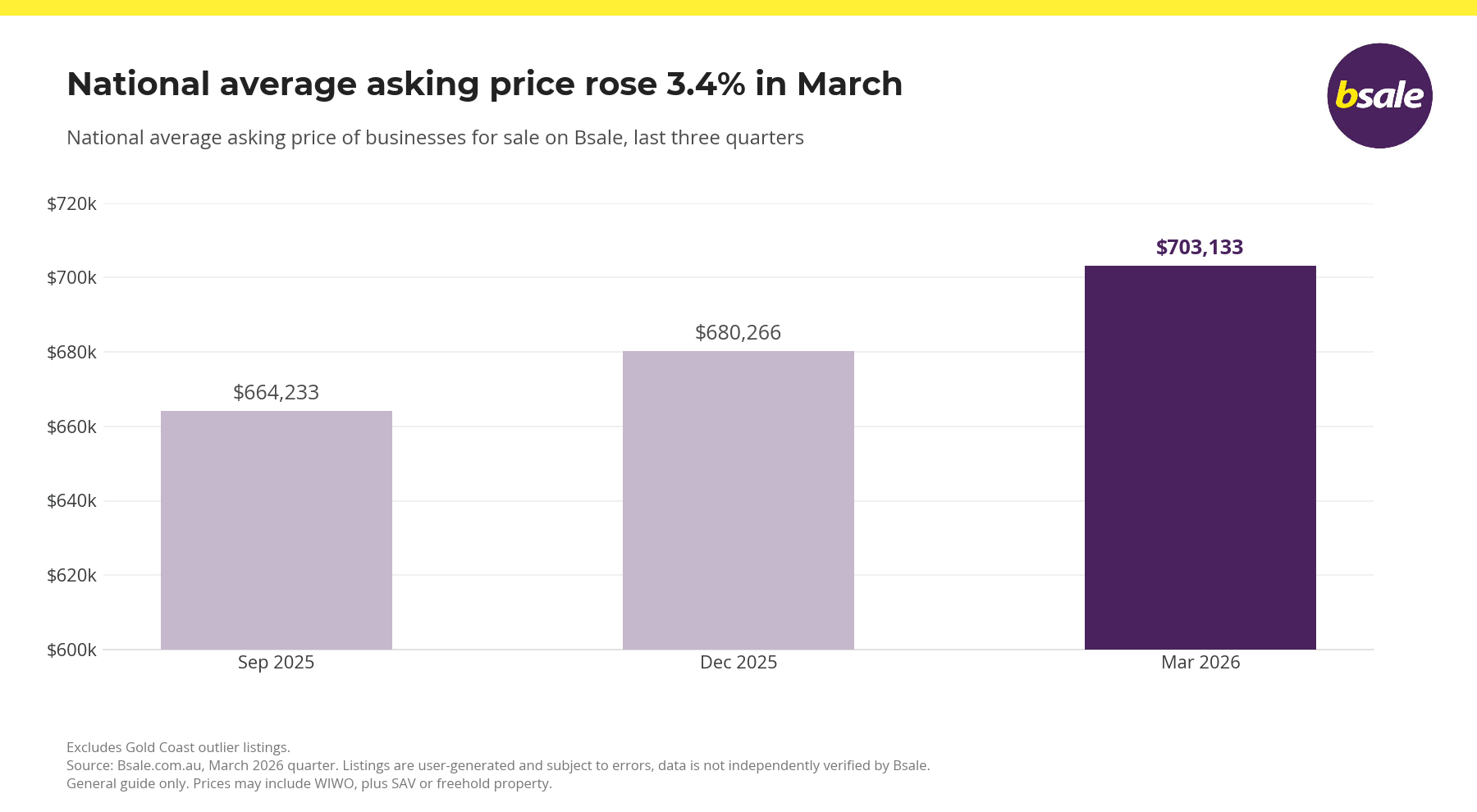
Graph: National average asking price of businesses for sale on Bsale, September 2025 – March 2026.
The number of businesses for sale on Bsale held broadly steady, up 0.3% on December and 4.6% since September 2025. The early months of the year typically bring a slower pipeline of new listings, as many owners wait until after the holiday period to launch a sale.
Overall, the national market continues to build steadily. Pricing is lifting at a measured pace, supply is stable and the mix of businesses coming to market is improving, supporting a balanced environment heading into the June quarter.
State Analysis
South Australia recorded the highest average asking price of any state in March 2026 at $964,180, followed by Western Australia and Queensland. New South Wales recorded the strongest increase of the larger states, while Tasmania was the most affordable.
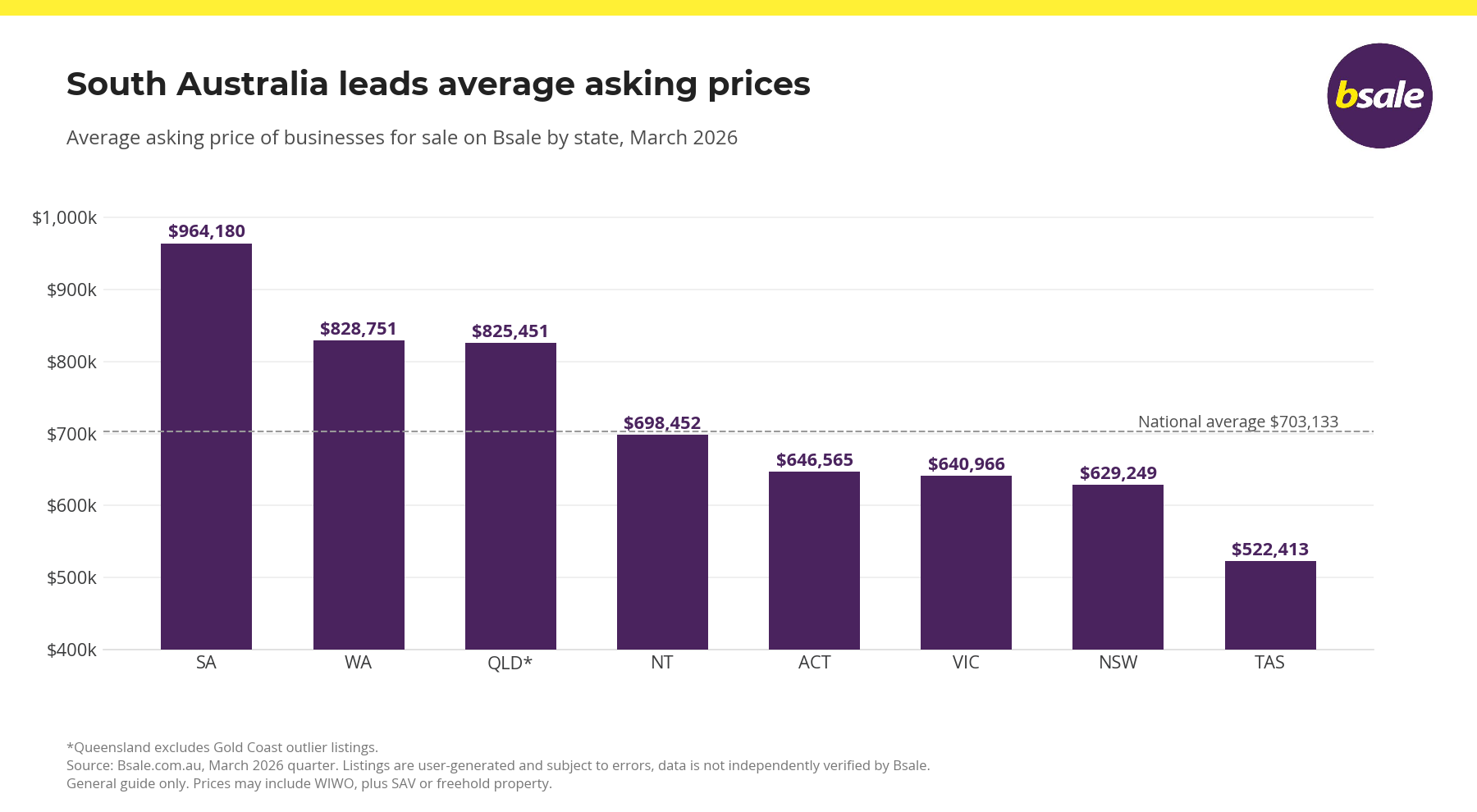
Graph: Average asking price of businesses for sale on Bsale by state, March 2026.
South Australia
South Australia recorded the standout pricing result of the quarter. The average asking price rose 10.0% from $876,879 in December to $964,180, the highest of any state, while the number of businesses for sale eased 0.9%.
The combination of flat supply and strong price growth suggests a shift toward higher-value businesses entering the market, alongside continued demand for established, well-performing operations.
Western Australia
Western Australia averaged $828,751, up 2.5% on December, while listings eased 2.3%. WA continues to perform strongly at the upper end, supported by resource-linked and asset-backed businesses.
Queensland
Queensland averaged $825,451, easing 1.5% from December, while listings rose 4.5%, the largest increase of the larger states. This figure excludes Gold Coast outlier listings.
The slight decline appears to reflect listing mix rather than weakening demand, with continued activity across both metropolitan and regional markets.
Northern Territory
The Northern Territory averaged $698,452, up 7.8% on December. Given the small size of the market, this movement is likely driven by changes in listing composition, where a few higher-value businesses can significantly move the average.
Australian Capital Territory
The ACT averaged $646,565, down 2.0%, while listings rose 14.0%. This suggests new listings entered at slightly lower values, in a market where a handful of listings can shift the result.
Victoria
Victoria averaged $640,966, easing 1.4% from December, with listings up 1.0%.
The key takeaway is stability. Victoria did not experience a sharp shift in pricing, indicating the mix of businesses coming to market has remained relatively consistent. This reinforces its position as a balanced, high-volume market with strong accessibility for buyers.
New South Wales
New South Wales remained Australia's largest business for sale market on Bsale by listing volume. Its average asking price rose 11.0% from $566,828 to $629,249, the strongest increase of the larger states, while listings rose 2.2%.
The rise suggests an uplift in the quality and scale of businesses entering the market. Despite this, NSW pricing remains below the national average, reflecting the state's depth and concentration of smaller owner-operated businesses.
Tasmania
Tasmania recorded the lowest average asking price of any state at $522,413, down 7.6% on December, with listings broadly unchanged. As a smaller market, Tasmania's average is sensitive to the addition or removal of a few higher-value tourism or hospitality businesses.
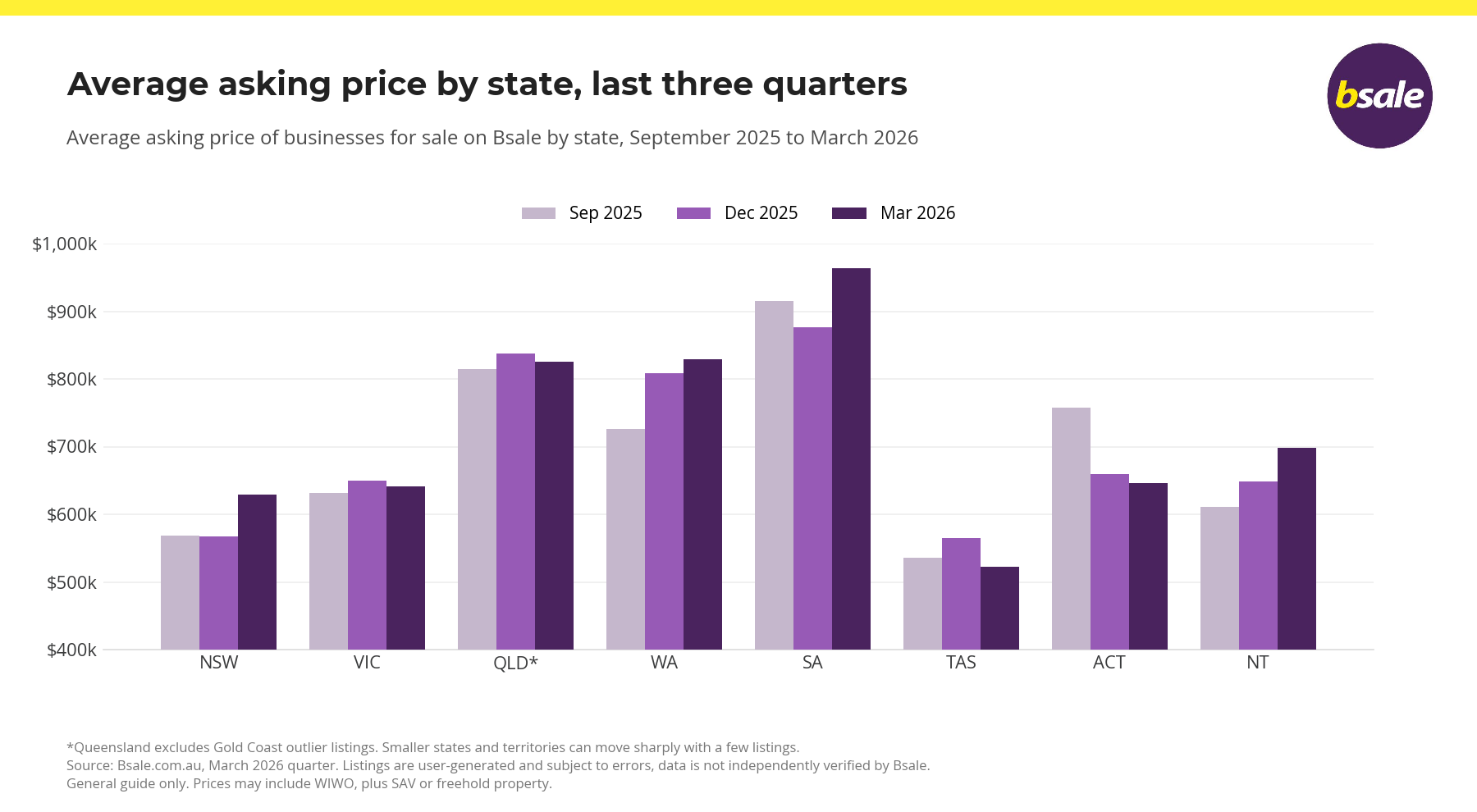
Graph: Average asking price of businesses for sale on Bsale by state, September 2025 – March 2026.
Capital City Analysis
Adelaide was the standout capital city in the March quarter, with its average asking price rising 11.5% to $1,021,182, the highest of any capital.
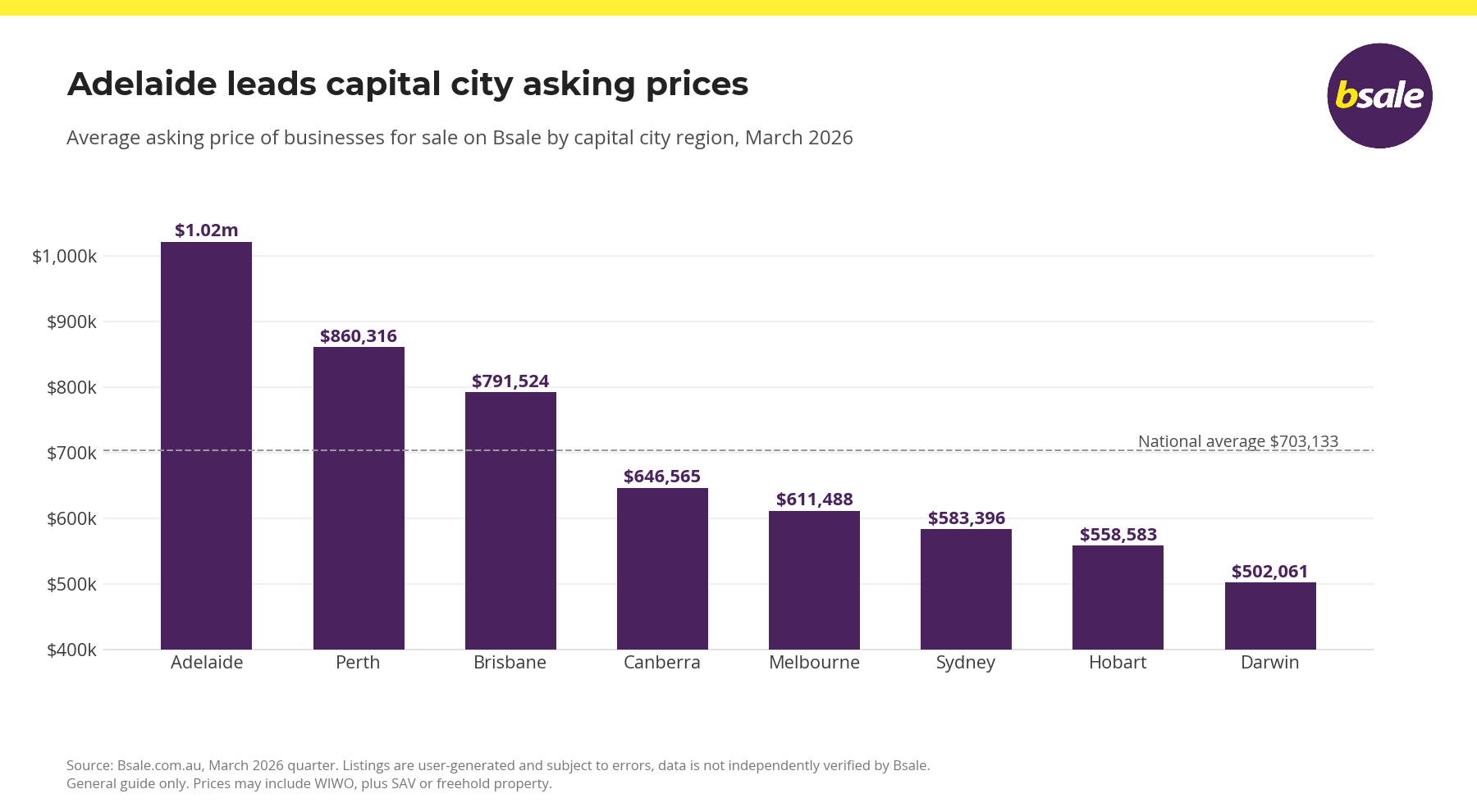
Graph: Average asking price of businesses for sale on Bsale by capital city region, March 2026.
Adelaide's lift reflects a stronger presence of higher-value businesses entering the market, combined with continued demand for stable, well-performing operations, and mirrors the broader South Australian result.
Perth followed at $860,316, up 6.4%, supported by resource-linked industries and a stable pipeline of established businesses. Brisbane was third at $791,524, up 1.4%, and remains one of the most consistent capital city markets.
Sydney recorded the largest rise of the capitals, up 15.5% from $504,944 to $583,396. The uplift suggests a stronger mix of mid-sized and higher-value businesses entering the market, although Sydney remains below most other capitals due to its concentration of smaller, leasehold operations. Melbourne eased 1.5% to $611,488. As the two largest capital city markets, both continue to be influenced by a high proportion of smaller service and retail businesses.
Canberra averaged $646,565, down 2.0%. Hobart fell 9.3% to $558,583, and Darwin fell 15.3% to $502,061, the lowest of the capitals. In small markets such as Hobart and Darwin, these shifts are likely driven by the removal of a few higher-value listings rather than a structural change in demand.
Overall, the March quarter highlights a capital city market shaped by relative movement rather than broad shifts in sentiment. Adelaide, Perth and Brisbane lead on pricing, Sydney and Melbourne remain volume-driven markets with more accessible entry points, and the smaller capitals continue to show greater sensitivity to changes in listing mix.
Regional Market Insights
Mackay & Central Queensland was the highest-priced regional market on Bsale in March 2026, with an average asking price of $1.87 million across more than 100 listings.
Regional Australia continues to play a significant role in shaping national pricing, particularly at the upper end. The data shows a clear divide between high-value regional markets driven by freehold and asset-backed businesses, and lower-priced lifestyle regions offering accessible entry points.
Highest-priced larger regional markets (March 2026)
- Mackay & Central Queensland (QLD) – $1.87m
- Gippsland (VIC) – $1.27m
- Dubbo & Central West (NSW) – $1.08m
- South Coast (NSW) – $1.06m
- Mid North Coast (NSW) – $802,728
Mackay's average rose 5.5% on December, supported by mining services, transport and industrial businesses. Gippsland rose 17.3% and the South Coast NSW 33.8%, while Dubbo & Central West rose 14.1%.
Several smaller markets recorded higher averages, including Broome & Kimberley ($1.60m), Broken Hill & Western NSW ($1.56m), Alice Springs ($1.52m) and the Pilbara ($1.36m). Each has fewer than 25 listings, so one high-value business can move the average sharply.
These elevated averages are often driven by deal structure rather than volume. Many of these regions have a higher proportion of freehold businesses, particularly across accommodation, fuel, transport and tourism, so advertised prices often reflect a combined business and property value.
The mid-range
A broad band of coastal and regional markets sits between about $650,000 and $800,000, including Toowoomba & Darling Downs ($798,900), Shepparton & Hume ($729,560), the Sunshine Coast ($729,254), Newcastle & Hunter Valley ($722,659), Wagga Wagga & Riverina ($708,423) and Geelong & South West Victoria ($679,414).
These markets benefit from a balance of population growth, infrastructure investment and diversified local economies, making them increasingly competitive with capital cities for buyer attention. The Gold Coast averaged $602,164, one of the more accessible large coastal markets.
More accessible entry points
At the lower end, the Mornington Peninsula ($437,047), Bunbury & South West WA ($452,854) and Launceston & Northern Tasmania ($454,594) recorded the lowest averages among the larger regional markets, with the Blue Mountains ($288,000) lower still across a smaller pool of listings.
These regions are often driven by smaller hospitality and tourism businesses, where lifestyle considerations play a larger role in buyer decisions, though seasonality and operational risk are often part of the trade-off.
Higher regional averages may partly reflect what the asking price includes, such as plant, machinery, vehicles, stock or freehold property, so buyers should check what the price covers.
Industries
Engineering and manufacturing remained the highest-priced major category in March 2026 at $1.65 million, closely followed by building and construction at $1.60 million.
Industry data highlights a clear split between asset-intensive sectors at the top of the market, essential service businesses around the national average, and high-volume hospitality and service categories at the more accessible end.
|
Category |
Average asking price, March 2026 |
|---|---|
|
Engineering Manufacturer |
$1,654,562 |
|
Building and Construction |
$1,602,805 |
|
Mechanics |
$754,493 |
|
Alcohol Liquor Shop |
$717,930 |
|
Hardware |
$637,055 |
|
Supermarket |
$598,404 |
|
Mobile Services |
$539,547 |
|
Educational |
$483,121 |
|
Gym |
$468,359 |
|
Lawn Mowing |
$460,148 |
|
Bakery |
$429,086 |
|
Restaurant |
$405,210 |
|
Cleaning |
$391,572 |
|
Takeaway |
$363,364 |
|
Cafe |
$337,922 |
|
Beauty Salon |
$220,043 |
Engineering and manufacturing eased 9.3% from December, while building and construction rose 14.3%. Mechanics eased 17.5% to $754,493, though it remains well above most service categories, reflecting steady demand for automotive services.
Liquor stores, hardware and supermarkets cluster around the national average, supported by recurring demand and, in many cases, established premises. Education businesses, gyms, mobile services and lawn mowing sit below the average but above entry level, benefiting from repeat customers and structured operations, though buyers remain mindful of staffing and operating costs.
Hospitality remains the highest-volume sector but continues to sit at the lower end of pricing. Restaurants, bakeries, takeaway and cafes averaged between about $340,000 and $430,000. These businesses are typically leasehold, owner-operated and sensitive to rent and staffing costs, which limits upward movement in average prices despite ongoing buyer interest.
Cleaning businesses and beauty salons continue to offer the most accessible entry points into business ownership, requiring hands-on involvement but lower capital.
Overall, higher-value categories are driven by assets, contracts and scale, while lower-priced sectors provide accessibility and volume. Buyers continue to segment clearly by budget and risk profile.
Where Buyers Are Enquiring
Buyer enquiries on Bsale rose about 23% on the December quarter, as buyers returned after the Christmas and New Year slowdown. Demand spanned a wide range of industries and price points, with a clear pattern around cashflow, simplicity and operational clarity.
WA and NSW lead enquiry
Western Australia attracted the largest share of buyer enquiries at about 33%, followed by New South Wales (28%), Queensland (18%) and Victoria (15%). Interest in WA was particularly strong across service-based and essential business categories, consistent with its strong pricing and resource-linked economy.
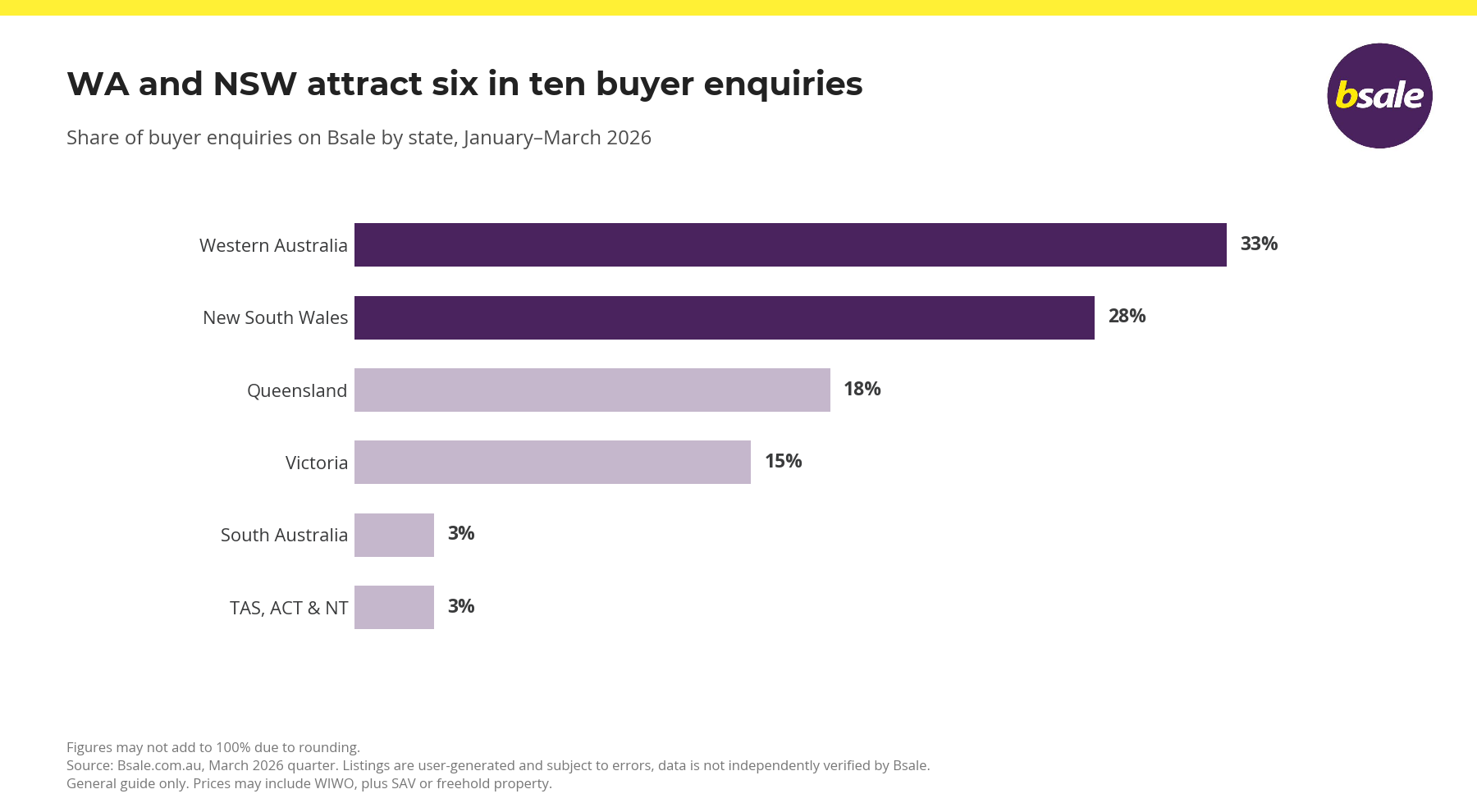
Graph: Share of buyer enquiries on Bsale by state, January–March 2026.
The businesses buyers are targeting
Asset-backed and essential service businesses remained among the strongest performers. Petrol stations, car washes, supermarkets and liquor stores featured prominently among the most-enquired listings, underpinned by consistent demand and, in many cases, a freehold or long-term lease.
Service businesses with strong cashflow and low overheads also attracted significant attention. Bookkeeping services, cleaning businesses, vending machine operations and landscaping businesses all featured heavily, as models that are often scalable, easier to operate and less reliant on large teams.
Hospitality remained active, with a clear shift in expectations. Cafes, takeaway businesses and small bars continued to generate enquiries, particularly where pricing was accessible or the business was under management.
Fitness, health and personal services, including gyms, wellness hubs and dental clinics, attracted attention where there was an established client base or recurring revenue. Online businesses, including AI-led opportunities and digital service providers, also appeared more often in enquiry data, attracting interest well beyond their small share of listings.
Buyers were active across the full price spectrum, from entry-level businesses under $100,000 to multi-million-dollar motels and asset-backed operations. Across all categories, the common thread is a preference for businesses that are easy to understand, easy to run and capable of delivering reliable returns.
What's Selling January–March 2026
The number of businesses marked as sold on Bsale in the March quarter is not directly comparable with other quarters. 1,047 businesses were marked as sold, a figure lifted by large batches of listings being marked as sold at once. A large number of listings appear to have been marked as sold at once through broker status updates, particularly in New South Wales and Queensland, so the quarter's count overstates activity and is not reported here.
The businesses marked as sold spanned a broad range of industries. Food Hospitality, Services and Beauty and Health were the most common, followed by Retail and Manufacturing.
The March quarter often reflects a slower pipeline of new listings, as many owners delay launching sales campaigns until after the holiday period, while deals agreed before Christmas continue to settle in the new year.
Not every completed sale is recorded as sold. Brokers often withdraw listings to maintain confidentiality, and automated broker feeds can mark several listings as sold at once, so the number marked as sold can vary between quarters and is best read as an indicator of activity on Bsale rather than a complete count.
Outlook for the June 2026 Quarter
Activity on Bsale is expected to build as the market moves into one of its busiest periods. The lead-up to 30 June typically brings added urgency, with buyers and sellers working to finalise deals before the end of the financial year.
A new wave of businesses is also likely to enter the market in the new financial year. EOFY remains a natural decision point for many owners, whether driven by tax planning, a performance review or a long-term exit strategy, which is likely to support continued growth in listings into the second half of 2026.
Global conditions are becoming more complex. Volatility in fuel prices can flow through to inflation, operating costs and interest rate expectations, with the potential to influence business profitability, lending conditions and buyer confidence, particularly in cost-sensitive sectors.
The impact is unlikely to be evenly felt. Businesses with stable earnings, strong margins and clear operating structures are expected to continue attracting buyer interest, particularly where sellers are realistic. Businesses under pressure may take longer to sell or require more flexible deal structures.
The key trend to watch is a continued shift toward quality. Buyers remain active but disciplined, focusing on businesses that can demonstrate resilience and consistency in changing conditions.
Updated October 2026: Bsale has revised how listings are counted for these reports, excluding listings already marked as sold and older listings since removed. National, state, capital city, regional and sold figures in this report have been updated to the current basis, consistent with the September 2026 quarter report.
About This Data
This report is based on listing information entered by brokers and business owners on Bsale. It should be treated as a general guide to trends only, as the data has inherent limitations:
- Asking prices may include stock, plant and equipment, or freehold property. Bsale does not verify the data, or analyse or adjust for what each price includes.
- Prices for businesses marked as sold are the advertised asking prices, not final sale prices, which are rarely disclosed by sellers.
- As a business address is not required when listing, the same business may be advertised more than once, for example by different brokers, and franchise and business opportunities may be advertised in many locations.
- Not all data is provided, updated or entered accurately. Listings may be withdrawn or changed, stay active after a sale, or be marked as sold without full details.
- Listing figures are a snapshot taken on the last day of each quarter.
- The data reflects activity on Bsale only, not all business sales in Australia.
This information is not professional, legal, financial or investment advice and should not be relied on when making financial decisions, such as starting, buying or selling a business. Readers should conduct their own research and obtain independent professional advice.
Tags: market insights quarterly report business brokers
About the author

Vanessa Lovie-Yousaf
CEO Bsale Australia
Vanessa Lovie-Yousaf is the CEO and manager of Bsale.com.au, one of Australia’s most trusted business for sale marketplaces since 2000. With 15 ...


