How to Buy a Restaurant in Australia

Buying a Restaurant in Australia. A Buyer's Guide
Thinking about buying a restaurant? Whether you're a chef ready to run your own kitchen, an operator looking for another venue, or a buyer with business skills and a love of food, buying an established restaurant is usually a faster way into the industry than starting from scratch.
That was the path for Bowen Li, now a partner at Bizlink Group in Western Australia. He trained as a chef before buying his first pizza shop in 2012.
"Kitchen is interesting, but to own a business, to own a hospitality business should be more fun," he said.
It's also a big commitment. Restaurants rely on location, staff, rent and tight margins, and the difference between a profitable business and a money pit is often found in the lease, the financials and the condition of the kitchen.
This guide walks through how to buy a restaurant in Australia step by step, using Bsale marketplace data and insights from business brokers who work with hospitality businesses every day.
Buying an Established Restaurant vs Starting From Scratch
An existing restaurant comes with the kitchen fitted out, staff in place, customers who already know where to find it and a lease already signed. You can trade from the day you take over, rather than waiting months for approvals, a fit-out and a customer base.
Starting from scratch means paying for the fit-out, kitchen equipment, approvals, branding and marketing before you serve your first meal. A commercial kitchen and dining room fit-out can easily run into hundreds of thousands of dollars, and there's no trading history to tell you whether the concept will work in that spot.
With an established restaurant, you can see what the business has actually done. You can review its sales, costs and profit, watch how busy it is and judge whether the asking price is fair for what you're getting.
The trade-off is that you also inherit the business's problems. That's why the checks in this guide matter.
How Much Does It Cost to Buy a Restaurant?
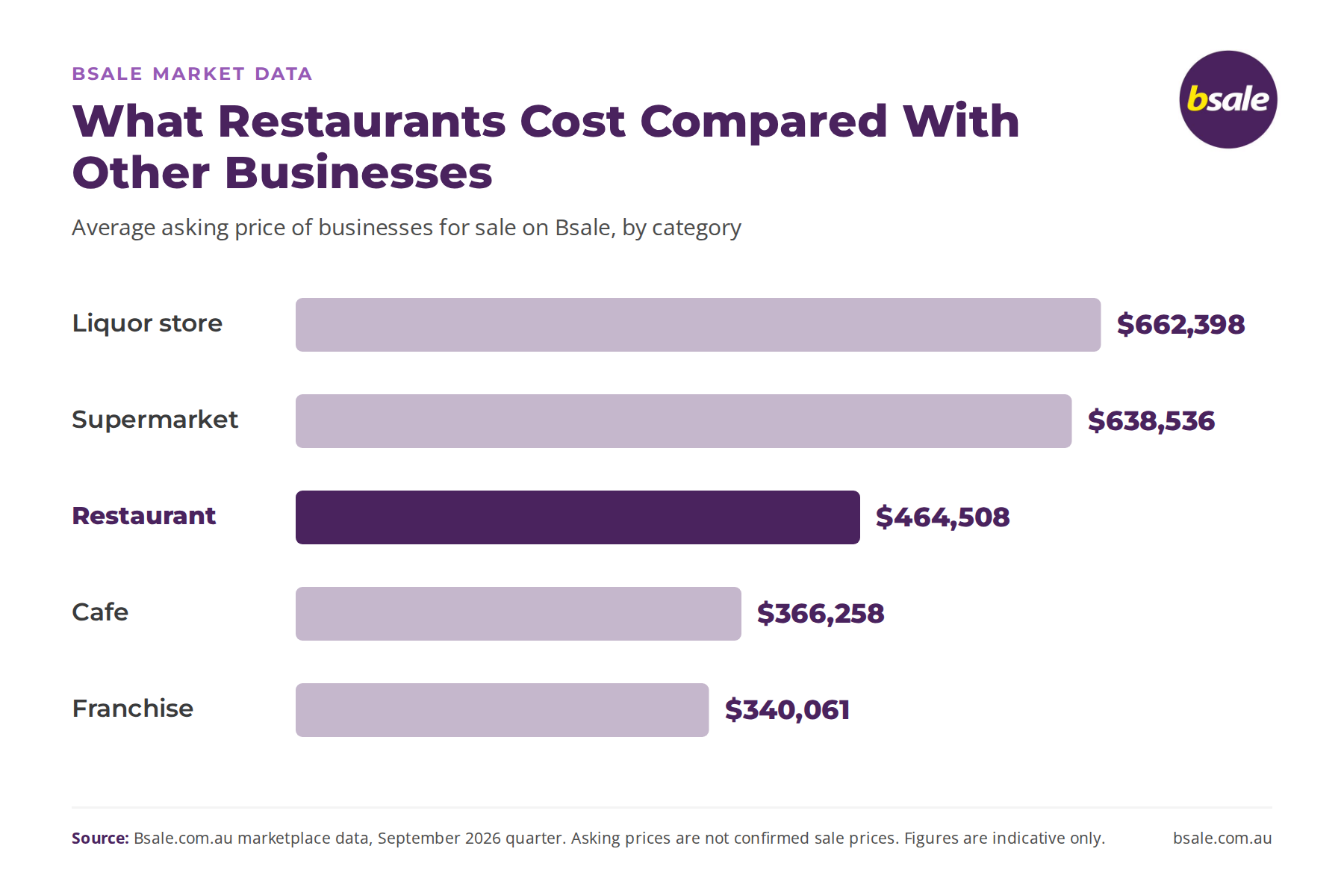
According to Bsale marketplace data for the September 2026 quarter, restaurants for sale on Bsale had an average asking price of $464,508. That sits above cafes ($366,258) and below supermarkets ($638,536) and liquor stores ($662,398).
|
Restaurants on Bsale, September 2026 quarter |
|
|---|---|
|
Average asking price, restaurants for sale |
$464,508 |
|
Restaurants marked as sold |
48 (66 a year earlier) |
Restaurants were the second most common food and hospitality business marked as sold on Bsale during the quarter, behind cafes. Food and hospitality also attracted about 28% of buyer enquiries on Bsale, more than any other industry, although restaurants recorded fewer enquiries than a year earlier.
Averages hide a wide range. The price of a restaurant depends on its profit, location, lease, equipment and trading history, and on what the asking price includes. A price advertised as WIWO or plus SAV can mean quite different amounts once stock is added, so check before comparing listings.
How Restaurants Are Usually Priced
Most restaurants are priced based on their earnings, often using adjusted annual profit that accounts for the owner's wages and certain business expenses. This figure is multiplied by an amount that reflects the business's profitability, stability and risk. For example, a restaurant generating $150,000 in adjusted annual earnings and advertised at $300,000 is asking two times earnings.
A lower multiple doesn't automatically mean a bargain. A short lease, high rent, ageing equipment or a business that relies heavily on one chef can all justify a lower price. Buyers should also check whether the asking price includes stock, equipment and other assets.
Bsale doesn't value businesses, so for an independent assessment, speak to a business broker or an accountant experienced in hospitality, or read our guide on how businesses are valued.
How to Buy a Restaurant in 10 Steps
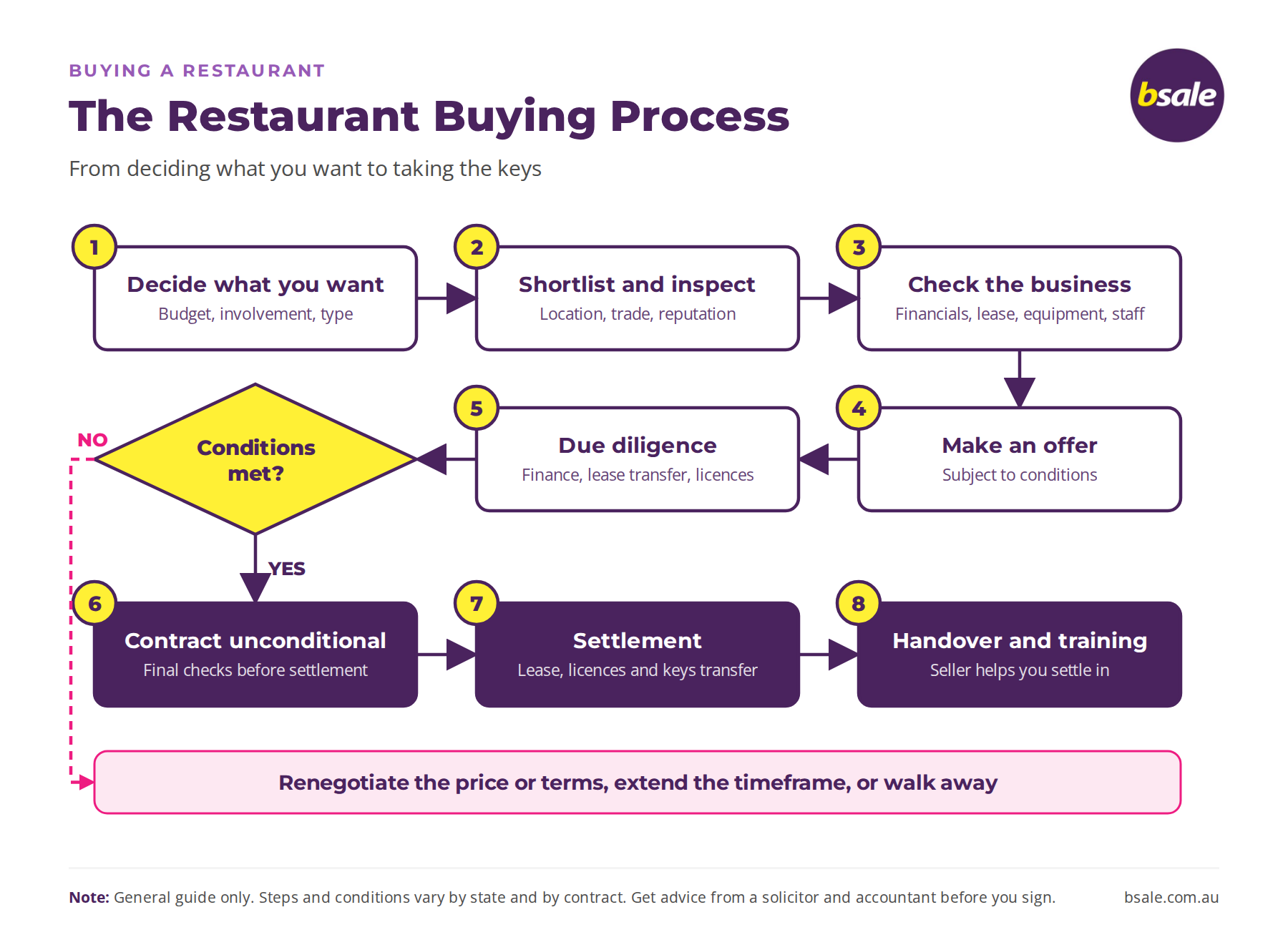
1. Decide What Kind of Restaurant You Want
Start with why you want to buy.
Do you want a profitable restaurant you can walk into and keep running, or a fixer-upper you can change and make your own? Both can work, but they suit different buyers, budgets and levels of experience.
Think about how involved you want to be. An owner-operator restaurant may be cheaper to buy, but it usually means long hours in the kitchen or on the floor. A restaurant run under management costs more and relies on the people you inherit.
Set a budget that covers more than the asking price. Allow for stock, legal and accounting fees, stamp duty where it applies, and enough working capital to cover wages and suppliers in the first few months.
2. Check the Location
A good location can be worth paying for.
You can rebrand a restaurant, change the menu and put your own stamp on it, but you can't move it. Prime spots, such as Sydney's Darling Harbour, rarely become available.
Visit at different times of the day and week. How many people walk past at lunch, at dinner and on weekends? Is there parking, public transport or nearby offices, homes and venues that bring people in? How many competitors are close by?
Also check for changes that could affect trade. Look for development applications on the council website, roadworks or new competitors. If the restaurant is in a shopping centre, ask about redevelopment plans, tenancy mix and trading hours.
Make sure the location matches the price you are paying.
3. Understand the Financials
A restaurant can look busy and still not make money.
Ask for at least two to three years of profit and loss statements, and check them against BAS lodgements, point-of-sale reports and bank statements.
Restaurants rely heavily on staff, so review PAYG withholding and superannuation records to confirm employees have been paid correctly. Ask how many hours the owner works, and whether their own labour has been accounted for. A business that only makes a profit because the owner works 70 unpaid hours a week isn't as profitable as it looks.
Wages, rent and food costs are the three big expenses that make or break a restaurant. Commonly used rules of thumb are:
- Food costs of around 28% to 35% of sales
- Labour costs of around 25% to 35% of sales
- Rent of around 10% to 15% of sales
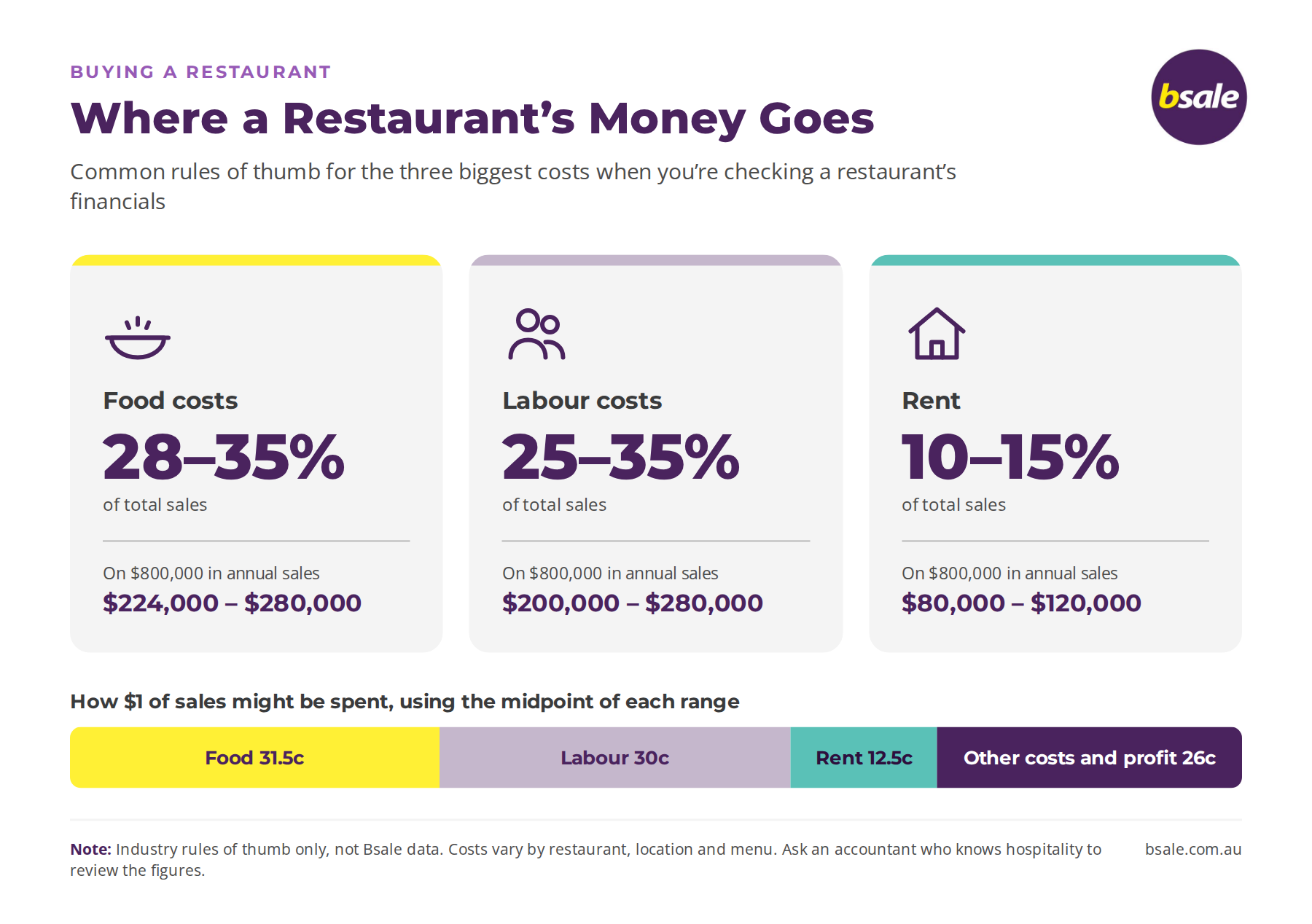
For example, a restaurant with $800,000 in annual sales would ideally be paying around $80,000 to $120,000 a year in rent. These are guides only, and an accountant who knows hospitality can tell you whether a particular restaurant's costs make sense.
Also check how card payments are handled. With card surcharges banned from 1 October 2026, trading figures from earlier periods may not reflect what the restaurant will earn now. Our article on protecting the value of a hospitality business after the surcharge ban explains why.
Susan Butler, principal broker at Beyond 2000 with more than 22 years' experience across North Queensland, says established regional hospitality businesses are among the most sought-after opportunities, but buyers look for the right fundamentals.
"Quality businesses with consistent profits, reasonable rent, and systems that reduce reliance on the owner are particularly appealing," she said.
4. Read the Lease Carefully
The lease should be at the top of your list.
For most restaurants, it is the single most important document after the financials, and a solicitor should review it before you commit.
Check:
- How long is left on the lease, and what options to renew are available
- The current rent, outgoings and how rent reviews are calculated
- What the landlord needs before agreeing to transfer (assign) the lease to you, including any personal guarantee
- Permitted use, trading hours and any restrictions on renovations or the menu
- Demolition, relocation or make-good clauses
A short lease can also make the purchase harder to fund. In Susan's experience, businesses with very high rents, declining profits or short lease terms can face challenges as financing becomes more complicated.
Read more about how a lease agreement can affect a business sale price.
5. Inspect the Equipment and Fit-Out
Buying a fully equipped restaurant can save you a significant amount on setup costs.
But you need to know what condition everything is in and who actually owns it.
Check the kitchen equipment, coolrooms, exhaust and extraction, seating, furniture and point-of-sale system. If major items need replacing soon, factor that into your offer.
Confirm whether equipment is owned by the seller, leased, financed or owned by the landlord. Only the seller's equipment will usually transfer to you, and financed items may have security interests registered on the Personal Property Securities Register (PPSR). Make sure the contract includes a full equipment list.
An experienced broker or a plant and equipment valuer can help you understand what the fit-out is worth. Bowen Li, who owned pizza shops before he became a broker, now uses that experience when he appraises hospitality businesses.
"Once I walk into the restaurant or cafe, I can tell straight away what sort of equipment you have and the value of that equipment," he said.
6. Check Licences, Permits and Compliance
Restaurants need a number of approvals to trade, and some don't transfer automatically. Requirements vary by state and council, but check:
- Food business registration with the local council, and recent health inspection reports
- Food safety supervisor and food handler training requirements
- The liquor licence, if the restaurant serves alcohol, and how it will be transferred through your state's liquor regulator
- Outdoor dining or footpath permits
- Music licences and any conditions on trading hours or noise
A liquor licence transfer can take time. If the restaurant's trade depends on alcohol sales, make the transfer a condition of the contract.
7. Look Closely at Staff and Operations
Managing a restaurant means managing a team of chefs, kitchen hands and front-of-house staff, often casual or part-time.
Check employee records, wages and rosters against the Restaurant Industry Award. Underpaid wages and unpaid superannuation can become a costly problem. Find out what leave entitlements staff have built up and how they will be treated at settlement.
Ask which staff are staying, and how much the business depends on a head chef or the current owner. Many regional restaurants are family-run, which keeps wage costs down. If you won't be working the same hours, you'll need a plan to hire and keep staff.
Labour can also be harder to find in some markets. Rajiv Rajan, State Chair of the AIBB in Western Australia, recalls one hospitality operator in Broome paying a barista $60 an hour simply to keep the cafe running.
"If I'm not selling coffee, I'm not selling food," the owner told him. "So the cost to trade is that I have to pay for the labour."
8. Assess the Reputation and Customer Base
A restaurant with loyal customers has a head start. Read its online reviews, look at its social media and delivery app ratings, and ask locals what they think.
Look for patterns. Are complaints about one dish, slow service or a staff member, which you could fix? Or about the location and value, which are harder to change? Also consider how customer tastes and spending habits are shifting, and whether the menu and price point still suit the area.
9. Identify the Growth Potential
Look for restaurants with untapped potential. Catering, functions, extended trading hours, takeaway and delivery, online ordering or a loyalty program can all add revenue.
That's often what attracts buyers in the first place. Kevin Connolly, a Director at CRE Brokers who has worked in hospitality sales and valuations since the late 1970s, finds buyers tend to prefer a particular type of hospitality business.
"But generally, you could say that most buyers are entrepreneurs who want to improve the business and put their stamp on it," he said.
Be realistic. Pay for the business as it trades today, not for what you hope it could do.
10. Arrange Finance, Make an Offer and Complete Due Diligence
Talk to a lender before you make an offer, so you know what you can borrow and what deposit you'll need.
Lenders look closely at the restaurant's earnings, the lease and your experience. Some sellers may also offer vendor finance. Read our guide on how to secure finance to buy a business.
When you make an offer, it's usually subject to conditions such as finance approval, the landlord agreeing to the lease transfer, the liquor licence transfer and satisfactory due diligence. A handover or training period with the seller can also help.
Your accountant should check the numbers and your solicitor should check the contract and lease. Contract conditions differ between states, which is where industry experience counts. As Bowen puts it, "If you don't understand the industries, you don't know what you should put in."
The period between an accepted offer and settlement is often where problems surface. Kevin describes the broker's role simply.
"The broker's job is to put out bushfires between vendors and purchasers, and there are always bushfires. We're the fire brigade."
For a full checklist, read what is due diligence in a business sale and our step-by-step guide on how to buy a business in Australia.
Legal Checklist Before You Sign
Most of the risk in a restaurant purchase sits in the legal detail, so have a solicitor experienced in business purchases review everything before you sign. For more depth, Sprintlaw's legal checklist for buying a restaurant in Australia is a useful read.
What You're Actually Buying
Most restaurants are sold as a sale of business assets. That usually means the goodwill, equipment and fit-out, stock, trading name, and the right to take over the lease. It can also include the website, social media accounts, phone number, booking system and delivery app accounts.
Some restaurants are sold as a share sale, where you buy the company that owns the business. In that case, the company's past liabilities come with it. Either way, the contract should list exactly what is included and what isn't.
Legal Documents to Have in Place
- A sale of business contract, including any special conditions
- A lease assignment or new lease, the landlord's written consent, and any disclosure statement required under your state's retail leasing laws
- A full equipment list, noting anything leased or financed
- Applications to transfer the liquor licence and food business registration
- Agreed arrangements for staff who are transferring and their leave entitlements
- A restraint of trade on the seller
- Transfer of the trading name, domain, social media, supplier and delivery platform accounts
Common Legal Risks and How to Reduce Them
|
Risk |
How to reduce it |
|---|---|
|
The landlord won't transfer the lease, or the terms change |
Make landlord consent and acceptable lease terms a condition of the contract |
|
The seller opens a competing restaurant nearby |
Include a reasonable restraint of trade on area and time |
|
Equipment is financed or has a security interest over it |
Search the PPSR and require clear title at settlement |
|
Staff have been underpaid or have large leave balances |
Review payroll records and adjust the price or seek warranties |
|
The liquor licence transfer is delayed or refused |
Make the transfer a condition and allow time before settlement |
|
Trading figures don't hold up after you take over |
Make the sale subject to financial due diligence, with warranties and a training period |
So, Are You Ready?
The right restaurant for you depends on why you're buying.
A profitable restaurant you can walk into suits a different buyer from a fixer-upper with room to grow.
Whichever you choose, take the time to check the location, lease, financials, equipment, licences and staff before you commit. Then the restaurant you buy is the one you thought you were buying.
Browse restaurants for sale on Bsale, explore other food and hospitality businesses, or find a business broker who specialises in hospitality.
Frequently Asked Questions
How much does it cost to buy a restaurant in Australia?
It varies widely with profit, location and the lease. In the September 2026 quarter, restaurants for sale on Bsale had an average asking price of $464,508. Restaurants marked as sold during the quarter had an average asking price of $333,854.
Is it better to buy a restaurant or start one?
Buying an established restaurant lets you trade from day one, with a fit-out, staff and customers already in place and a trading history to review. Starting from scratch gives you full control of the concept, but means paying for the fit-out and approvals before you earn any income.
Can a liquor licence be transferred when you buy a restaurant?
Usually, but it isn't automatic. The transfer is approved by the liquor regulator in your state and can take time, so it's common to make the transfer a condition of the contract.
Originally published 2023, Updated 28 September 2026
Disclaimer: Statistics are based on Bsale.com.au marketplace data and do not represent the entire Australian business sales market. Listing information is supplied by advertisers and is not independently verified by Bsale. Data may contain errors, duplicates or outdated information. Listings and asking prices may not be directly comparable, including those advertised as WIWO, plus SAV or including freehold property. Asking prices are not confirmed sale prices, and listings marked as sold do not verify completed transactions. Figures are indicative only. This article is general information, not professional advice. Readers should conduct independent due diligence before making business or investment decisions.
Tags: hospitality guides
About the author

Catherine Mangana
Customer Support
Catherine enjoys generating articles that highlight some of the opportunities that are now available for purchase on Bsale. She hails from a family of ...


