How to Sell a Business in Australia: 10 Step Guide With Insights From Business Brokers

How to Sell a Business in Australia
For most owners, selling a business happens once. It is also far more involved than listing it, accepting an offer and handing over the keys.
Buyers are out there. On Bsale, buyer enquiries in the September 2026 quarter were about 28% higher than a year earlier, and buyers are asking for financials, arranging finance and requesting confidentiality agreements more often than at any point in the past year. That is good news for sellers, but it also means buyers are looking harder before they commit.
Broker Zoran Sarabaca, who has spent 22 years in business broking, put it simply: “You never fail to find a buyer. What you fail is to complete a deal.” In his experience, deals most often fall over because the price is wrong or the seller makes the process harder than it needs to be.
Bsale has been connecting business buyers and sellers since 2000. This guide draws on what we have seen and on our conversations with business brokers to walk through the 10 stages of selling a business in Australia, so you know what to expect before you talk to your advisers.
We've mapped out how to sell a business in 10 stages (yes 10!)
1. Be sure you are ready to sell
2. Build your team
3. Get tax and legal advice early
4. Prepare the business
5. Price it realistically
6. Put together an information memorandum
7. Market the business
8. Handle offers, negotiation and due diligence
9. Finalise the contract of sale
10. Settle and hand over
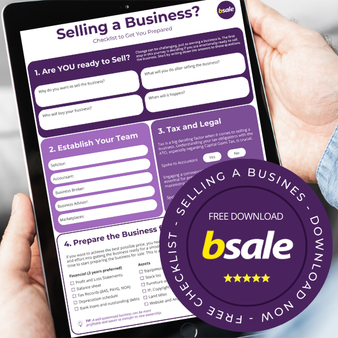
To make it easier we have created a checklist and PDF version of this guide, so you can print it out and get started on your list.
1. Be Sure You Are Ready to Sell

Before you speak to a broker or a buyer, be clear about why you are selling and what comes next. For many owners, the business is closely tied to who they are, and letting go can be harder than expected.
We have heard of plenty of deals fall over late because the owner changed their mind, or because family members suddenly wanted to take over after declining many times. Working through these questions early saves everyone time.
The seller checklist breaks this stage into four questions:
- Why do you want to sell? Retirement, burnout, a new opportunity or a change in family circumstances will all shape your timing and terms.
- What will you do afterwards? Owners with a clear plan for life after the sale tend to stay committed when the process gets slow.
- Who is likely to buy it? A competitor, an employee, a first-time owner or an investor will each look at the business differently.
- Are you ready for the wait? Selling takes months, and most sellers agree to a handover period after settlement as well.
It can also help to talk it through with someone outside the business, such as a mentor, your accountant or a counsellor who works with business owners.
If you are still running every part of the business yourself, now is the time to start stepping back.
Buyers are increasingly cautious about businesses that depend on the owner, a point Queensland broker Dione Mauric explores in Why Some Businesses Sold in 2026 and Others Didn’t. See also Why It’s Important for a Business Owner to Step Back Before Selling.
2. Build Your Team

Most owners know how to run their business but have never sold one. You don’t have to do it alone, and the right advisers can save you money and stress.
- Accountant. Prepares the financial information buyers will review and helps you understand the tax impact of how the sale is structured.
- Solicitor. Prepares or reviews the confidentiality agreement, heads of agreement and contract of sale, and checks leases and key contracts. Choose one with experience in business sales, not just general practice.
- Business broker. Appraises the business, markets it, screens buyers, manages enquiries and keeps the deal moving to settlement. Decide early whether you will sell privately or with a broker, and understand how broker commissions work.
- Business coach or industry adviser. Can help lift performance and tidy up operations in the lead-up to a sale.
Adviser choice matters more than many owners realise. Brisbane broker Dustin Slypen of LINK business sales has found that transactions can become unnecessarily complicated when buyers or sellers use advisers without experience in commercial deals.
It is also worth deciding where your business will be advertised. Whether you sell privately or through a broker, know which business for sale marketplaces your listing will appear on.
More: 5 Professionals Who Can Help Sell Your Business
3. Get Tax and Legal Advice Early

Tax and legal questions can change how much you walk away with, so raise them with your advisers before the business goes on the market, not after an offer arrives.
Tax. How the sale is structured can make a big difference to the tax you pay. Small business owners may be eligible for capital gains tax concessions, particularly those who have owned the business for a long time or are selling to retire. Eligibility depends on your circumstances, and planning often needs to start well before a sale, so speak to your accountant early. Read more in SME Concessions When Selling a Business Remain in Place After the 2026 Federal Budget.
Legal. A solicitor experienced in business sales can review the documents that will matter to a buyer before they become a problem. That includes your premises lease, supplier and customer agreements, and employment arrangements for key staff. A short lease term or a supplier contract that can’t be passed to a new owner is much easier to fix before a buyer finds it.
Once the sale is underway, your solicitor will usually prepare the confidentiality agreement, help you assess offers, and draft the heads of agreement and contract of sale.
More: Why You Need a Lawyer When Selling a Business
4. Prepare the Business

Preparation is where many sales are won or lost. Owners are often surprised by how long it takes, but a well-prepared business is easier to price, easier to finance and easier to hand over.
Get your financial records in order. Buyers, their accountants and their lenders will all look closely at the numbers. Dustin Slypen has seen good businesses held back by this alone.
“We know they’ve got a great business in terms of revenue and profit figures may exist, but if financial records are a mess, accountants can’t complete due diligence, and lenders are reluctant to lend,” he said.
Use the seller checklist to gather your financial statements, tax returns, lease, equipment list and key contracts in one place. These documents will set the asking price and be reviewed again during due diligence.
Build systems so the business runs without you. A business with documented processes is easier to hand over and less risky for a buyer. Record training videos, write checklists and map out who does what. Setting a target of a few new systems each week keeps the work manageable. See Create Systems for Your Business and Sell for More.
Think about your staff. Many owners keep the sale confidential until a deal is close, to avoid losing key people or unsettling customers. Even so, review employment contracts, roles and incentives now, so key staff feel secure under a new owner. See How to Break the News to Staff.
More: 8 Ways to Boost Your Business Value Before Selling
5. Price It Realistically

Brokers we speak with regularly name unrealistic pricing as one of the main reasons businesses sit on the market. Buyers will pay well for a good business, but they look closely at maintainable earnings, add-backs and the risk they would be taking on.
Roy Levy of Core Business Brokers, who has more than 30 years in business broking and a background in accounting, believes it is easy to overquote a business’s value simply to win the listing. He is prepared to tell owners when their expectations are out of reach.
“I say to them, ‘I don’t believe that you’re going to get that in the market for these reasons. If that’s your minimum expectation, I can’t legally or morally sign our agency agreement as I’ve got to insert my opinion of the realistic price range’,” he said.
It is worth getting more than one view on price:
- Accountant. Usually bases a figure on profitability and an earnings multiple. A useful starting point, though it may not reflect current buyer demand.
- Business valuer. Provides a formal valuation for a fee, often from around $3,000-$5,000. Useful where there are several owners or the figure may need to stand up to scrutiny.
- Business broker. Provides an appraisal based on your profit, how ready the business is to sell, and what similar businesses have recently sold for.
- Your own research. Look at comparable businesses for sale in your area and industry, and set up Bsale alerts to see what comes to market.
Comparing these views will give you a realistic range rather than a single hopeful number. When you list, show a clear asking price where you can.
More: What Is the Difference Between a Business Appraisal and a Business Valuation?
6. Put Together an Information Memorandum

The information memorandum (IM) is the main document you share with serious buyers. It explains how the business operates, how it has performed and why it is for sale, and it often answers the first round of buyer questions before they are asked.
A typical IM covers the business history, products and customers, staff and management, premises and lease, equipment, financial performance and growth opportunities. It is usually a PDF prepared by the owner or broker, sometimes with help from the accountant.
Buyers usually receive the IM only after signing a confidentiality agreement and showing genuine interest. That protects sensitive information while still giving qualified buyers what they need to make an offer.
More: What Is an Information Memorandum in a Business Sale?
7. Market the Business

With your preparation done, it is time to bring buyers in. Selling usually takes months, and Bsale’s recent analysis put the benchmark to sell a business at 202 days on market (aka the median time it took from listing a business for sale, until it was marked sold). Keep the business trading strongly throughout, because a dip in performance during the sale can hurt the price.
If you use a broker, you will agree on a marketing plan together. The broker will usually advertise the business, handle enquiries and screen buyers, and may charge a marketing fee to cover advertising. If you sell privately, you will write and manage the listing yourself.
A few things make a real difference:
- Write a listing that gives buyers a reason to enquire. Lead with what makes the business attractive, such as steady earnings, a strong team, recurring customers or room to grow, while keeping identifying details private.
- Don’t rely on one channel. Use business-for-sale marketplaces, your broker’s database and your own network. Your best buyer could be a supplier, competitor or employee.
- Know what buyers are after. On Bsale, buyer enquiries in the September 2026 quarter showed a clear preference for businesses that don’t need a full-time owner, including under-management and partly automated operations.
- Filter enquiries. Not every enquiry is a genuine buyer. Ask about their experience, funding and timeframe before sharing detailed information.
More: Can You Stay Anonymous When Selling a Business?
8. Handle Offers, Negotiation and Due Diligence

Once buyers have reviewed the IM, offers start to arrive. Before you respond, be clear on your minimum price, your ideal terms and what you can be flexible on.
The highest number isn’t always the best offer. Anthony Papas of ABBA Group, who moved into broking after negotiating the sale of four cafes he co-owned in Sydney’s CBD, sees buyers compete on more than price.
“With businesses, it’s different to real estate,” he said. “You might have two or three parties that are all prepared to pay the same amount of money. But what differentiates those buyers? Some include earn-out periods, different payment arrangements or requirements for the owner to remain involved during the handover. Others seek a much faster transition.”
When an offer is accepted in principle, the buyer usually pays a deposit, often around 10% of the price, which is held in trust by a solicitor or broker. The agreed terms are often set out in a heads of agreement.
The buyer then completes due diligence, checking the financial and operational information you have provided. Expect questions about your accounts, add-backs, lease, staff and contracts. This is where earlier preparation pays off. Clear, consistent information keeps the deal moving, and gaps or surprises can quickly erode a buyer’s confidence.
Be upfront. Holding back information or overstating results can cause a deal to collapse and can be costly. Letting your broker or solicitor handle the back-and-forth also takes some of the emotion out of negotiations.
More: Essential Negotiation Skills for Selling a Business and What Is Due Diligence in a Business Sale?
9. Finalise the Contract of Sale

When due diligence is complete and terms are agreed, your solicitor prepares the contract of sale, usually based on the heads of agreement. Once both parties sign, the sale is binding and a settlement date is set.
The contract usually covers:
- Price and deposit. The agreed price and the deposit already paid.
- What is included. Equipment, stock, intellectual property, customer lists and other assets.
- Liabilities. Any debts or obligations the buyer will take on.
- Staff. How employees and their entitlements will be handled.
- Premises. How the lease will pass to the buyer.
- Seller assurances. Statements from the seller about the condition of the business.
- Restraint of trade. How long, and how far away, you can’t open a competing business.
- Handover. How long you will stay on to train the buyer.
- Conditions. Anything that must happen before settlement, such as landlord consent to the lease or the buyer securing finance.
- Settlement date. When the business changes hands.
Read it carefully with your solicitor. Both parties are bound by these terms, and getting them right now prevents disputes later.
10. Settle and Hand Over

10. Settle and Hand Over
Settlement is when the business becomes the buyer’s, but it isn’t always the end of your involvement. Depending on the terms in your contract, you may stay on for a handover period, and part of your money may arrive months or even years later.
Settlement Day
The buyer pays the balance, or the upfront part of the price, and you hand over keys, passwords, supplier and customer contacts, operating procedures and anything else the new owner needs to run the business from day one. Work through your handover list with your broker and solicitor so nothing is missed. It is a big moment. Many owners find it both exciting and unsettling to step away from something they built.
The Handover Period
Most contracts include a handover or training period after settlement. Depending on the size and complexity of the business, it can range from about two weeks to 12 months.Your contract will set out how long it lasts and how much time you are expected to give. Use it to introduce the buyer to staff, suppliers and key customers, and keep a simple record of what you have covered. A smooth handover protects your reputation and the buyer’s confidence in what they bought.
If Part of the Price Is Paid Later
In many sales, the buyer pays the full price at settlement and your remaining role is the handover. Some deals are structured differently, with part of the price paid after settlement through an arrangement such as:
- Earn-out. Part of the price depends on how the business performs after the sale, over an agreed period.
- Vendor finance. You lend the buyer part of the price, and they repay you over time.
- Staged buy-out. The buyer acquires the business in stages, and you usually stay involved until the final stage.
These arrangements can help get a deal done and may lift the total price, but they carry more risk than being paid in full at settlement. The money still to come depends on how the business performs under its new owner and on the buyer keeping up payments. If an earn-out or deferred payment is on the table, get advice from your solicitor and accountant before you agree to it. They can check how performance will be measured, what security you hold, what happens if payments stop and how the timing affects your tax. Once the sale settles, stay in touch with the buyer, track payments against the contract, and speak to your solicitor promptly if anything falls behind.
Frequently Asked Questions
- How long does it take to sell a business in Australia? Usually several months. Bsale’s recent benchmark is around 202 days on market, and the handover period after settlement can add more. Well-prepared, realistically priced businesses tend to move faster. See How Long Does It Take to Sell a Business?
- Should I use a business broker or sell privately? A broker handles pricing, marketing, buyer screening and negotiation, for a commission. Selling privately saves the fee but puts all of that work on you. See Should You Sell Privately or with a Business Broker?
- What do buyers look for? Reliable earnings backed by clear financial records, a business that doesn’t depend entirely on the owner, a secure lease and a realistic price.
- Why do business sales fall through? Common reasons include an unrealistic price, poor financial records, surprises during due diligence, buyers being unable to secure finance, and sellers changing their minds. See 7 Mistakes Business Owners Make When It’s Time to Sell.
Ready to Start?
Download the seller checklist to work through each stage, or list your business on Bsale. If you would prefer professional help, find a business broker in your area.
Disclaimer: Statistics are based on Bsale.com.au marketplace data and do not represent the entire Australian business sales market. Listing information is supplied by advertisers and is not independently verified by Bsale. Data may contain errors, duplicates or outdated information. Listings and asking prices may not be directly comparable, including those advertised as WIWO, plus SAV or including freehold property. Asking prices are not confirmed sale prices, and listings marked as sold do not verify completed transactions. Figures are indicative only. This article is general information, not professional advice. Readers should conduct independent due diligence before making business or investment decisions.
Originally published 2021. Updated October 2026.
Tags: selling tips small business selling a business
About the author

Vanessa Lovie-Yousaf
CEO Bsale Australia
Vanessa Lovie-Yousaf is the CEO and manager of Bsale.com.au, one of Australia’s most trusted business for sale marketplaces since 2000. With 15 ...


