How Long Does it Take to Sell a Business?

How Long Does it Take to Sell a Business?
How long is a piece of string?
We can give you some general timelines for selling a business, but business sales aren't as straightforward as real estate. There are no near-identical comparisons, and every business is unique.
Take this simple comparison of two cafes, both priced at $350,000.
The first sits on a busy main road. It goes through 16kg of coffee a week and turns over around $900,000 a year. But the lease has 18 months left with no options to renew, and the rent of $2,800 a week takes up about 16% of turnover.
The second is around the corner. It uses 11kg of coffee a week and turns over about $650,000. It has a new five-year lease with a five-year option, and the rent of $1,000 a week is about 8% of turnover.
Because the first cafe pays so much more in rent, both make around $140,000 a year in owner’s profit.
Same price. Same profit. But the second cafe is likely to sell first.
A buyer of the first cafe would be paying $350,000 for a business they may only be able to operate for 18 months. Lenders often want the lease term to cover the loan, and the landlord could raise the rent or decline to renew. The second cafe gives a buyer up to 10 years in the location at a rent the business can comfortably carry. That’s often what turns an enquiry into a sale.
Business sales aren't as simple as comparing a 4, 2, 2 house on a 600sqm block. Every business has different financials, operations, risks and buyer appeal.
Do we have stats and records of businesses marked sold? Yes.
Can we tell you exactly how long it will take to sell your particular business? No.
Are their industry standards? Kind of. There are multipliers that brokers use to value a business, and a rough guide on time frames. But there is no "you will sell in X days"
No two businesses are the same. The buyers aren't the same, the operations aren't the same, and the sale process will always be different.
What Is the Typical Time to Sell?
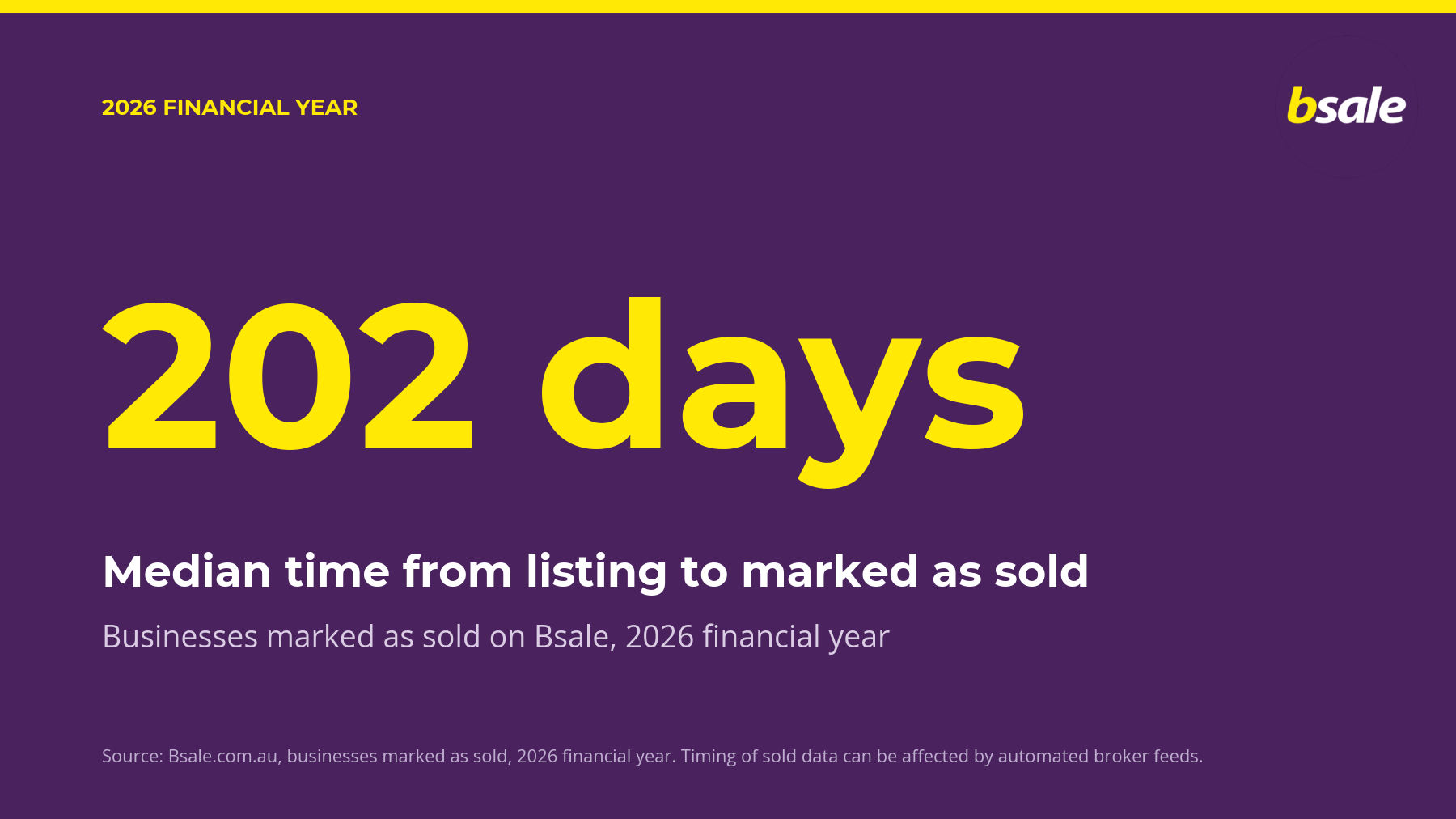
Bsale’s recent 12 month analysis in June 2026 saw that the median time in Australia is 202 days to sell a business, or roughly six and a half months. That analysis is based on the time it takes from a businesses being listed for sale, to it being marked sold on the Bsale website.
Is it all sales? No.
Is it the entire business sales market? No.
Its a rough guide based on businesses that had their status changed from 'for sale' to 'sold'.
But chatting with business brokers, it fits with what they are seing in their brokerages, that of the businesses that do sell, it takes six to nine months.
The size of the business makes a difference. As a general guide:
- Under $500,000: these businesses can sometimes sell within three to six months if they are priced correctly and marketed well.
- $500,000 to $2 million: these usually take six to 12 months, because there is more due diligence and finance approval is often involved.
- Over $2 million: these can take one to two years, because there are fewer buyers and the negotiations and financial assessments are more extensive.
At the top end, Perth broker Nigel Gill of Ascend Corporate, who sells businesses including mining services firms, says larger deals typically take six to 18 months to settle.
“It’s a big process in the transactions that are $20 million and more,” Nigel said.
As always, it depends on the business, the sale process, the advisers you engage, the pool of buyers and, ultimately, how well prepared your business is to sell.
What Bsale Is Seeing in 2026
There is no shortage of buyers right now, but they are taking their time.
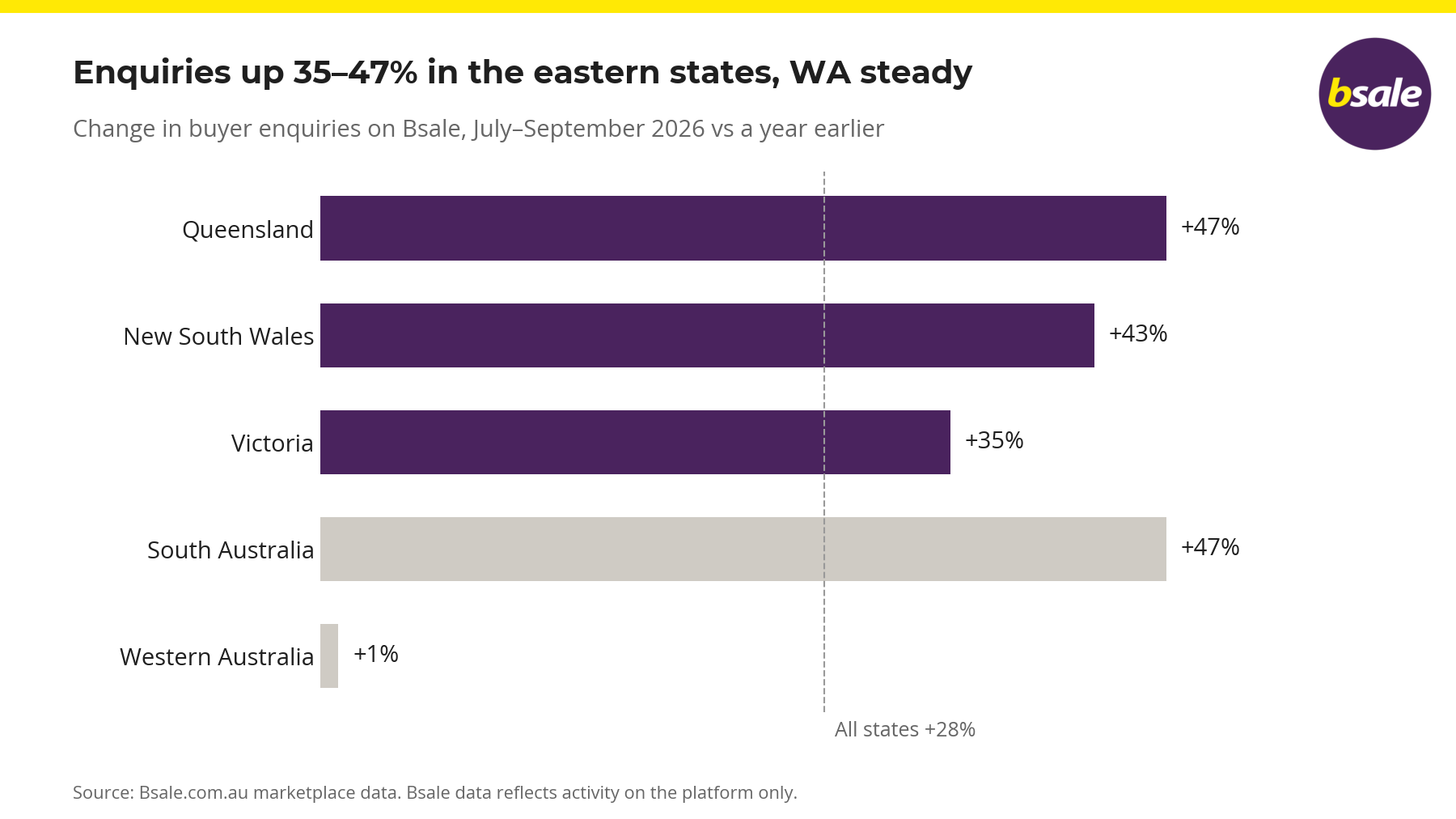
According to Bsale marketplace data, buyer enquiries in the September 2026 quarter were up around 12% on the June quarter and 28% on the same period last year. It was the third consecutive quarter of rising enquiry.
More enquiry has not automatically meant faster sales. A total of 444 businesses were marked as sold on Bsale during the September quarter, broadly in line with the 459 recorded in the June quarter. In the June quarter report, Bsale noted that buyers appeared to be comparing more opportunities and looking more closely at financials before committing.

Buyers are also asking for more information earlier. Among buyers who included a message with their enquiry on Bsale in the September quarter:
- 23% asked for financials, a profit and loss statement or an information memorandum, up from 17% a year earlier.
- 18% asked about finance or vendor finance, up from 13%.
- 10% mentioned a confidentiality agreement, up from 6%.
For sellers, the message is that a buyer's first question is now more likely to be about the numbers. If those numbers aren't ready, the clock keeps ticking.
Enquiries are growing year on year with QLD, NSW and SA seeing the largest growth in enquiries.
7 Factors That Affect How Long It Takes to Sell
1. The Type of Business
Some businesses are in high demand and sell quickly, while others take longer to find the right buyer. Cafes, restaurants and small retail stores often attract plenty of interested buyers, but they also have more competition from similar listings. Manufacturing businesses, professional services and niche B2B companies may take longer because of their specialised nature and the smaller number of qualified buyers.
Buyer interest also shifts over time. On Bsale in the September 2026 quarter, enquiries for online and technology businesses roughly doubled year on year, and professional services enquiries rose almost 60%. Hospitality remained the largest enquiry category but grew only about 6%.
2. How Well the Business Is Prepared for Sale
Businesses that are sale-ready attract buyers faster. That means clean financials, strong customer contracts, efficient systems and clear documentation. If a buyer has to dig through messy accounts or unclear lease terms, they will take longer to decide and may walk away altogether, so try to avoid these common seller mistakes.
Dione Mauric of Advantage Business Sales & Valuations in Queensland runs the brokerage with her husband, Stephen Wolff. Both are chartered accountants, and she says his attention to detail is deliberate.
"Stephen's the detailed guy. He makes sure everything is perfect because surprises kill deals."
Writing for Bsale about the businesses that sold in 2026, Dione said buyers increasingly expect financial statements, lease information, employee details and contracts earlier in the process.
"Where this information is available and well prepared, transactions tend to maintain momentum. Where it is incomplete or inconsistent, confidence can quickly fall away."
3. Pricing
Setting the right price is crucial. Overpriced businesses sit on the market longer, while those priced fairly on earnings and industry benchmarks tend to sell faster. A business appraisal or valuation can help you set a realistic price.
Perth broker Harry Kalligeros saw the difference firsthand. A business had been listed with a previous agency for 18 months without selling. Harry sold it in four weeks, and for more than its original appraisal.
"Honesty sells," Harry said. "We go to market for a fair price and aim for a win-win."
Pricing doesn't only affect how long it takes to find a buyer. It also affects whether the deal gets over the line. Zoran Sarabaca, who has worked in business broking for 22 years, believes technology has made finding buyers the easier part.
"You never fail to find a buyer," he said. "What you fail is to complete a deal."
In his experience, deals most commonly fail because the price is wrong or because the seller makes the transaction unnecessarily difficult.
4. How Much the Business Relies on You
Buyers are increasingly cautious about businesses where the owner controls every customer relationship and key decision. A business that can run without you is easier to sell.
On Bsale in the September 2026 quarter, businesses advertised as under management drew around 30% more enquiries than the average listing. A year earlier, they drew about 20% fewer. If your business can't operate without you, consider stepping back before you sell and training staff to take on key roles.
5. Buyer Finance and Due Diligence
Even if you find a buyer quickly, finance approvals and due diligence can slow the process down. Buyers often need bank loans or vendor finance, which can take weeks or months to arrange. During due diligence, the buyer reviews financial records, contracts and legal obligations, which takes time.
The more questions you can answer before a buyer asks them, the less time this stage tends to take.
6. Market Conditions
Economic factors, interest rates and industry trends all affect how quickly businesses sell. In uncertain times, buyers can become more cautious, and timelines stretch.
Zoran described a building services business that went to market three times. The first attempt was interrupted by COVID, and the second was halted by an Australian Taxation Office audit. The business hadn't changed substantially by the third attempt, but he says the quality of buyers was significantly better, there were more offers, and the final price exceeded what could have been achieved earlier.
7. The Business Broker You Choose
A good business broker can speed up the process by targeting serious buyers and handling negotiations efficiently. It's important to choose a broker with experience in your industry and a strong track record.
In one example from Advantage Business Sales & Valuations, a couple had spent 12 months trying to negotiate the sale of their business directly with a corporate buyer. After they engaged the brokerage, the sale was completed within three months with the same buyer, for an additional $100,000 and on better contract terms.
What Happens If Your Business Doesn't Sell?
This is always a risk, whether you sell privately or with a business broker.
To reduce the chance of it happening, be ready for the process and don't fall into the trap of seller fatigue. Yes, it can get exhausting.
If your business has been on the market for over a year with little interest, it's time to reassess. Ask yourself:
- Is the price too high? Review your valuation and consider adjusting it.
- Is the marketing working? Check where your business is listed and how it's being promoted.
- Are buyers struggling with finance? Offering vendor finance, where you accept part of the payment over time, can attract more buyers.
- Is the business too dependent on you? If it can't operate without you, buyers may hesitate.
Tips to Speed Up the Sale
Start with these 10 questions buyers will ask, then work backwards and prepare your answers.
Preparation is everything. If buyers have to wait for information, the whole sale slows down.
Our guide to selling a business in Australia covers the full process.
So, How Long Will It Take for You?
Selling a business isn't an overnight process. On average, expect it to take six to nine months. It can be quicker if your business is well prepared and priced right.
Buyers are out there in 2026, and more of them are enquiring than a year ago. But they are asking for the numbers sooner and taking more care before they commit.
If you're serious about selling, start preparing early. The better prepared your business is, the faster you're likely to find the right buyer, and the better price you're likely to get.
Originally published 2019, update October 19, 2026
Disclaimer: Statistics are based on Bsale.com.au marketplace data and do not represent the entire Australian business sales market. Listing information is supplied by advertisers and is not independently verified by Bsale. Data may contain errors, duplicates or outdated information. Listings and asking prices may not be directly comparable, including those advertised as WIWO, plus SAV or including freehold property. Asking prices are not confirmed sale prices, and listings marked as sold do not verify completed transactions. Figures are indicative only. This article is general information, not professional advice. Readers should conduct independent due diligence before making business or investment decisions.
Tags: selling a business exit strategy
About the author

Vanessa Lovie-Yousaf
CEO Bsale Australia
Vanessa Lovie-Yousaf is the CEO and manager of Bsale.com.au, one of Australia’s most trusted business for sale marketplaces since 2000. With 15 ...


