How to Buy a Business in Canberra and the ACT

How to Buy a Business in Canberra and the ACT. Image: Canberra
Canberra is a smaller business for sale market than Australia's major capital cities, with opportunities across hospitality, retail, professional services, trades and established businesses.
The ACT economy is influenced by government, defence, education and the professional services supporting these industries. For buyers, this creates opportunities but also specific considerations, particularly where businesses depend on government contracts or commercial clients.
Buying an existing business can provide an established customer base, employees and trading history. However, buyers need to understand the financial performance, lease arrangements, licences and legal obligations involved.
This guide covers how to buy a business in Canberra and the ACT, including local market conditions, due diligence, stamp duty, Crown leases and ACT government requirements.
For an overview of the buying process, read Your Essential Guide to Buying a Business in Australia, or view businesses for sale in Canberra.
Canberra and the ACT Business for Sale Market
According to Bsale marketplace data for the September 2026 quarter, businesses for sale in the ACT carried an average asking price of $696,656.
That put the ACT in the middle of the states and territories, above Victoria ($680,506), New South Wales ($673,143) and Tasmania ($532,624), and below Western Australia, the Northern Territory, Queensland and South Australia.
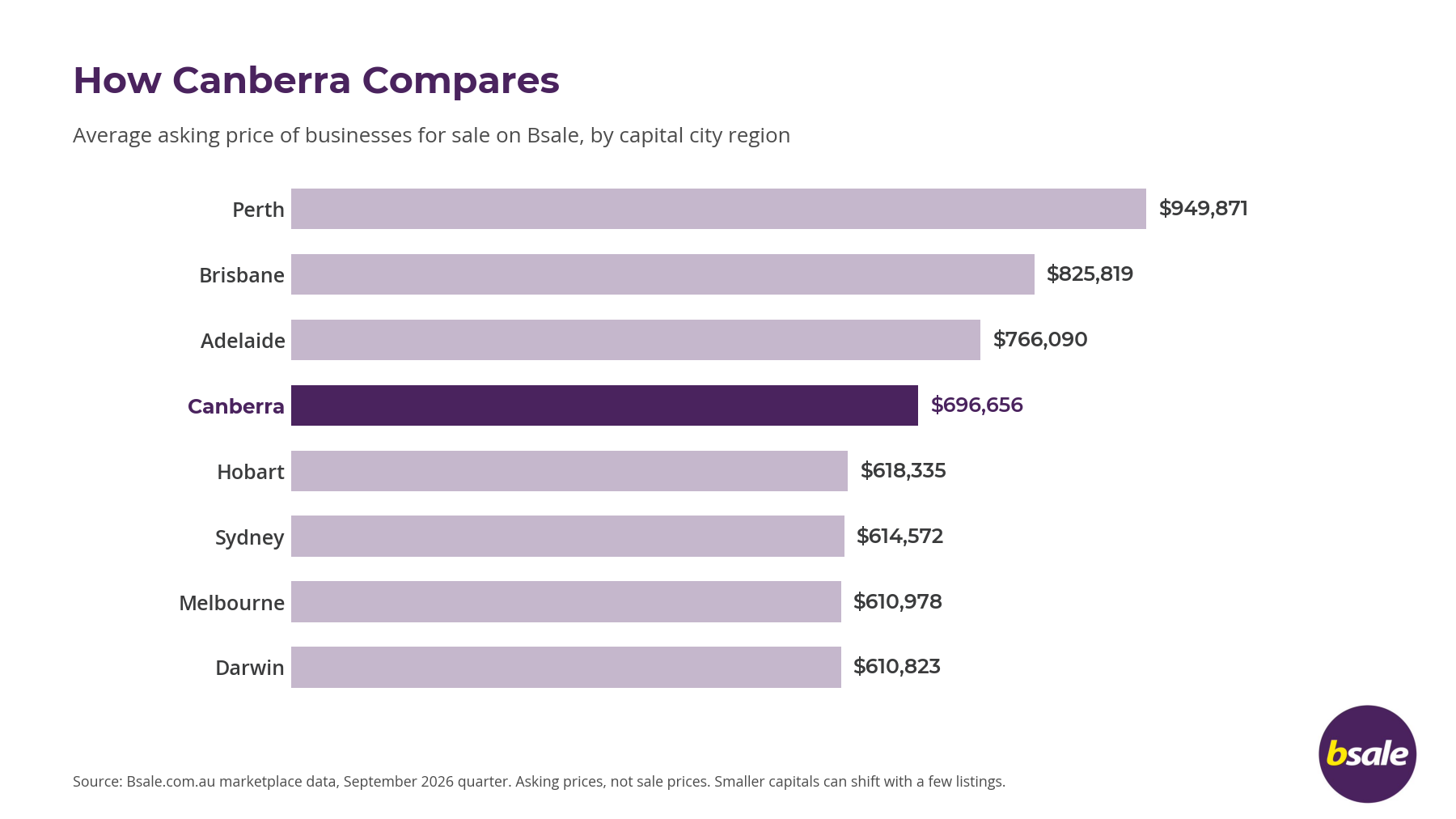
Because nearly all ACT listings are in Canberra, the city's average was the same, placing it fourth among the capital cities behind Perth, Brisbane and Adelaide.
Bsale figures represent advertised asking prices and may include WIWO, +SAV, freehold property. Not verfied.
A Smaller Business Sales Market
Almost all ACT businesses advertised on Bsale are located in Canberra, making the city's figures representative of the broader territory. Compared with Sydney or Melbourne, the ACT has fewer listings, meaning a handful of higher-value businesses can significantly influence average asking prices.
Buyer enquiries for ACT businesses increased 28% year-on-year in the September 2026 quarter, while the number of individual buyers making enquiries rose approximately 27%.
For buyers, the smaller market means fewer opportunities to compare at any one time. Registering with brokers and setting up alerts can help identify suitable businesses as they become available.
Bsale figures represent advertised asking prices and may include WIWO, +SAV, freehold property, not independently verified business values or completed sale prices.
How to Buy a Business in Canberra
The buying process in the ACT follows the same general steps as the rest of Australia, although territory laws can affect leases, property transfers and business licences.
- Set your budget and criteria. Decide how much you can invest, what industry suits your experience and whether you want an owner-operated or under-management business.
- Arrange finance early. Speak with a bank or business finance broker about borrowing capacity and working capital requirements.
- Find suitable businesses. Search businesses for sale in Canberra, register with local brokers and set up Bsale buyer alerts.
- Review business information. Request financial statements and an information memorandum. A confidentiality agreement may be required.
- Inspect the business. Review the premises, equipment, staffing and daily operations. Consider how its location and customer base affect trading.
- Make an offer. Your solicitor can help structure an offer with appropriate conditions relating to finance, due diligence, leases and licences.
- Complete due diligence. Have your accountant and solicitor verify the financial, operational and legal position of the business.
- Finalise the contract and settlement. Confirm the purchase price, included assets, employee arrangements, stock adjustments and handover requirements.
The ACT Government Business Hub provides information about business registrations, licensing, premises and operating requirements.

ACT Laws and Requirements When Buying a Business
Several ACT regulations can affect the cost, timing and conditions of a purchase. Buyers should check the requirements relevant to their industry and transaction.
Business Broker Licensing
Business brokers operating in the ACT are regulated under the Agents Act 2003. Access Canberra licenses business agents and maintains public registers where buyers can check an agent's licensing details.
Access Canberra – Business Agent Licensing and Public Registers
The broker is generally engaged by the seller, so buyers should obtain independent advice from their accountant and solicitor.
Crown Leases and Property Ownership
One important difference when buying a business in Canberra is the ACT's land ownership system. Land in the ACT is generally held under Crown leases rather than traditional freehold title. These leases establish how the land can be used and the obligations of the leaseholder.
If a business purchase includes commercial premises, buyers should check the Crown lease for permitted uses, restrictions and any development conditions. For example, a property approved for office use may not automatically be suitable for a restaurant, retail shop or licensed venue.
The ACT Government's Crown Lease Guide explains how land tenure works and why permitted use matters.
A solicitor should review the Crown lease before the buyer commits to purchasing the property or changing its business activities.
Stamp Duty on Business Purchases
Whether stamp duty applies in the ACT depends on what is being transferred, particularly if the transaction includes commercial property, a Crown lease or vehicles. From 1 July 2026, the ACT's commercial conveyance duty-free threshold increased to $2.1 million.
Qualifying commercial property transactions valued up to $2.1 million are exempt from conveyance duty. Transactions above that threshold are generally subject to a flat rate of $5 per $100 of the total dutiable value.
The ACT Revenue Office publishes the current commercial property duty rates and eligibility requirements.
Business-only transactions may be treated differently from property transfers. Buyers should ask their solicitor to confirm whether duty applies to the specific assets, leases or property being acquired.
Retail and Commercial Leases
For businesses operating from rented premises, the lease can significantly affect the value and viability of the purchase.
Many commercial and retail leases in the ACT are governed by the Leases (Commercial and Retail) Act 2001, which covers matters including disclosure, lease assignment and dispute resolution. When buying a business, the existing lease may need to be assigned to the purchaser with the landlord's consent.
Before committing, review the remaining lease term, renewal options, rent increases, outgoings, permitted use and make-good obligations.
Buyers can review the Leases (Commercial and Retail) Act 2001 through the ACT Legislation Register.
For more information, read 6 Ways a Lease Agreement Can Impact Your Business Sale Price.
Business Licences and Registrations
Licences and registrations do not necessarily transfer automatically when a business changes ownership.
Requirements depend on the industry, business activities and location.
- Food businesses – Most cafes, restaurants, takeaways and other food businesses must be registered with the ACT Health Protection Service. Changes in ownership must be notified. See Access Canberra – Food Business Registration.
- Liquor licences – Pubs, bars, restaurants and bottle shops require appropriate approvals. Liquor licences can be transferred through an application process with Access Canberra.
- Franchises – Buyers usually need approval from the franchisor and should review the franchise agreement and disclosure documents.
- Other regulated industries – Childcare, health, transport, security, automotive and trade businesses may require additional licences or accreditations.
The Access Canberra Business and Work Portal provides information about local licences, registrations and business compliance requirements.
Employee Entitlements and Workers Compensation
Buying a business with existing employees can involve ongoing employment obligations.
Under ACT long service leave laws, employees who continue working after a change of ownership may retain their previous service. The new employer can inherit the associated long service leave liability.
WorkSafe ACT – Long Service Leave Guidance
ACT employers must generally maintain workers compensation insurance for their employees through an approved insurer.
WorkSafe ACT – Workers Compensation Requirements
Payroll tax may also apply depending on wages and grouping arrangements.
For the 2026–27 financial year, the ACT annual payroll tax threshold is $1.75 million, with a general rate of 6.75% for employers with Australia-wide wages above the threshold and up to $20 million. Higher rates can apply to larger employers.
ACT Revenue Office – Payroll Tax Thresholds and Rates
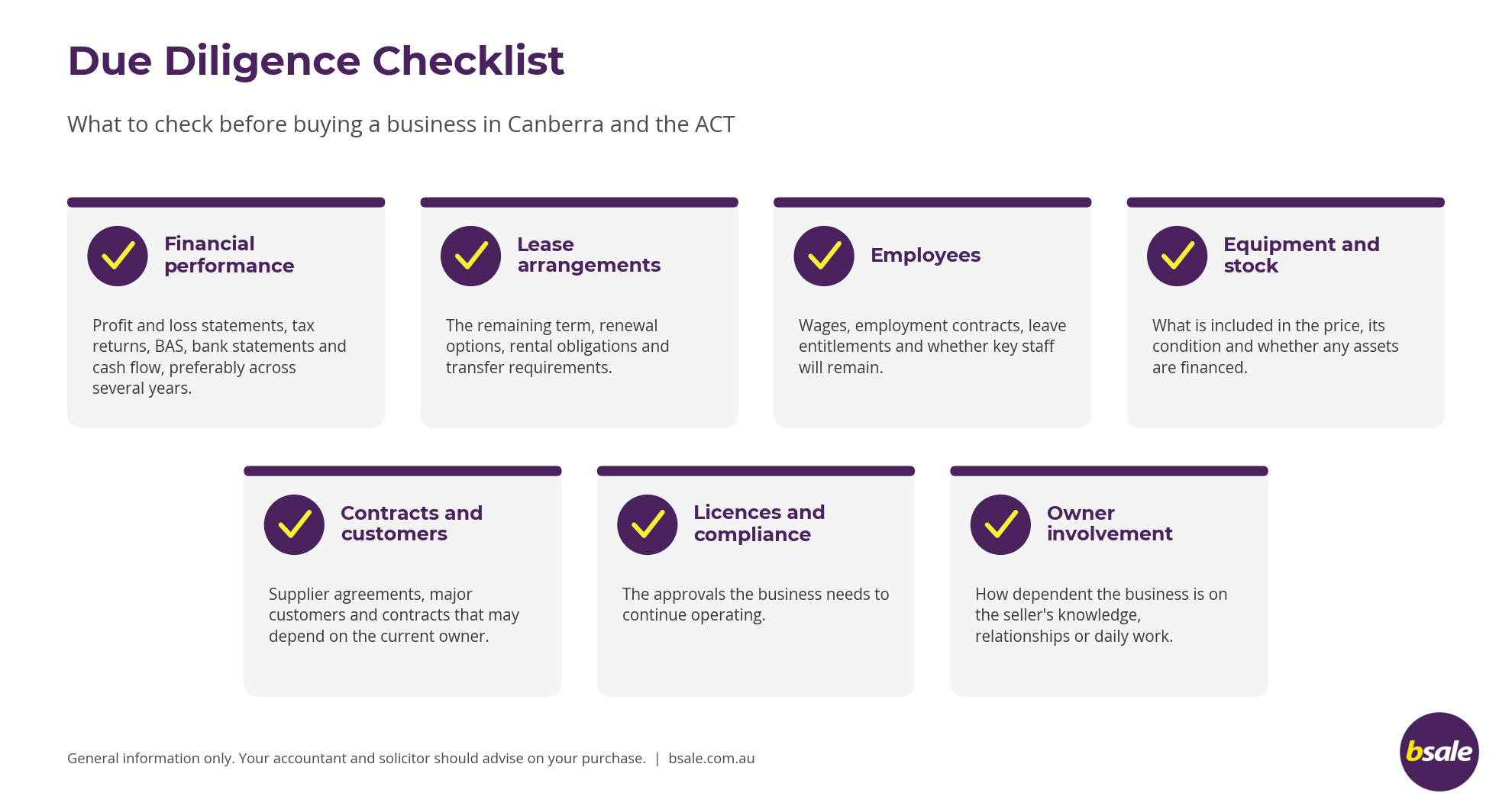
What Should Buyers Check During Due Diligence?
Due diligence involves independently checking whether the business is performing as represented and identifying potential risks before settlement.
Important areas include
- Financial performance – Review profit and loss statements, tax returns, BAS, bank statements and cash flow, preferably across several years.
- Lease arrangements – Confirm the remaining term, rental obligations, renewal options and transfer requirements.
- Employees – Check wages, employment contracts, leave entitlements and whether key staff will remain.
- Equipment and stock – Verify what is included in the purchase price, its condition and whether any assets are financed.
- Contracts and customers – Review supplier agreements, major customers and contracts that may depend on the current owner.
- Licences and compliance – Confirm the business has the approvals required to continue operating.
- Owner involvement – Understand how dependent the business is on the seller's knowledge, relationships or daily work.
For Canberra businesses, buyers should also review any reliance on government contracts, security clearances and commercial customers.
For assistance, read The 5 Experts Every Business Buyer Needs on Their Team.
Things to Consider When Buying a Business in Canberra
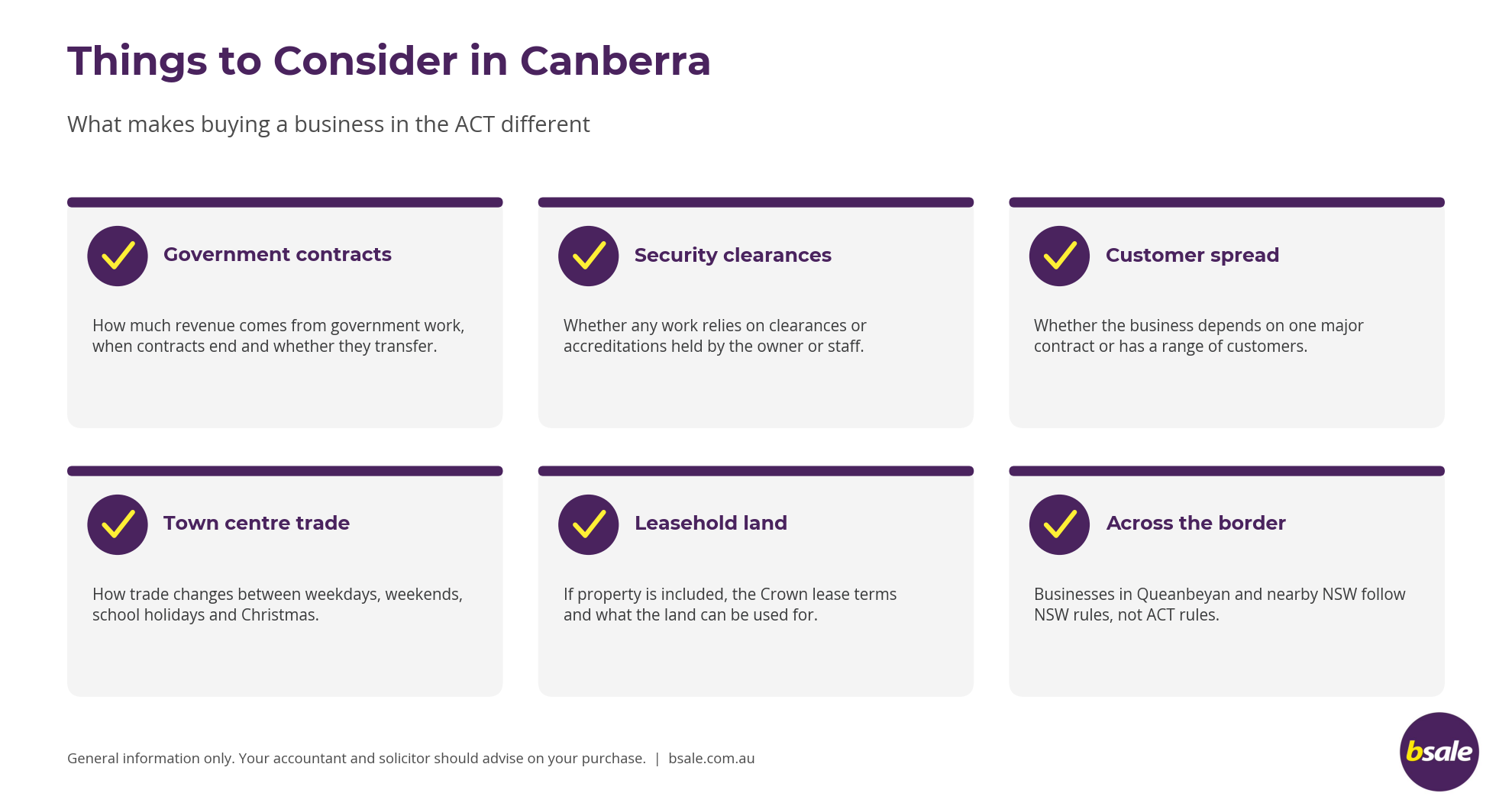
Canberra's economy, commercial districts and proximity to New South Wales create considerations that may not apply to businesses in other capital cities.
Government Contracts and Commercial Customers
Many Canberra businesses provide services to government departments, defence-related organisations or contractors supporting these sectors.
If a business relies on government contracts, buyers should check how much revenue comes from those agreements, when they expire and whether the contracts can be transferred to a new owner.
Some contracts may need to be retendered or require security clearances, accreditations or specialist staff. A business with a broad customer base may be less exposed to the loss of a single government or commercial contract.
Location and Local Trading Conditions
Canberra's town centres and commercial precincts can have different customer markets and operating conditions.
Businesses in Civic may depend heavily on office workers, while those in Belconnen, Woden, Tuggeranong or Gungahlin may draw more customers from surrounding residential areas. Industrial and trade precincts such as Fyshwick, Hume and Mitchell accommodate automotive, wholesale, manufacturing and service businesses.
Before buying, consider customer demand, accessibility, lease costs and whether trading changes during school holidays, public holidays or the Christmas period.
Buying Across the NSW Border
Canberra's business market also extends into nearby New South Wales, particularly Queanbeyan and surrounding areas. However, businesses operating in NSW are subject to NSW laws, including different requirements for leases, licensing, workers compensation and stamp duty.
Buyers considering businesses on both sides of the border should check which jurisdiction applies to each part of the transaction.
Businesses Operating Under Management
Nationally, businesses advertised as under management attracted approximately 30% more buyer enquiries than the average listing on Bsale in the September 2026 quarter. For buyers considering this operating model, it's important to verify whether the existing manager, employees and systems can continue without the current owner. An under-management business may still require regular oversight, particularly where major customers or contracts depend on the seller.
Frequently Asked Questions About Buying a Business in Canberra
How Much Does It Cost to Buy a Business in Canberra?
Businesses advertised for sale in Canberra carried an average asking price of $696,656 on Bsale during the September 2026 quarter. Prices vary depending on the industry, earnings, assets and whether property is included.
Do You Pay Stamp Duty When Buying a Business in the ACT?
It depends on what is being transferred. Qualifying commercial property transactions valued up to $2.1 million are exempt from conveyance duty from 1 July 2026. Different rules may apply to business-only transactions, property leases and vehicles.
Can You Buy Freehold Property With a Business in Canberra?
ACT land is generally held under Crown leases rather than traditional freehold ownership. Buyers purchasing commercial premises should check the Crown lease, permitted use and any restrictions before signing.
Do You Need a Business Broker to Buy a Business in Canberra?
No. Buyers can purchase directly from business owners or through licensed business brokers. Access Canberra maintains a register of licensed business agents operating in the territory.
How Long Does It Take to Buy a Business?
The timeframe depends on finance, due diligence, lease assignment, licensing and contract negotiations. Nationally, the median time between a business being listed and marked as sold on Bsale was 202 days, although this measures listing activity rather than the buyer's transaction timeframe.
Find Businesses for Sale in Canberra and the ACT
Bsale has connected business buyers and sellers across Australia since 2000, with listings advertised by business brokers and private sellers.
View businesses for sale in Canberra or across the Australian Capital Territory.
Buyers can also find an adviser through Bsale's business broker directory.
Disclaimer – Bsale marketplace statistics reflect activity on Bsale.com.au and do not represent all Australian business sales. Listing details, asking prices and sold statuses are supplied by advertisers and are not independently verified. Asking prices may be advertised as walk-in walk-out (WIWO), plus stock at valuation (SAV), or include property or associated Crown lease interests. Asking prices are not confirmed sale prices. Figures are indicative only. This article provides general information and is not legal, financial or investment advice. Buyers should obtain independent professional advice and complete due diligence before purchasing a business
About the author

Vanessa Lovie-Yousaf
CEO Bsale Australia
Vanessa Lovie-Yousaf is the CEO and manager of Bsale.com.au, one of Australia’s most trusted business for sale marketplaces since 2000. With 15 ...


