How to Buy a Business in New South Wales

How to Buy a Business in New South Wales. Image: Sydney Harbour
New South Wales has more businesses listed for sale on Bsale than any other state in Australia. From Sydney cafes and service businesses to established operations in Newcastle, the Central Coast and regional NSW, buyers have a wide range of opportunities to consider.
Buying an existing business can provide an established customer base, employees and trading history. But before making an offer, buyers need to understand the financial performance, lease arrangements, licences and legal obligations involved.
This guide covers how to buy a business in NSW, including local market conditions, due diligence, stamp duty, business licences and advice from NSW business brokers.
For an overview of the buying process, read Your Essential Guide to Buying a Business in Australia, or view businesses for sale in NSW.
NSW's Business for Sale Market
According to Bsale marketplace data for the September 2026 quarter businesses for sale in New South Wales carried an average asking price of $673,143. That makes NSW one of the most accessible of the larger states, below Western Australia ($903,336), Queensland ($833,117) and South Australia ($773,344).
NSW attracted about 30% of buyer enquiries on Bsale in the September quarter, the largest share of any state. Enquiries rose about 43% on a year earlier.

Graph: NSW Business Enquiry rate vs other states. Sept 2026.
Interest was strongest around Sydney, with strong buyer interest in Penrith and Newcastle. For more, read NSW Leads Australia for Buyer Enquiries as Brokers Say Prepared Sellers Are Winning.
Because NSW has so many businesses listed, demand is spread across a lot of choice. Western Australia, by comparison, drew more than three times as many enquiries per business for sale.
How Much Does a Business Cost in NSW?
Sydney averaged $614,572. Together with Melbourne, it accounts for more than four in ten businesses for sale on Bsale, including many smaller cafes, restaurants and service businesses. For buyers, that means plenty of options at the more affordable end of the market, and plenty of similar businesses to compare
Asking prices vary considerably between Sydney and regional NSW.
| Region | Average Asking Price |
|---|---|
| Wagga Wagga & Riverina | $1.48 million |
| Mid North Coast | $908,610 |
| Newcastle & Hunter Valley | $789,871 |
| Sydney | $614,572 |
The Blue Mountains and Central Coast were among the more affordable markets by average asking price.
Higher regional averages can reflect larger businesses or listings that include equipment, vehicles, stock or freehold property. Smaller markets can also be influenced by a handful of high-value listings.
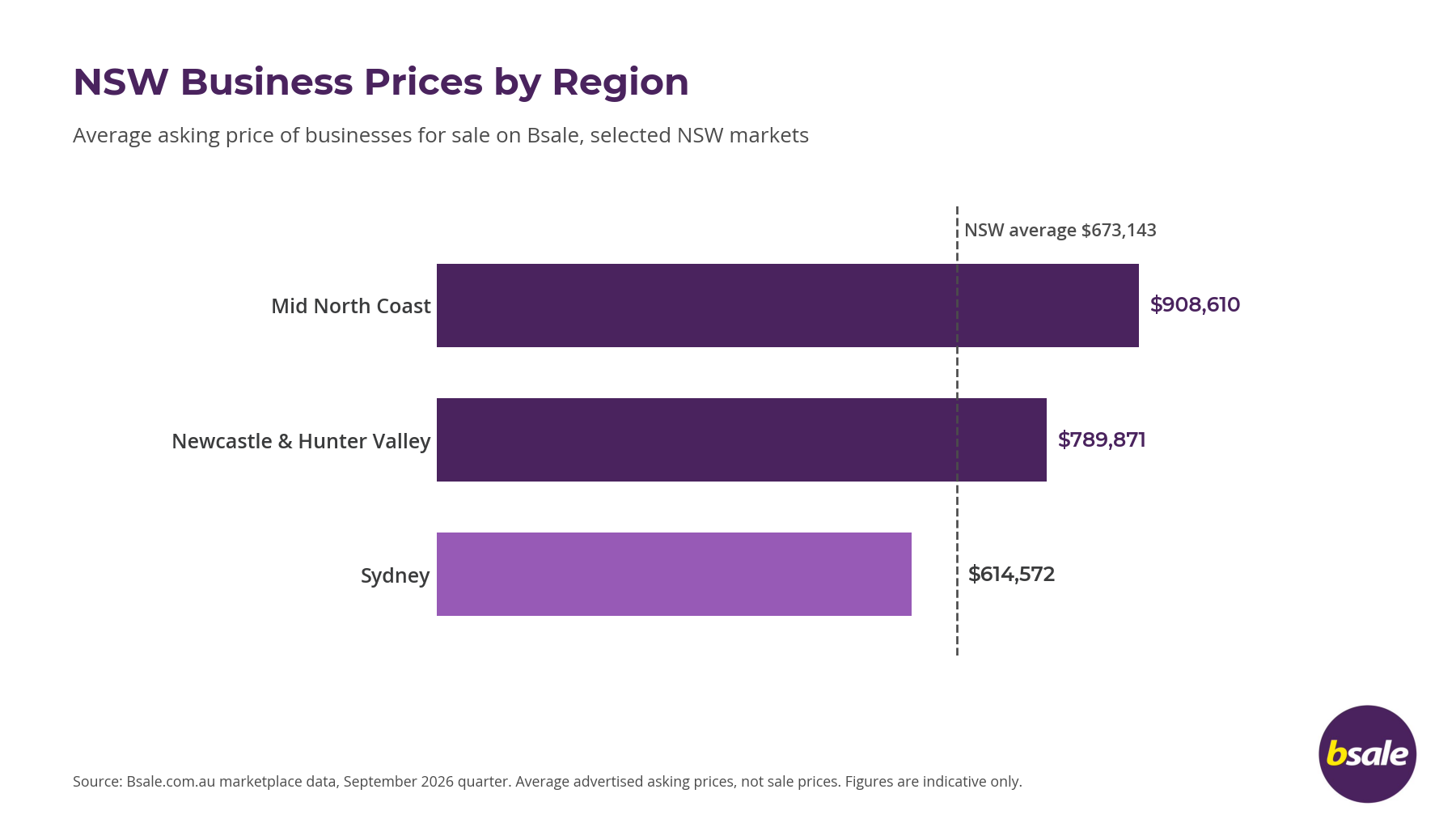
Graph: NSW Regional Asking Prices. Sept 2026.
Asking prices may be advertised as walk-in walk-out (WIWO), plus stock at valuation (SAV), or include freehold property. Prices are supplied by advertisers and are not independently verified by Bsale.
How to Buy a Business in NSW
The buying process in NSW follows the same general steps as the rest of Australia, although state laws can affect leases, stamp duty and licensing.

Infograph: 10 steps to buying a business in NSW
-
Set your budget and criteria. Decide how much you can invest, what industry suits your experience and whether you want an owner-operated or under-management business.
-
Arrange finance early. Speak with a bank or business finance broker to understand your borrowing capacity and working capital requirements.
-
Find suitable businesses. Search businesses for sale in NSW, register with local brokers and set up Bsale buyer alerts.
-
Review business information. Request financial statements and the information memorandum. A confidentiality agreement may be required.
-
Inspect the business. Review the premises, equipment, staffing and daily operations.
-
Make an offer. Your solicitor can help structure an offer with appropriate conditions relating to finance, due diligence, leases and licences.
-
Complete due diligence. Have your accountant and solicitor verify the business's financial, operational and legal position.
-
Finalise the contract and settlement. Confirm the purchase price, included assets, employee arrangements, stock valuation and any handover period.
The Australian Government provides additional guidance on buying an existing business, including how to assess financial records, contracts and liabilities.
NSW Laws and Requirements When Buying a Business
Several NSW regulations can affect the cost, timing and conditions of a business purchase. Buyers should check the requirements relevant to their industry and transaction.
Stamp Duty on Business Purchases
NSW abolished transfer duty on many business assets from 1 July 2016, including goodwill, intellectual property and statutory licences.
However, stamp duty can still apply when a business purchase includes land, an interest in land such as a commercial lease, or certain plant and equipment.
For example, a business purchased with an assigned lease may have different duty implications from a business purchased without premises. Duty can also apply to freehold property and relevant fixtures.
Revenue NSW explains which assets are dutiable and how different transactions are assessed.
Revenue NSW – Transfer Duty on Business Purchases
Have your solicitor confirm any duty before signing, particularly where the sale includes a lease, valuable equipment or property.
Business Broker Licensing
Business brokers in NSW generally operate under the state's property agency licensing framework.
Before dealing with a broker, buyers can check their licence details through the NSW Government's public register.
Service NSW – Check a Property Agent Licence
The broker is usually engaged by the seller. While they can assist with the transaction, buyers should obtain independent advice from their own accountant and solicitor.
Retail and Commercial Leases
For businesses operating from rented premises, the lease can significantly affect the value and viability of the purchase.
Many retail leases in NSW are governed by the Retail Leases Act 1994. When a business is sold, the existing lease may need to be assigned to the buyer with the landlord's consent.
Before committing, review the remaining lease term, renewal options, rent increases, outgoings, permitted use and make-good obligations.
Retail lease assignments also involve disclosure requirements. Buyers should obtain the relevant lease documents and understand whether the landlord will approve the transfer.
NSW Small Business Commissioner – Transferring Your Lease
For more information, read 6 Ways a Lease Agreement Can Impact Your Business Sale Price.
Business Licences and Registrations
Licences and registrations do not necessarily transfer automatically when a business changes ownership.
Requirements depend on the industry, business activities and location.
-
Food businesses – Cafes, restaurants and other retail food businesses generally need to notify their local council. Certain higher-risk food businesses require a NSW Food Authority licence. Check the NSW Food Authority requirements.
-
Liquor and gaming – Pubs, bars, bottle shops and gaming venues may require licence transfers or additional approvals through Liquor & Gaming NSW.
-
Franchises – Buyers usually need approval from the franchisor and should review the franchise agreement and disclosure documents.
-
Other regulated industries – Childcare, health, transport, security and trade businesses may require industry-specific licences.
Buyers can check licence details through Service NSW.
Employee Entitlements and Workers Compensation
Buying a business with existing employees can involve ongoing employment obligations.
Under NSW long service leave laws, employees who transfer to a new owner may retain their previous service. The new employer can become responsible for long service leave entitlements accrued under the previous owner.
The NSW Government's long service leave guide explains how these obligations apply when a business changes hands.
Most NSW employers with workers also need workers compensation insurance, subject to exemptions. Buyers should check the requirements through icare NSW.
Payroll tax may also apply. For the 2026–27 financial year, the NSW annual payroll tax threshold is $1.2 million, with a rate of 5.45% on taxable wages above the applicable threshold. Grouping arrangements can affect eligibility.
Revenue NSW – Payroll Tax Thresholds and Rates
What Should Buyers Check During Due Diligence?
Due diligence is where you confirm the business is what the seller says it is. In NSW, it usually covers:
- Financials: profit and loss statements, tax returns and BAS for at least two to three years, matched against bank statements.
- Lease: the full lease, any variations, the landlord's position on assignment and the remaining term including options.
- Licences and registrations: food notification or licences, liquor or gaming licences, franchise approval and any industry-specific requirements, plus what is needed to transfer them.
- Staff: who is staying, their pay and conditions, and accrued leave including long service leave.
- Contracts and suppliers: key customer contracts, supplier agreements and anything that depends on the current owner.
- Equipment and stock: an inventory of plant and equipment, its condition and whether any of it is leased or financed.
- Freehold and property: for freehold going concerns, building condition, zoning and any duty that applies to the land.
It helps to understand where the value in the business actually sits. Martin LoSurdo , a broker working across Sydney, the Southern Highlands, the South Coast and Wollongong, looks past the profit figure when assessing a business.
“Is it in the equipment? The goodwill? Intellectual property? Contracts? The underlying cash flow?” he said.
He also cautions against relying on a simple multiple. “A business with $200,000 in profit does not automatically have a $600,000 value, based on a 3 times multiple. Different businesses have different risk profiles, and therefore different required returns,” he explained.
For help putting your advisers together, read the 5 experts every business buyer needs on their team.
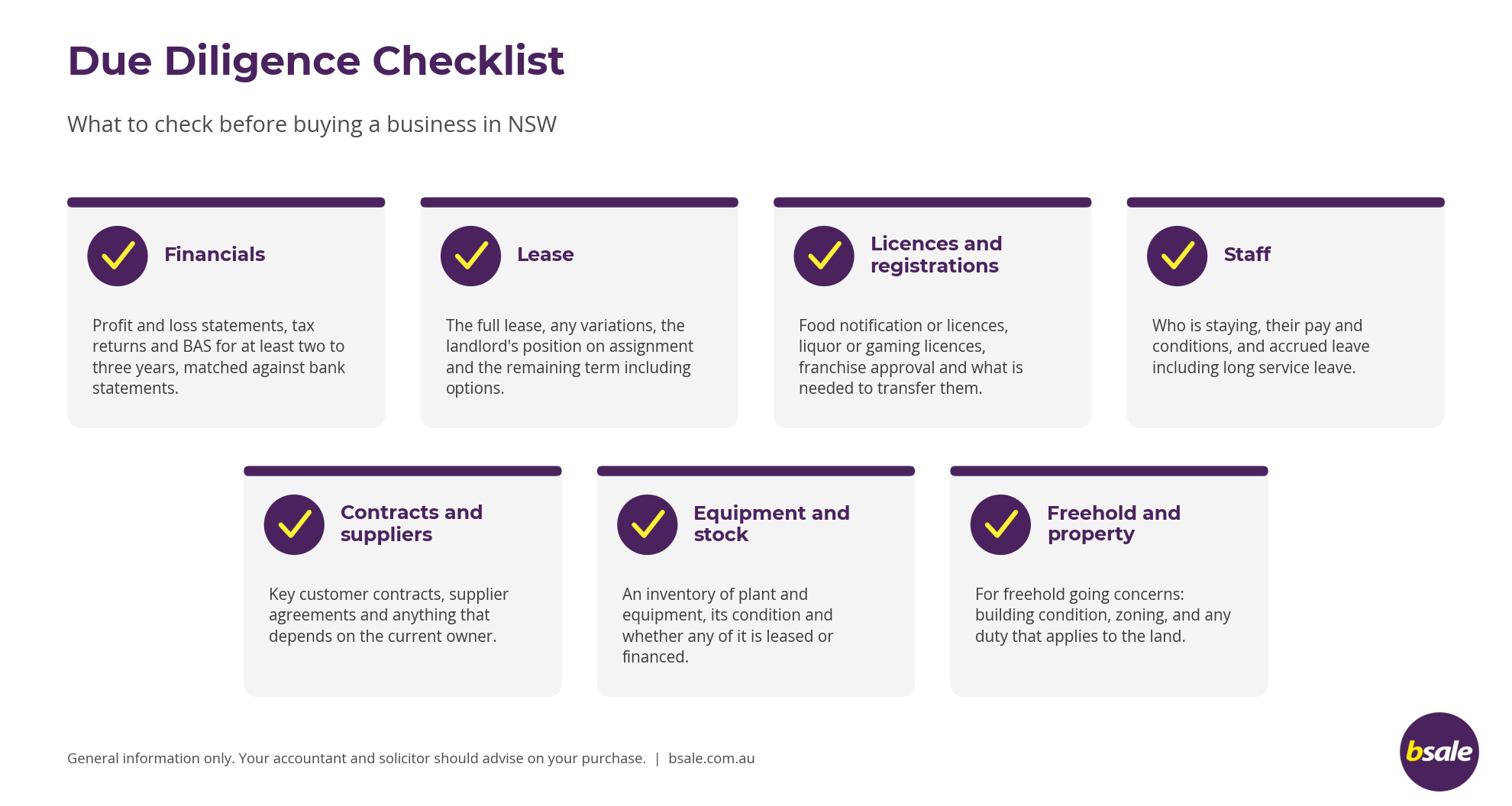
Infograph: Due Diligence Checklist for NSW
What NSW Business Brokers Are Seeing
Bsale regularly interviews brokers working across Sydney and regional NSW. Their experience highlights how buying conditions can differ between industries and locations.
Demand for Established Service Businesses
On the Central Coast, John Ramsay of Central Coast Business Brokers sees opportunities in business-to-business services, small industrial businesses and companies supporting tradespeople.
He also sees greater pressure on hospitality and retail businesses, where higher operating costs mean buyers need to assess whether earnings justify the time and investment required.
Martin LoSurdo reports similar conditions across Sydney and the South Coast, with interest in business services, manufacturing and some consumer service businesses.
Local Market Knowledge Matters
Newcastle broker Shane Fox of Merchant Business Brokers believes buyers need to understand local trading conditions rather than relying entirely on national averages.
“There's markets within markets,” he said.
Businesses in Sydney, Newcastle and regional NSW can have different customer bases, competition, staffing challenges and growth opportunities.
Finding the Right Business
Sydney broker Sukhdeep Mangat of LINK Business Brokers, who specialises in service stations, emphasises understanding the buyer as well as the business.
She finds that first-time buyers can underestimate the daily involvement required to operate a business, particularly in industries such as retail and hospitality. For buyers, choosing a business that suits their experience, finances and preferred level of involvement can be just as important as negotiating the purchase price.
FAQ About Buying a Business in NSW
Do You Pay Stamp Duty When Buying a Business in NSW?
Not on many standalone business assets, including goodwill and intellectual property. However, duty can apply when the purchase includes land, a lease or certain equipment. Check the requirements with Revenue NSW.
Is It Cheaper to Buy a Business in Sydney or Regional NSW?
Sydney's average asking price was $614,572 in the September 2026 quarter, below several regional areas including Newcastle & Hunter Valley ($789,871) and the Mid North Coast ($908,610). Prices depend heavily on the business type, assets and whether property is included.
Do You Need a Broker to Buy a Business in NSW?
No. Buyers can purchase directly from an owner or through a licensed business broker. Registering with brokers in your preferred industry or location can help you find suitable opportunities.
How Long Does It Take to Buy a Business?
The timeframe depends on finance, due diligence, lease assignment, licensing and contract negotiations. Nationally, the median time between a business being listed and marked as sold on Bsale was 202 days, although this measures listing activity rather than the buyer's transaction timeframe.
Find Businesses for Sale in NSW
Bsale has connected business buyers and sellers across Australia since 2000, with listings advertised by business brokers and private sellers.
View businesses for sale in NSW, including Sydney, Newcastle & Hunter Valley, the Central Coast, Wollongong & Illawarra, the South Coast and regional NSW.
Buyers can also find an adviser through Bsale's business broker directory.
Disclaimer:Bsale marketplace statistics reflect activity on Bsale.com.au and do not represent all business sales in Australia. Listing details, asking prices and sold statuses are supplied by advertisers and are not independently verified. Asking prices may include stock, plant, equipment or freehold property and do not represent confirmed sale prices. This article provides general information only and is not legal, financial or investment advice. Buyers should obtain independent professional advice and complete due diligence before purchasing a business.
About the author
Vanessa Lovie-Yousaf
CEO Bsale Australia
Vanessa Lovie-Yousaf is the CEO and manager of Bsale.com.au, one of Australia’s most trusted business for sale marketplaces since 2000. With 15 ...


