How to Buy a Motel in Australia

How to Buy a Motel in Australia
Buying a motel is rarely just buying a business. In many cases you are also buying a home, because the manager's residence comes with the sale, and a way of life that runs from early check-outs to late arrivals. Depending on how the motel is sold, you may be taking on a lease that will shape the business for years, or the land and buildings themselves.
Motels appeal to a wide range of buyers, from couples planning a regional move to investors who want a property-backed business run by a manager. They suit operators who enjoy hospitality and do not mind being on call, and they sit in very different markets, from highway towns busy with contractors to coastal and alpine destinations that fill in the holidays. You can compare leasehold and freehold opportunities among the motels for sale in Australia on Bsale.
Buyer enquiries across all businesses on Bsale rose about 28% on a year earlier in the September 2026 quarter, according to Bsale's latest market report. Accommodation and tourism moved the other way. It was one of only two industries to record fewer enquiries than a year earlier, and accommodation and tourism listings marked as sold were down about 37%. The average advertised asking price across all businesses on Bsale was $740,955 at 30 September 2026, and regional markets again recorded the highest averages, which the report notes may partly reflect what is included in the price, such as freehold property. These are industry and national figures rather than motel benchmarks.
Specialist brokers describe a market where good motels are still tightly held. "There is exceptionally high demand for both leasehold and freehold motel assets," said Rod Devlin of CRE Brokers, who works across regional hospitality markets. "Leasehold yields are very strong, and there's high demand for profitable freehold motel assets."
Both views can be true. Some motels are matched with buyers from a broker's database before they are widely advertised, so the businesses you see online are only part of the market. This guide explains how motels make money, what they cost, how they are valued, the tax and compliance issues that apply and what to check before you buy, with a section at the end for owners preparing to sell.
In this Guide
1. Leasehold, freehold or under management
2. How much does it cost to buy a motel?
3. Where motel revenue comes from
4. Operating expenses and profitability
5. How motels are valued
6. GST, licences and compliance
7. Risks and red flags
8. Due diligence for a motel
9. 10 steps to buying a motel
10. Selling a motel
Leasehold, Freehold or Under Management
The first decision is how you want to own the motel. Most motels for sale fall into one of two structures.
- Leasehold. You buy the business, including its goodwill, forward bookings and usually the furniture and equipment, and take over a lease of the land and buildings from a landlord. The upfront cost is lower, but you pay rent, and much of the business's value depends on how long the lease has left to run.
- Freehold going concern. You buy the business and the property together. The capital required is much higher and the purchase involves commercial property lending, but there is no landlord and you hold the real estate as well as the trading business.
Buyer preferences between the two have shifted over time. Craig Clark of CRE Brokers has seen both sides of the cycle. "After the GFC, no one wanted freehold going concerns everyone was chasing leaseholds and cash flow," he said. "Now both are sought after."
Then decide how involved you want to be. Many motels are run by an owner-operator couple living on site, handling reception, bookings, housekeeping and maintenance between them. Others are run by a manager and staff for an owner who lives elsewhere. A managed motel costs more to run, so the profit available to the owner is lower, but it gives you more flexibility. Think about the type of trade, too. A highway motel serving contractors and corporate travellers runs very differently from a beachside motel that fills up in school holidays and is quiet in winter.
How Much Does It Cost to Buy a Motel?
Motel prices vary widely because the structure, size and location vary widely. In Bsale's roundup of 7 motels for sale across regional Australia, published in November 2026, asking prices ranged from $595,000 for a 13-room leasehold motor inn in Deniliquin to $4.22 million for a 35-room freehold hotel and motel with a restaurant and liquor licence in Western Australia's South West. In between were a 12-room leasehold in Miles at $640,000, a 12-room leasehold in Inverloch at $1,050,000 and freehold motels in Nimmitabel, Swansea and Gympie priced from $1.3 million to $1.59 million.
Several things explain the spread.
- Leasehold or freehold. A freehold includes the land and buildings, so it usually costs considerably more than a leasehold with a similar number of rooms.
- Lease term. Among the leaseholds in that roundup, one advertised a 25-year lease with CPI increases only and another had about 16 years remaining. The length and terms of a lease have a direct effect on value.
- Earnings. The Miles leasehold advertised adjusted net profit of $177,352 for 2025-26, while several other motels in the roundup did not disclose turnover or profit.
- Rooms and facilities. Room numbers, the standard of fitout, a pool, a restaurant or a liquor licence all affect price.
- Location and trade. Steady corporate and contractor demand, or a strong tourist season, supports higher prices.
Check what each asking price includes. WIWO, or walk in walk out, generally means the agreed business assets and inclusions transfer with the sale, but the inclusions vary, so confirm them. Bsale's explainer on what WIWO and SAV mean sets out the difference. For a freehold purchase, also budget for stamp duty, which is set by each state and territory, as well as legal and accounting fees, valuations, building inspections, working capital and any furniture or room upgrades you plan to make.
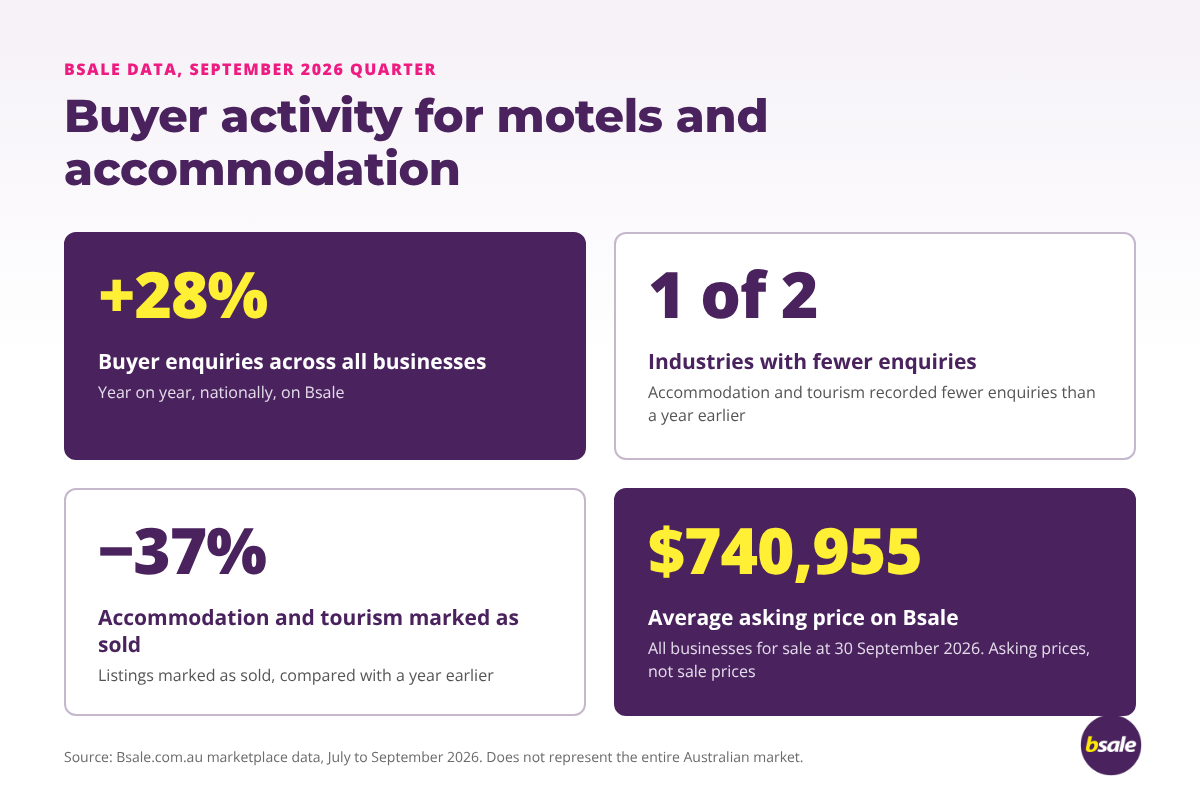
Source: Bsale marketplace data, September 2026 quarter. Accommodation and tourism figures cover the whole industry, not motels alone.
Where Motel Revenue Comes From
Most motel revenue comes from room nights. Three measures explain how well a motel turns its rooms into income.
- Occupancy. The share of available room nights that are sold.
- Average daily rate. Room revenue divided by the number of room nights sold.
- Revenue per available room. Room revenue divided by all available room nights, which combines occupancy and rate in one figure.
As an illustrative example only, a 12-room motel open every night of the year has 4,380 room nights available. At 65% occupancy and an average rate of $140, it would sell about 2,847 room nights and earn about $398,580 in room revenue, or about $91 per available room night. Ask the seller for these figures by month for at least two to three years, because a strong annual average can hide very quiet months.
Look at where the bookings come from. Corporate accounts, contractors and government travellers often fill rooms midweek, while leisure guests book weekends and holidays. Direct bookings through the motel's own website and phone avoid the commissions charged by online travel agents, so a high share of agent bookings reduces the income you keep. Other income may come from a restaurant or bar, guest laundry, conference rooms or, as one Snowy Mountains motel in Bsale's roundup advertised, EV charging.
Sellers often identify ways to grow revenue. Listings in the same roundup pointed to higher room rates and occupancy, longer check-in hours, operating all year rather than seasonally and space for extra cabins. Treat these as opportunities to test rather than as income you are paying for, and price the motel on what it earns today.

Image: Growth ideas drawn from motel listings featured on Bsale in November 2026. A general guide only.
Operating Expenses and Profitability
The main costs of running a motel are wages, rent or loan repayments, booking commissions, cleaning and laundry, utilities, insurance, repairs and maintenance, and marketing. Motels also need regular spending on furniture, linen, air conditioning and room refurbishments to stay competitive, so set aside money for replacements even in years when nothing breaks.
Profit is what remains after all expenses. In owner-operated motels, the owners' own work is often not fully reflected in the accounts. A couple running reception, cleaning and maintenance seven days a week is doing the work of several paid staff. Ask your accountant to adjust the profit for a fair wage for every role the owners perform, so you can see what the motel earns as an investment and what it would earn under management.
Look closely at seasonality and cash flow. A motel that earns most of its profit in summer needs enough cash to cover wages, rent and loan repayments through the quieter months. Confirm whether the motel's free accommodation for the owners is treated as a benefit in the profit figure, and whether any family members working in the business are paid.
How Motels Are Valued
Leasehold motels are generally valued on their adjusted net profit and the security of the lease. Your accountant starts with the net profit in the financial records, adds back items that will not continue under your ownership and deducts a fair wage for unpaid owner work. The remaining lease term, rent review terms, options and the landlord's repair obligations then have a large effect on what that profit is worth.
Freehold motels are valued on the property and the business together. A valuer will look at the land, buildings, condition, zoning and the income the motel produces. Lenders usually require their own valuation before approving a freehold loan.
Hospitality brokers note that accommodation assets are often compared on yield, meaning the return the income produces on the price paid. Phil Mammolito of CRE Brokers observes that caravan parks and motels tend to trade within similar yield ranges, while pubs, which are often seen as slightly higher risk, typically trade on higher yields. Ask your accountant and a valuer to test any yield quoted in an advertisement against verified figures.
GST, Licences and Compliance
The ATO treats motels as commercial residential premises, and their sale and lease are subject to GST. Whether you can claim a GST credit depends on how the sale is structured, including whether it is a GST-free sale of a going concern or uses the margin scheme. The GST treatment of room income also depends on how long guests stay, with concessional treatment available for stays of 28 days or more, according to the ATO's guidance on commercial residential premises and GST. Get tax advice before you sign the contract.
Local councils and state or territory governments manage most licences and permits for accommodation businesses. Depending on the motel, approvals may be needed for food, alcohol, signage, waste disposal and building works, according to business.gov.au's guide to the accommodation and food services industry. Fire safety, pool safety and building compliance requirements are set by state and local governments, so ask your solicitor and the council what applies. Do not assume licences or approvals transfer automatically to a new owner.
Staffing brings award, payroll and work health and safety obligations. Accommodation Australia, the industry association representing more than 3,500 accommodation providers, offers workplace relations advice to its members.
Risks and Red Flags
Some problems can be fixed after you buy. Others should change the price or end the negotiation. Look out for these warning signs.
- A short or weak lease. Little time remaining, no options or uncapped market rent reviews put a leasehold buyer's investment at risk.
- Reliance on a few clients. A motel that depends on one contractor, project or government account can lose much of its trade when that work ends.
- Temporary demand. Bookings tied to a construction or energy project may not last once the project is finished.
- Deferred maintenance. Ageing roofs, air conditioning, hot water systems and pools are expensive to fix.
- Figures that cannot be verified. Occupancy and revenue should match the booking system, BAS and bank statements.
- Heavy reliance on online travel agents. High commissions reduce the income you keep.
- Compliance issues. Outstanding fire safety, pool or building notices need to be resolved before settlement.
Due Diligence for a Motel
Due diligence is where you confirm the motel is what it appears to be. Build a team with an accountant and a solicitor experienced in accommodation purchases, and for a freehold add a valuer and a building inspector. Bsale's guide to due diligence in a business sale covers the general process. For a motel, ask for these records.
- Profit and loss statements, balance sheets, BAS, tax returns and bank statements for at least two to three years.
- Booking system reports showing monthly occupancy, average daily rate and revenue by booking channel.
- Corporate and contractor account agreements, and the share of revenue each provides.
- The lease, including term, options, rent reviews, outgoings, repair obligations and make good, or for a freehold the title, zoning and building reports.
- Payroll records, staff contracts and rosters.
- An asset register for furniture, linen, equipment and vehicles.
- Fire safety, pool safety and building compliance records.
- Forward bookings and deposits already paid by guests.
Stay at the motel as a guest before your formal inspection. You will learn a lot about the rooms, the service, the town and the kind of guests the motel attracts. Bsale's article on how a lease can affect a business sale price explains why the lease deserves close attention in a leasehold purchase.

Image: Five areas buyers should review before committing to a motel purchase.
10 Steps to Buying a Motel
The process follows the same order as Bsale's guide to buying a business in Australia, with the motel details added at each step.
- Decide what type of motel suits you. Choose between leasehold and freehold, owner-operated and managed, and corporate or tourist trade.
- Know your buying capacity. A freehold involves commercial property lending as well as business lending. Talk to a finance broker early and budget for stamp duty, fees and working capital.
- Search for opportunities. Compare motels by structure, rooms, location and price, and contact accommodation specialists through the Bsale broker directory.
- Enquire and sign a confidentiality agreement. Explain your experience and funding, and do not approach staff, guests or the landlord without the seller's agreement.
- Review the information memorandum. Look at occupancy, room rates, revenue by channel, costs, the lease or property details and the manager's residence.
- Make an offer. Make it conditional on due diligence, finance, a valuation for freehold purchases and the landlord's consent to assign a lease.
- Complete due diligence. Check the booking data against the financial records, and review the lease or property, compliance records and corporate accounts.
- Secure your finance. Lenders will want the financial records, a business plan, cash flow forecasts and, for a freehold, a valuation.
- Negotiate and finalise the contract. Cover the assets included, forward bookings and guest deposits, staff entitlements, the handover period, restraint of trade and the GST treatment of the sale.
- Settle and take over. Learn the booking system, rate settings and online listings from the seller, and meet corporate clients early to confirm their arrangements.
Selling a Motel
If you own a motel and are thinking about selling, look at it through a buyer's eyes. Buyers will compare your occupancy and room rates with your financial records, check how much of your trade depends on a few clients and test how much of the profit relies on your own unpaid work. Monthly occupancy, average daily rate and channel reports that match your BAS and bank statements make that process faster and support your asking price.
For a leasehold, the lease is often the most important asset a buyer is paying for. Consider negotiating options or an extension with your landlord before you list. Fix obvious maintenance issues, refresh tired rooms where the cost is justified, and have your compliance records, asset register and corporate account agreements ready. Bsale's guide on how to sell a business in Australia explains the full selling process.
Ready to Compare Motels?
Buying a motel means weighing up the business, the lease or property, the town and the lifestyle that comes with it. Buyers who understand occupancy and room rates, check the lease or building carefully, get tax advice early and are realistic about the hours involved are in the best position to buy well. If you are also considering other accommodation businesses, Bsale's guide to buying a caravan park explains how those businesses compare.
Disclaimer: This article provides general information only and does not constitute financial or legal advice. Listing information is supplied by advertisers and has not been independently verified by Bsale. Market figures reflect Bsale marketplace activity and do not represent the entire Australian business sales market. Asking prices are advertised prices, not confirmed sale prices, and listings marked as sold do not necessarily represent completed transactions. Buyers should conduct their own due diligence and obtain independent professional advice before purchasing a business.
Originally published: 4 February 2025
Updated: 24 October 2026
Tags: motel accomodation guide
About the author

Catherine Mangana
Customer Support
Catherine enjoys generating articles that highlight some of the opportunities that are now available for purchase on Bsale. She hails from a family of ...


