Buying a Pub in Australia? Here is What to Know Before You Buy

Tips Buyings a Pub in Australia
Pubs are part of everyday life in Australia, from inner-city gastropubs to the country hotel on the main street. For many buyers, owning one is as much a lifestyle choice as a business decision.
Plenty of buyers want in. Craig Clark of CRE Brokers, who sells hospitality businesses along the east coast, says buyers are keen on hotels, motels and caravan parks, but there aren’t enough to go around.
“There’s a huge demand outstripping supply,” he said. “That’s our biggest issue: not having enough stock.”
Buying a pub is more complicated than buying most businesses. It brings together hospitality, liquor licensing, property and staff, and often gaming and accommodation as well. The building matters as much as the business, and in regional towns the pub’s future can be closely tied to the town’s.
Regional hospitality broker Rod Devlin grew up as the child of a publican and now sells pubs, motels and caravan parks. He puts it simply.
“Whether it’s Victoria, New South Wales, Queensland, South Australia or Tasmania, well-run pubs are well-frequented and strong businesses,” he said.
This guide covers what to check before buying a pub in Australia, from the lease and licences to the financials, the building and the people who keep it running. If you’re ready to start looking, you can browse pubs for sale on Bsale.
The Pub Market on Bsale
Much of the market on Bsale has been getting busier, but interest in pubs has stayed remarkably consistent. Over the past five quarters, enquiries for pubs have stayed within a fairly narrow range, with a slight dip in the latest quarter.
The rest of Bsale looks quite different. Enquiries across all businesses for sale jumped about 28% on a year earlier. Pubs haven’t been part of that rush, but they haven’t lost their appeal either. A steady group of buyers comes looking for a pub every quarter.
That steadiness can work in your favour. With less competition than in faster-moving categories, you’ll often have more time to visit a venue, go through the numbers and line up your finance and advisers before making an offer.
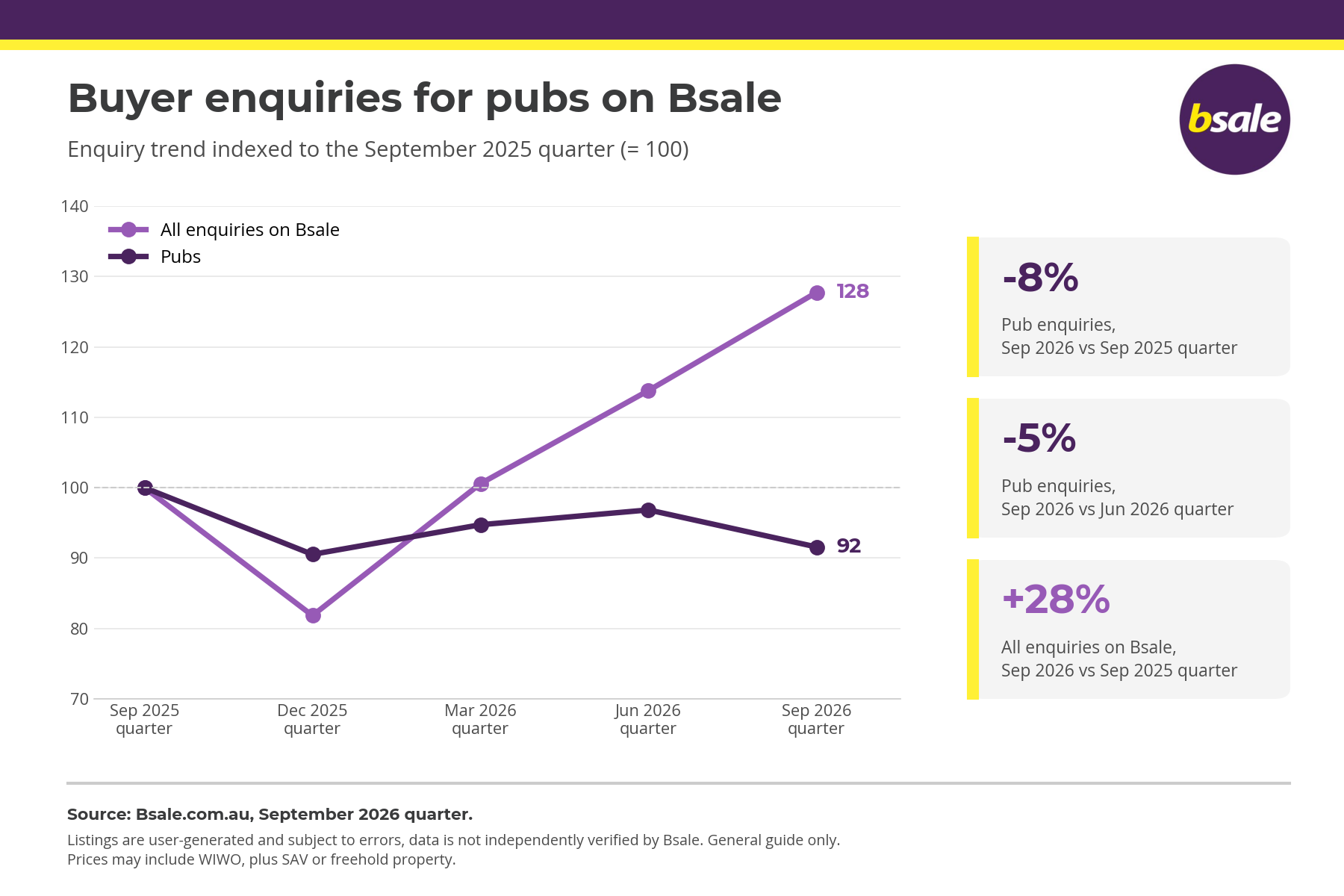
You’ll also have a bit more to choose from. The number of pubs listed for sale on Bsale rose about 9% on a year earlier, with an average asking price of just over $1 million in the September 2026 quarter. Asking prices can cover very different things, from a leasehold business to freehold with accommodation, so check exactly what each price includes before comparing venues.

Freehold or Leasehold?
The first question with any pub for sale is what you're actually buying.
Leasehold means you buy the business, including its goodwill, equipment and the right to trade, but not the building. You pay rent to the landlord. Most pubs in Australia are sold this way, and it means a much smaller upfront cost.
Freehold going concern means you buy the business and the building together. It costs considerably more, but you have full control over the property and its future, and no landlord to deal with.
Buyer preferences between the two have shifted over time, as Craig Clark has seen.
"After the GFC, no one wanted freehold going concerns, everyone was chasing leaseholds and cash flow," he said. "Now both are sought after."
Some buyers also purchase a freehold pub as an investment and lease it to an operator.
Reading the Lease
If you're buying leasehold, the lease is one of the most important parts of the deal. Pub leases are often structured as 5x5x5 or 10x10x10, meaning an initial term of five or ten years with two further options of the same length.
When reviewing the lease, check:
- Rent and annual increases. Make sure the rent stays viable based on the pub's trading figures.
- Time remaining and renewal options. You're paying for the business and the lease term. If there's little time left, the landlord may find a new tenant or sell when it ends.
- Restrictions. Some leases limit renovations, trading hours or changes to how the venue operates.
- Outgoings. Understand what you'll pay on top of rent, such as rates, insurance and maintenance.
- Repairs and maintenance. Find out who's responsible for the building, the kitchen and major equipment.
Have a solicitor review the lease before you commit.
Buying Freehold
If you're buying the building, get a building inspection and check with the council for any zoning changes or heritage restrictions. Many Australian pubs are in older buildings, so maintenance and compliance costs can be significant.
Liquor Licences and Gaming
A pub can't trade without its liquor licence, so the licence is central to the sale. Licensing is handled by each state and territory, and the rules differ between them.
Before buying, find out:
- what type of licence the pub holds, and its trading hours and patron capacity
- whether there are any conditions on the licence
- whether there have been any breaches or complaints
- how the licence will be transferred, and what approvals you'll need as the new licensee or approved manager
You'll usually need to meet your state's requirements, such as responsible service of alcohol training and probity checks, before the transfer is approved. Make the sale conditional on the licence transfer being approved.
If the pub has gaming machines, take extra care. Gaming rules, entitlements and taxes vary widely between states, and gaming can make up a large share of a pub's income. Understand exactly what's included in the sale, and how much of the pub's earnings depend on gaming compared with bar, food and accommodation.
Checking the Financials
The pub's trading figures are the best guide to whether it's a sound purchase. Start with the information memorandum, then test the figures during due diligence with your accountant.
Questions worth asking include:
- What is the net profit to the owner, and how has it changed year on year?
- How long will it take to earn back your investment?
- How is income split between bar, food, gaming and accommodation?
- How much does trade change with the seasons, or depend on events and tourists?
- What are the wages, and how many hours does the current owner work in the business?
- Will you need to spend money on a fit-out, repairs or rebranding?
- Are there any outstanding debts or liabilities?
The Australian Taxation Office publishes small business benchmarks for pubs, taverns and bars. Comparing a pub's figures against them can show whether its costs look high or its margins look low.
Pubs can also hold up well through tougher times, in Rod's experience.
"Pubs seem to go well in recessions," he said. "People who might have gone out for fine dining drop back to mid-range, and those who went mid-range drop back to a pub style meal. People budget their entertainment dollars accordingly."
That doesn't apply to every pub, though. The figures are where you find out whether the one you're looking at is well run.
Location, the Town and the Council
A pub's trade depends heavily on who walks through the door. Look at foot traffic, parking, competition nearby, and whether the pub relies on locals, tourists or passing traffic.
In regional areas, the pub's future is often tied to the town's. Some regional towns have lost trade when a highway bypass diverted traffic away from the main street. Before buying, check the council's plans for the area over the next five to ten years, including road changes, new developments and any new hospitality venues planned nearby.
Regional pubs still attract plenty of buyers. Rohan Pertzel of CRE Brokers, who ran pubs before broking them across Western Victoria, has recently sold hotels in Warracknabeal and Ballarat.
"We do a lot of miles, a lot of driving to get to some of these little pubs, but we find they turn over quite readily," he said.
A pub can also mean a great deal to a small town. Rod Devlin, who works from Albury across northern Victoria and southern NSW, sold a heritage weatherboard pub north of Albury for $360,000. It had been closed for years, and reopened under its new owners.
"They've got their pub back," he said.
The Building, Kitchen and Accommodation
Many Australian pubs are in historic buildings, which is part of their appeal. It also means repairs, maintenance and compliance upgrades can be expensive. Whether you're buying leasehold or freehold, understand the building as well as the business.
The Kitchen
Food is a big part of most pubs' trade. Check the condition of the kitchen and its equipment, and work out what it would cost to fix or replace anything that's worn out. If you're buying leasehold, find out whether the landlord or the tenant is responsible, and raise any major issues before you buy.
Traditional pub food such as steaks, schnitzels and burgers is still the core of many menus. Some pubs have broadened their offering, but the right menu depends on the pub's size, location and customers.
Accommodation
Pubs with rooms are more common in regional Australia. Accommodation can add another income stream and bring in travellers who also eat and drink at the bar.
But rooms come with their own costs, including cleaning, linen, laundry, online booking systems and marketing. Many pub rooms are also due for renovation, which can be costly. Check occupancy rates, the condition of the rooms, and whether the landlord has any renovation plans.
Buyer preferences vary. Kevin Connolly, who has spent more than four decades at CRE Brokers, says buyers usually know which type of hospitality business suits them.
"There are buyers who like accommodation, other buyers who like licensed venues and others who want cafe/food-service businesses," he said. "But generally, you could say that most buyers are entrepreneurs who want to improve the business and put their stamp on it."

Reputation, Staff and Seeing It for Yourself
Read the Reviews
Check what customers say on Google, Facebook and sites such as TripAdvisor. Repeated complaints about slow service, prices or cleanliness can point to problems in how the pub is run. Consistently good reviews usually suggest a well-managed venue.
A poor reputation isn't always a reason to walk away. It may be something a new owner can turn around, but factor the time and cost into your plans.
Have a Drink and a Meal
One of the best ways to get a feel for a pub is to visit as a customer, ideally more than once and at different times of the week.
Watch how the staff work. Are they friendly? Is the service efficient? Are there key people who keep the place running, and will they stay after the sale? In a pub, losing a good manager or chef can change the business quickly.
Ask the seller how involved they are day to day. If they work long hours behind the bar, you'll either need to do the same or pay someone to replace them.
Getting the Right Advice
Buying a pub involves a lease or property purchase, a licence transfer, staff and often gaming, so you'll need a team around you. That usually includes a solicitor or conveyancer, an accountant who understands hospitality, and a business broker with experience selling pubs.
Rohan Pertzel sees the broker's role as keeping everyone moving in the same direction.
"Our role is to make sure we're the conduit between the buyer, the seller and the solicitor, because there can be some egos involved and some issues along the way," he said.
Industry bodies such as the Australian Hotels Association, which represents venues from country pubs to city hotels, can also be a useful source of information once you're in the industry.
Red Flags to Watch For
Not every pub for sale is a sound business. Be cautious of:
- declining revenue over several years
- licensing breaches or unresolved legal issues
- a short lease with no renewal options
- heavy reliance on one income stream, such as gaming or a seasonal tourist trade
- a building that needs major work
- consistently poor customer reviews
For a full overview of the buying process, from finding a business to settlement, see our guide to buying a business in Australia.
Frequently Asked Questions
- How much does it cost to buy a pub?
It varies widely. A leasehold pub in a small regional town can cost a fraction of a freehold hotel in a capital city, which can run into many millions. Beyond the price, budget for stock, legal and accounting fees, licence transfer costs and any repairs. To see current asking prices, browse pubs for sale on Bsale.
- Is owning a pub profitable?
It can be, but profit depends on the individual pub, including its trade, costs, lease and how well it's run. Ask for at least three years of financial records, and have an accountant review them before you buy.
- Can I run a pub with no experience?
It's possible, but it's a demanding business. Without hospitality experience, you'll rely more on good staff and an experienced manager, at least to begin with. You'll also need to meet your state's licensing requirements, such as responsible service of alcohol training.
- What's the difference between a freehold and leasehold pub?
A leasehold pub means you buy the business and rent the building. A freehold pub means you buy both the business and the building.
- Where can I find pubs for sale?
Pubs are advertised by business brokers, hospitality specialists and private sellers. You can browse pubs for sale on Bsale or speak with a broker who specialises in hospitality.
- How do I sell a pub?
Most pub owners sell through a broker with hospitality experience. Start by getting your financial records, lease and licence details in order. Our guide to selling a business in Australia covers the process step by step.
Originally published 2018. Updated October 2026.
The insights in this guide are based on enquiries and listings on Bsale.com.au only, not the entire Australian market. Listings are entered by brokers and business owners and are not independently verified by Bsale. Asking prices may include freehold property, stock, plant and equipment, so check what each price covers. Pubs are a relatively small category on Bsale, so trends should be read as a general guide only. Comments from brokers reflect their own views and experience.
About the author
Vanessa Lovie-Yousaf
CEO Bsale Australia
Vanessa Lovie-Yousaf is the CEO and manager of Bsale.com.au, one of Australia’s most trusted business for sale marketplaces since 2000. With 15 ...


