Guide to Buying a Beauty Salon in Australia

Guide to Buying a Beauty Salon in Australia
An established beauty salon comes with things that take years to build from scratch, including a client list, a treatment menu people already book, a fitted out space and, in many cases, a trained team. What you are paying for, though, is only as solid as the client retention, the equipment and the compliance behind it. This guide explains how to buy a beauty salon business in Australia, from choosing the right type of salon to reading the financials, checking licences and settling, so you can judge whether a salon is worth the price before you commit.
The beauty salons for sale on Bsale range from single room studios and nail, lash and brow bars to full service salons, skin and laser clinics, day spas and franchise outlets. Current asking prices run from under $30,000 for small owner operated salons to several hundred thousand dollars for multi room clinics with specialised equipment, and each model earns money and carries risk in a different way.
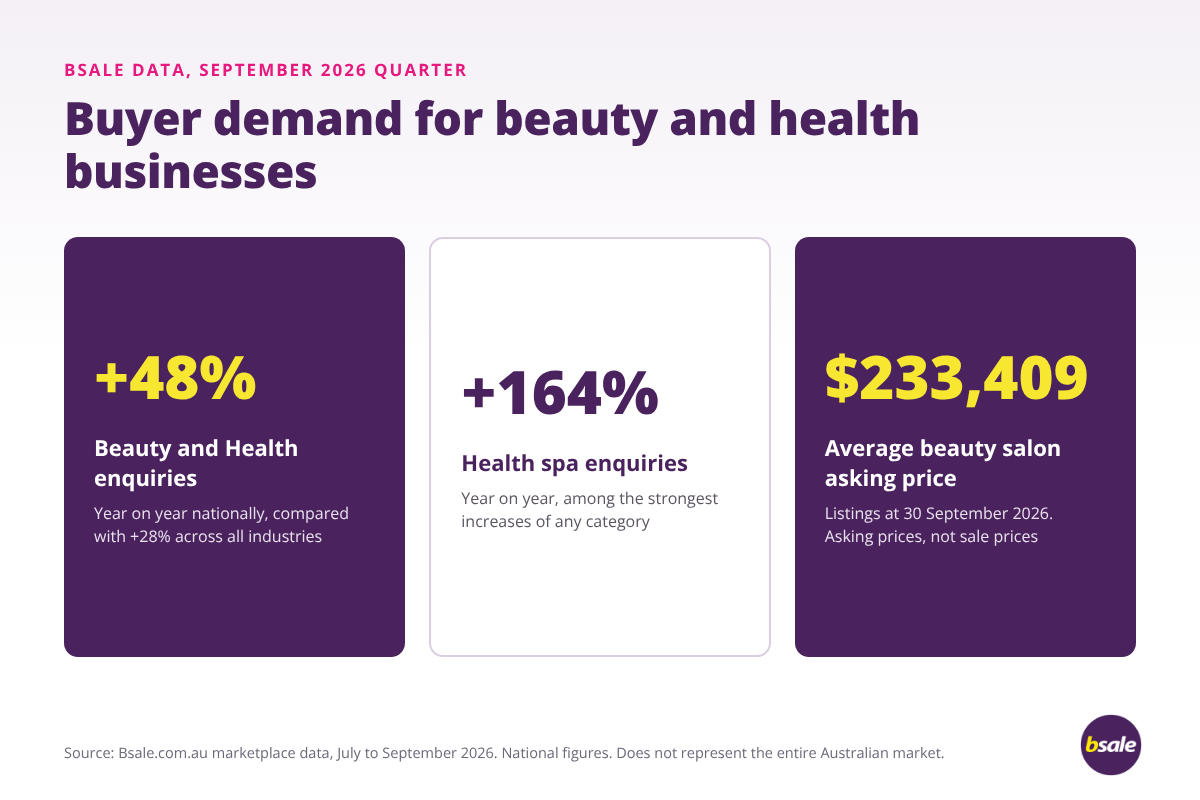
Buyer interest in the sector is growing. According to Bsale’s latest market report, enquiries for Beauty and Health businesses on Bsale rose 48% year on year nationally in the September 2026 quarter, well ahead of the 28% increase across all industries. Health spa enquiries rose 164%, among the strongest increases of any category. Beauty salons also remain one of the more accessible ways into business ownership, with an average advertised asking price of $233,409 at 30 September 2026, compared with $740,955 for all businesses for sale on Bsale. Stronger enquiry means more competition for good salons, so buyers who have their finance and advisers ready are better placed to act.
The buyers stepping into this part of the market are changing too. Davina Lacey of Stockbridge Business Brokers, who owned two Pilates studios before moving into broking, has noticed a shift in who is buying health and fitness businesses. “The new generation coming through and buying these businesses are about 20 years younger than the ones going out,” she said. She also notes that valuation multiples in health and fitness have softened compared with previous years, which makes careful assessment of each business all the more important.
The steps below follow the order of Bsale’s 10 step guide to buying a business in Australia, with the questions and checks that matter most for a beauty salon. If the business you are considering is mainly hairdressing, our guide to buying a hair salon covers stylist loyalty and chair rental in more depth.
1. Which Type of Beauty Salon Suits You?
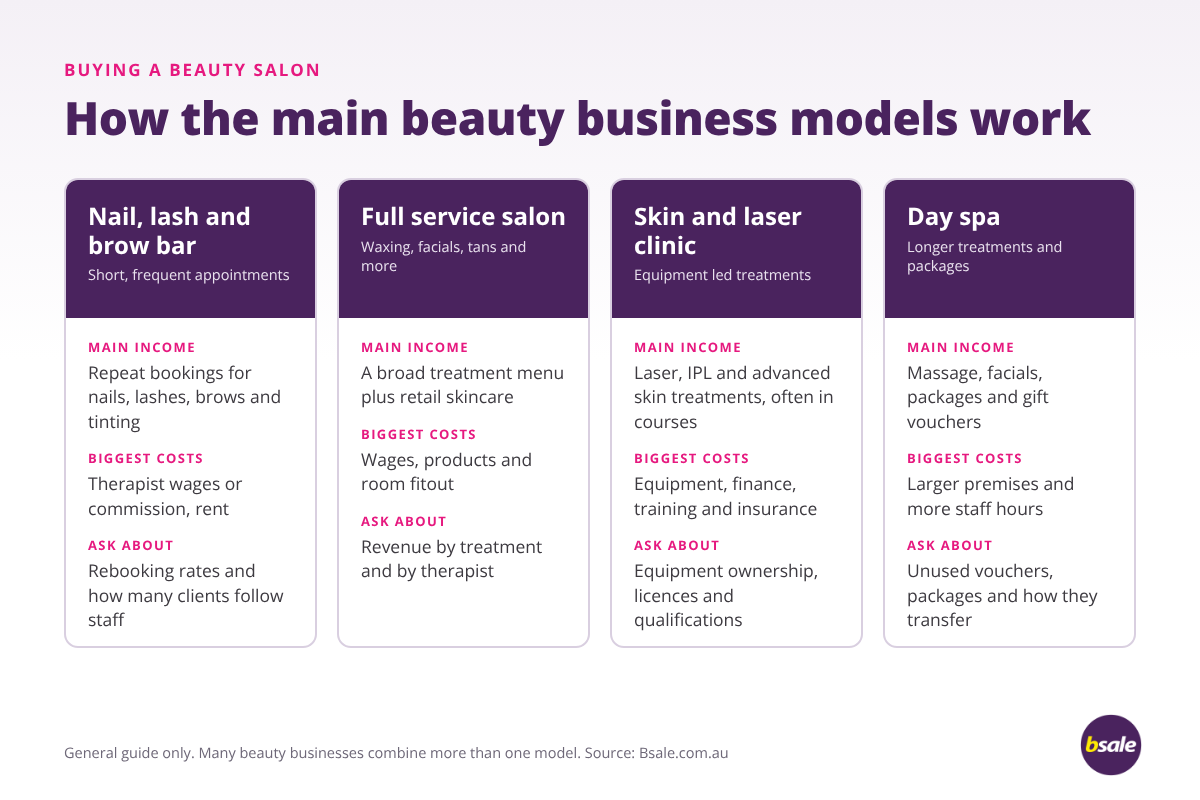
Beauty businesses vary more than the word salon suggests. Common models are listed below.
- Nail, lash and brow bars built on frequent, shorter appointments and regular rebooking.
- Full service beauty salons offering waxing, tinting, facials, massage, spray tans and similar treatments, often with a retail skincare range.
- Skin and laser clinics using higher value equipment for treatments such as hair reduction, skin rejuvenation and tattoo removal, often sold as courses.
- Day spas, which rely on longer treatments, couples rooms, packages and gift vouchers.
- Cosmetic clinics offering injectables, which involve registered health practitioners and separate professional rules.
- Franchise salons operating under a set brand, treatment menu, supplier arrangements and franchisor approval.
Think about whether you will treat clients yourself. A qualified therapist can step into an owner operated salon and keep costs down, while a buyer without beauty experience will need a business with a stable team and systems that do not depend on the current owner. Treatments that use lasers or penetrate the skin can also bring extra licensing and training requirements, which are covered in Step 7. If you would rather not work in the salon day to day, our guide to buying a business under management explains what to look for.
It also helps to understand where client spending is moving. The GLOW Quarterly Beauty Industry Report for Q2 2026 found Australian prestige skincare grew 12.4% year on year, with Australian developed prestige brands reaching about 31% of the category. Among readers under 35, TikTok had overtaken Instagram as the main way people find new products, at 54% compared with 38%. The report is based on a reader panel of about 2,800 Australian women aged 22 to 55 and is not nationally representative, but it gives a useful read on the retail ranges and marketing channels a salon may need.
2. How Much Does It Cost to Buy a Beauty Salon?
Advertised asking prices depend on profit, the client base, the equipment, the lease and how much the business relies on the owner. Current listings on Bsale show how widely they can vary.
- An established lash and brow studio on Sydney’s Northern Beaches is advertised at $99,000. The listing reports average net profit of $4,000 per month with the owner working approximately three days a week, a database of about 400 clients and a lease running to October 2028.
- A skin and laser clinic in Williamstown, Melbourne, is advertised at $175,000 plus SAV. The listing describes the clinic as fully under management, trading four days a week with more than 3,000 clients after 20 years in business. Turnover and profit are not disclosed in the listing.
- A beauty and cosmetic clinic in Albany, Western Australia, is advertised at $180,000. The seller reports turnover of $760,000 last year and an annual owner withdrawal of $100,000, with services including nails, skincare, massage and cosmetic injectables delivered by a team that includes two registered nurses.
- A beauty and wellness salon in Subiaco, Perth, is advertised at $260,000. It has eight rooms, including a couples room, and base rent of $1,145 per week. Turnover and profit are not disclosed in the listing.
These figures are supplied by the advertisers and have not been verified. They show why a salon with higher turnover is not necessarily worth more, and why the client base, the team and the equipment can matter as much as the headline price.
Budget for more than the asking price. Some listings are advertised plus SAV, which means stock at valuation, such as retail skincare and treatment products, is added at settlement. Others are offered walk in, walk out (WIWO), where stock is included. You may also need to pay out equipment finance on lasers or other devices, cover legal and accounting fees, transfer duty where it applies in your state, insurance and registration costs in your name, and working capital for wages, rent and product orders in the first months. Our guide on how to source finance to buy a business covers bank lending, vendor finance and other options.
3. Where Can You Find the Right Salon?
Compare listings across locations and price points to understand what different salons offer for the money. Pay attention to the treatment menu, the number of rooms, the size of the team and whether the owner works in the business.
Many salons are sold through business brokers, and some are offered confidentially before they are widely advertised. The Bsale business broker directory can help you find brokers in your area. Spend time in the suburbs you are considering, look at competing salons and their prices, read local reviews and set up buyer alerts so new listings reach you quickly.
4. What Should You Ask When You First Enquire?
Send a clear enquiry that explains your background, your qualifications, your budget and how you intend to run the salon. Sellers and brokers respond better when they can see relevant experience and finance in place.
Expect to sign a confidentiality agreement before receiving client numbers or financials. Beauty owners are often protective of this information because staff and clients may not know the salon is for sale. Buyers on Bsale are asking for detail earlier than before. In the September 2026 quarter, almost one in four buyers who wrote a message (23%) asked for financials or an information memorandum, up from about one in six a year earlier.
Useful early questions include why the owner is selling, how many days the owner works, which treatments generate most revenue, whether the equipment is owned and how many prepaid packages and gift vouchers are outstanding.
5. What Should You Look For When You Visit?
An information memorandum should set out the salon’s history, treatment menu, pricing, staffing, client base, equipment, lease and financial performance. Use it to build your list of questions.
Then visit, and if possible book a treatment as a client. You will learn a lot about the booking process, the service, cleanliness and the atmosphere. Things worth noting are listed below.
- How full the appointment book is across the week, including quieter weekdays.
- Which treatments are most popular and which rely on the most expensive equipment.
- The condition of treatment rooms, beds, sterilising equipment, hand basins and reception.
- How retail products are displayed, whether stock is in date and whether staff recommend products.
- Whether the owner is the main therapist for many regular clients.
6. What Should Your Offer Include?
Put your offer in writing and make it conditional on satisfactory due diligence, finance approval, assignment of the lease and, where relevant, franchisor approval and the registrations or licences you will need. Your solicitor can advise on the conditions and timeframes.
Be specific about what is included, such as equipment, the booking system and client database, website, social media accounts, phone number and retail stock. Ask for a schedule of unused prepaid packages, memberships and gift vouchers sold by the current owner, because clients will expect them to be honoured after you take over and their value is often deducted from the price at settlement.
For a franchise salon, ask about the franchise agreement, fees, training and any refit the franchisor may require. A skin and aesthetics clinic in Perth advertised at $295,000 plus SAV, for example, is transitioning into a franchise network offering training and ongoing support, and lists skin rejuvenation and IPL among its treatments.
7. What Should Due Diligence Cover for a Beauty Salon?
Due diligence is where you test the seller’s figures and claims. Our guide to due diligence in a business sale explains the process, and an accountant and solicitor experienced with service businesses can help you work through it.
How Do Revenue and Profit Differ in a Salon?
Most beauty salons earn revenue from treatments, retail product sales, packages and memberships, gift vouchers and, in some cases, room rental to independent practitioners. Revenue tells you how busy the salon is. Profit tells you what is left after wages, products, rent, equipment finance and other costs.
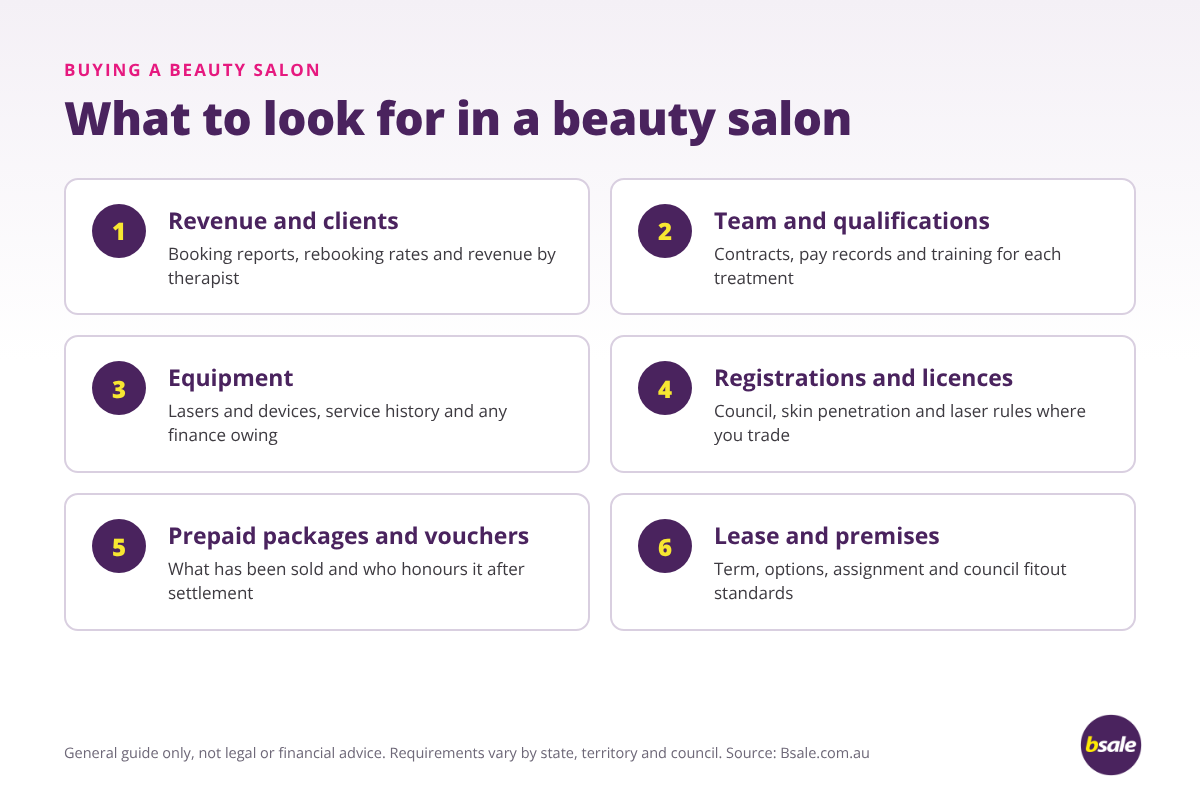
Request at least two to three years of profit and loss statements, BAS and tax returns, along with booking system reports. Compare revenue by treatment, retail sales and revenue by therapist, including the owner. Many listings show an adjusted profit or owner withdrawal that adds back the owner’s wage. If the owner works three or four days a week treating clients, you will need to do that work yourself or pay a qualified therapist, so reduce the adjusted figure by a realistic wage for that role. A salon’s value is usually based on the profit it can sustain, so understanding the difference between a business appraisal and a business valuation can help you judge the asking price.
The ATO publishes small business benchmarks for beauty services, based on 2023 to 24 tax returns, which give a useful point of comparison. For beauty businesses with annual turnover between $200,001 and $400,000, labour costs typically ranged from 25% to 37% of turnover and rent from 12% to 19%. If a salon’s costs sit well outside these ranges, ask why.
How Loyal Is the Client Base?
The client list is often a salon’s most valuable asset. Look at the number of active clients, rebooking rates, how many new clients arrive each month and where they come from. Check how much revenue is linked to the owner or individual therapists, because clients who book with a particular person may follow them if they leave. Confirm that client records sit in a booking system that will transfer to you, and ask whether the sale contract will include a restraint of trade on the seller.
Who Performs the Treatments?
Review employment contracts, pay records, rosters, leave balances and any room rental or contractor arrangements. Confirm that therapists hold the qualifications and training needed for the treatments they perform, particularly laser, IPL and advanced skin treatments. The Fair Work Ombudsman provides information on awards and pay rates. If key staff are likely to leave after the sale, consider how many clients and how much revenue may go with them.
What Equipment Is Included and Who Owns It?
Lasers, IPL machines and other devices can represent a large share of what you are paying for. Ask for an equipment list with purchase dates, service records and warranty details, and confirm which items are owned outright and which are leased or financed, as finance may need to be paid out at settlement. Check whether equipment is still supported by the supplier and whether manufacturer training is required for new operators.
What Registrations and Licences May Be Required?
Beauty regulation is set mainly by states, territories and local councils, and it depends on the treatments offered. Two examples show how much this can differ. In New South Wales, skin penetration procedures, which include beauty treatments, cosmetic enhancements and tattooing that penetrate the skin, require operators to register with the local council and meet hygiene and premises standards. In Queensland, a commercial cosmetic laser business needs cosmetic laser licences and approvals, including a possession licence for the equipment and a use licence for the person performing treatments such as hair reduction and tattoo removal.
Cosmetic injectables sit under a separate framework. Registered health practitioners such as nurses who perform non surgical cosmetic procedures must follow the Ahpra guidelines for non surgical cosmetic procedures issued on 2 September 2025. These include an in person or video consultation each time a cosmetic injectable is prescribed and limits on discounts and financing offers used to promote procedures. If injectables are part of the revenue, find out which practitioners provide them and whether they will stay after the sale.
Do not assume the current owner’s registrations or licences will transfer to you. Ask the seller for current registrations, licences and inspection records, confirm with the council and the relevant state regulator what you will need in your own name, and check that your insurance will cover every treatment on the menu.
How Does the Lease Affect the Purchase?
Broker Olivia Casson of GSE Hospitality Brokers sums up why this matters. “The lease can make or break business value and how quickly people buy.” Check the remaining term and options, rent and outgoings, rent reviews, make good obligations, permitted use and whether the landlord will consent to the lease being assigned. Ideally the lease term, including options, should cover any loan term. Our article on how a lease agreement can affect a business sale price explains why these terms matter. Confirm the premises meet any council requirements for the treatments offered, such as hand basins and treatment room standards.
8. How Do You Finance a Beauty Salon Purchase?
Once due diligence is underway, convert any conditional approval into formal finance. Lenders often look at the salon’s profit after a realistic wage for the work the owner does, along with the lease, the equipment list and your experience in the industry. A finance broker can help you compare lenders, and equipment finance may be available separately for lasers and other devices.
Allow for equipment servicing, product orders and a buffer for the first few months, when some clients may test the new ownership before rebooking. In the September 2026 quarter, nearly one in five buyers who wrote a message on Bsale (18%) asked about finance or vendor finance, up from 13% a year earlier.
9. What Should the Contract Cover?
Use your due diligence findings to settle the final terms. These may include price adjustments for equipment that needs replacing, how prepaid packages and gift vouchers will be accounted for, the treatment of staff entitlements, a restraint of trade on the seller and the length of the handover period.
If the owner is a key therapist, agree how and when clients will be introduced to you or your team. Make sure the contract transfers the booking system, client records, domain names and social media accounts, and that any registrations or licences are in place in your name before you start treating clients.
10. What Happens After Settlement?
At settlement, the balance is paid, stock is counted where the price is plus SAV, and you take over the keys and accounts. Use the handover period to learn the booking routines, supplier ordering and treatment protocols, and to meet regular clients alongside the current owner.
Make changes gradually. Clients often book with a salon because of a particular therapist or treatment, so it usually pays to understand what keeps them coming back before changing prices, products or the team. Once you have a clear view of the numbers, you can decide where to grow, whether that is new treatments, memberships, longer trading hours or a stronger retail range.
Next Steps
A sound beauty salon purchase comes down to matching the salon to your skills and budget, then testing the client base, the team, the equipment and the compliance before you sign. Line up an accountant, a solicitor and finance early, and check the rules for each treatment with the council and state regulator.
Browse beauty salons currently for sale across Australia on Bsale to compare opportunities by location and price, or widen your search to other beauty and health businesses such as day spas, skin clinics and massage businesses.
Disclaimer: This article provides general information only and does not constitute financial or legal advice. Listing information is supplied by advertisers and has not been independently verified by Bsale. Market figures reflect Bsale marketplace activity and do not represent the entire Australian business sales market. Asking prices are advertised prices, not confirmed sale prices, and listings marked as sold do not necessarily represent completed transactions. Buyers should conduct their own due diligence and obtain independent professional advice before purchasing a business.
Originally published: 24 November 2023
Updated: 13 November 2026
Tags: beauty salon beauty and health guide
About the author

Catherine Mangana
Customer Support
Catherine enjoys generating articles that highlight some of the opportunities that are now available for purchase on Bsale. She hails from a family of ...


