How to Buy a Franchise in Australia

10 Steps to Buy a Franchise in Australia
Buying a franchise means buying into a system someone else has built. You get a known brand, tested products, suppliers, training and a set way of running the business. In return you follow the franchisor's rules, pay ongoing fees and accept that the brand, and often the shopfront, are not entirely yours to control.
Franchising suits many first time buyers because it shortens the learning curve, and it attracts experienced operators who want a proven system rather than starting from nothing. Franchises in Australia range from bubble tea counters and bakeries to home-based service businesses and fast food stores turning over more than a million dollars a year. You can compare new and existing opportunities among the franchises for sale on Bsale.
Buyer interest in franchises softened in the September 2026 quarter, according to Bsale's latest market report. Franchise was one of only two industries to record fewer enquiries than a year earlier, and franchise enquiries fell 14% on the June quarter, the sharpest fall of any industry. Enquiries for franchised food outlets were down 39% on a year earlier. At the same time, franchise opportunities averaged an advertised asking price of $340,061, well below the $740,955 average for all businesses on Bsale, and franchise opportunity listings marked as sold rose about 7% on a year earlier. Softer enquiry can mean more choice and time for buyers, although the data does not explain why interest fell.
Business broker Sukhdeep Mangat of LINK Business Brokers in Sydney ran a 7-Eleven franchise for 20 years before moving into broking, and she encourages buyers to understand exactly what they are taking on. "It's a big decision in life, buying a business," she said. For new buyers without industry experience, she may recommend a franchise as a way to learn the fundamentals before moving into an independent business.
This guide explains how franchising works, what franchises cost, how resales are valued, the rules under the Franchising Code of Conduct and what to check before you sign, with a section at the end for franchisees preparing to sell.
In this Guide
1. How franchising works
2. New franchise or existing franchise?
3. How much does it cost to buy a franchise?
4. Franchise fees and operating expenses
5. Revenue and profitability
6. How franchise resales are valued
7. The Franchising Code and your rights
8. Risks and red flags
9. Due diligence for a franchise
10. 10 steps to buying a franchise
11. Selling a franchise
How Franchising Works
A franchise is a business arrangement under a legal agreement. As the franchisee, you pay to sell the products or services of an established business, using the franchisor's branding, trade marks, suppliers and business systems. In return, the franchisor typically provides training, ongoing support, operating manuals, marketing and supply arrangements.
The trade-off is control. You follow the franchisor's operating procedures, which the franchisor may change, and you generally cannot change products, suppliers or the way the business runs without approval. The franchisor may also control where you buy stock, even if you could get it cheaper elsewhere, according to business.gov.au's guide to buying a franchise.
Franchises cover most industries. Food and coffee brands are the most visible, and Bsale's guide to buying a takeaway business covers many of the issues specific to franchised food outlets. Retail, automotive, cleaning, home services, fitness, education and real estate also have well established franchise systems. Some are run from a shop or shopping centre tenancy, while others are mobile or home-based with no premises at all.
Think honestly about whether you are suited to working within someone else's system. If you want to change the menu, pick your own suppliers or set your own trading hours, an independent business may suit you better.
New Franchise or Existing Franchise?
You can buy a franchise in two main ways, and the risks are quite different.
- A new franchise from the franchisor. You open a new site or territory. There is no trading history, so you rely on the franchisor's information, any earnings information in the disclosure document and the experience of other franchisees. You usually pay an initial franchise fee and the cost of fitting out the site.
- An existing franchise from a franchisee. You buy a business that is already trading, often called a resale. You can review its actual financial records, staff and customers, but the franchisor must consent to the transfer, and you take on the time remaining on the franchise agreement and the lease or sign a new agreement for that period.
Many buyers prefer an existing franchise because the numbers can be checked. Look closely at how long the franchise agreement and lease have left, whether they line up, and whether a refurbishment is due during your term.
How Much Does It Cost to Buy a Franchise?
Franchise prices vary widely because the brands, sizes and business models vary widely. In Bsale's roundup of 7 franchise opportunities across Australia, published in October 2026, asking prices ranged from $89,000 plus stock for a bubble tea store in a Melbourne shopping complex to $695,000 plus SAV for a pizza store on the NSW Central Coast that turned over $1,626,281 in FY26. In between were a battery retailer in Brisbane at $169,000 plus SAV, a home-based flooring franchise on the Sunshine Coast at $195,000, a bakehouse in Melbourne's east at $198,000 plus SAV, a fully managed sandwich store at $340,000 plus stock and a muffin and coffee store in Perth offered at $625,000 including a scheduled refurbishment.
Several things explain the spread.
- Turnover and earnings. Higher priced stores generally show higher sales, but turnover alone does not tell you what the owner earns.
- Brand strength. Established national brands usually command higher prices.
- Owner involvement. A store run under management, or one where the owner works only part of the week, is priced differently from one where the owner works full time.
- Term remaining. A franchise agreement and lease with many years left are worth more than ones close to expiry.
- Upcoming costs. A required refurbishment can be a significant cost. In the Perth example, the store was offered at $625,000 including a $130,000 refurbishment, or $495,000 with the buyer covering it.
Check what each asking price includes. Plus SAV means stock at valuation is added at settlement, while WIWO generally means the agreed business assets transfer with the sale. Bsale's explainer on what WIWO and SAV mean sets out the difference. Then add franchise-specific costs such as training fees, transfer and documentation fees, legal and accounting advice, the lease bond and working capital. Two listings in that roundup set out training costs of $10,000 and about $25,000 plus GST.
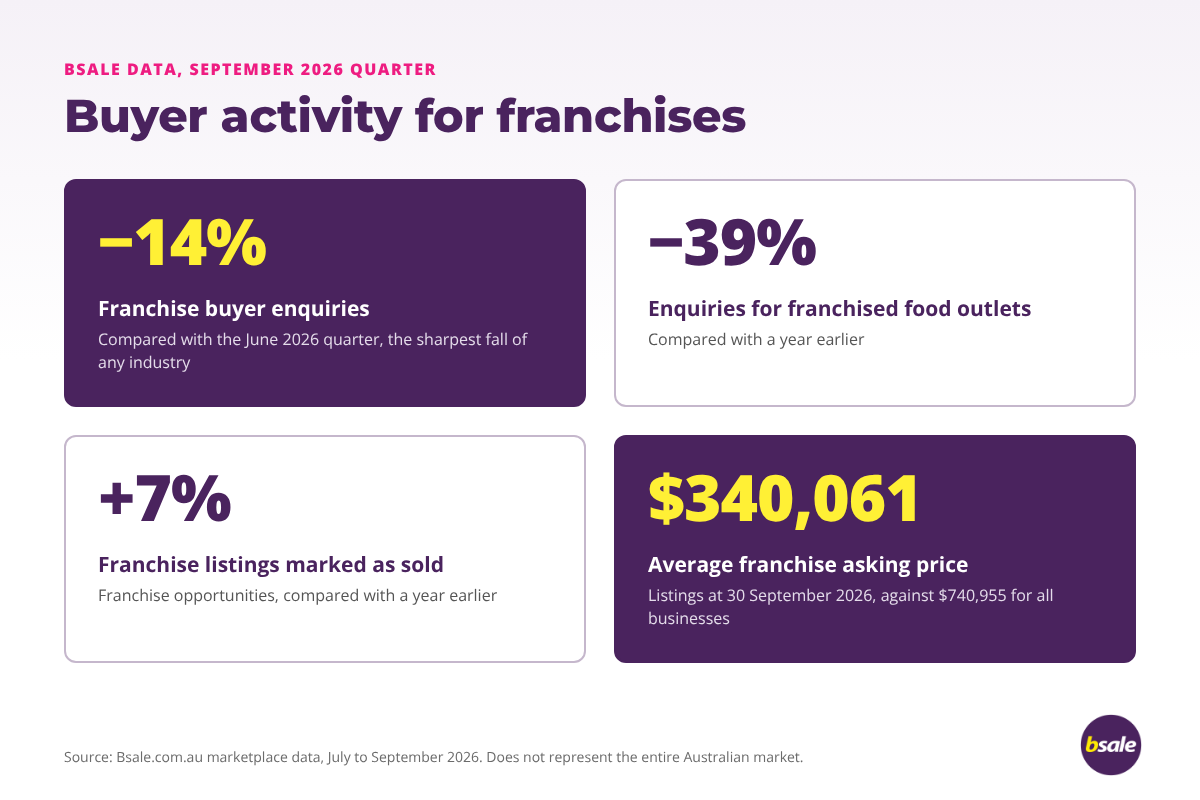
Source: Bsale marketplace data, September 2026 quarter. Franchise figures cover franchise listings of all types across Australia.
Franchise Fees and Operating Expenses
Franchises carry the normal costs of any business, such as wages, rent, stock, utilities and insurance, plus fees paid to the franchisor. These vary between systems, so read the disclosure document and franchise agreement carefully.
- Initial costs. An initial franchise fee for a new franchise, or transfer, training and documentation fees for an existing one.
- Royalties. Ongoing fees, usually a percentage of sales or a fixed weekly amount.
- Marketing fund contributions. Many systems require franchisees to pay into a common fund. The Franchising Code sets rules for how these specific purpose funds are managed.
- Supplier arrangements. You may have to buy stock and equipment from nominated suppliers.
- Technology and system fees. Point of sale, ordering platforms and software may carry their own charges.
- Capital expenditure. Refurbishments, new equipment or rebranding required by the franchisor during the term.
Some fees can be deductible. Business.gov.au notes that training fees, loan interest and ongoing franchise fees are among the franchise payments that can be deducted from taxable income, so ask your accountant how this applies to you.
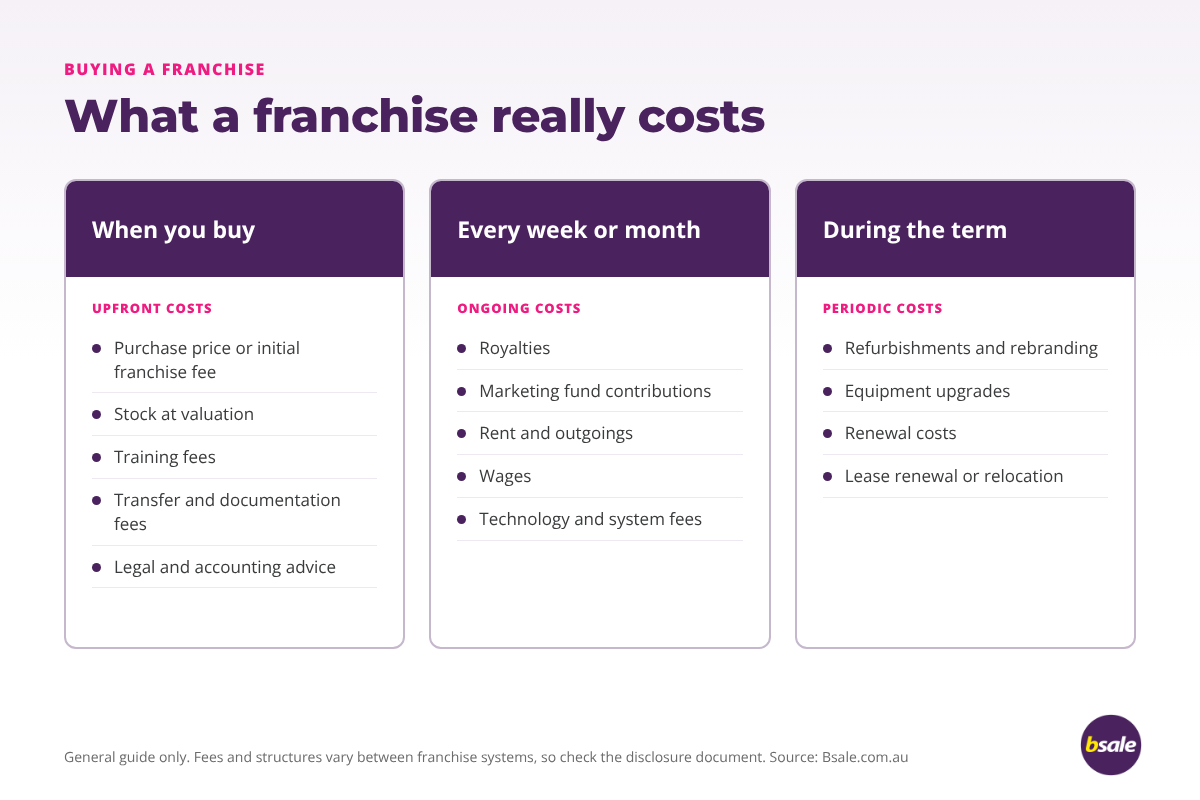
Image: The main costs of buying and running a franchise. Fees and structures vary between franchise systems.
Revenue and Profitability
Franchise revenue comes from selling the brand's products or services, whether over the counter, online, through delivery platforms or, for service franchises, through jobs booked in your territory. The franchisor's marketing and national brand recognition can bring customers in, but sales still depend heavily on location, local competition and how well the store is run.
Profit is what remains after royalties, marketing contributions, rent, wages, stock and every other expense. Two stores with the same turnover can produce very different profits if one pays higher rent or relies on paid managers. Compare weekly sales with what is left after all franchise fees and running costs, and ask for profit and loss statements and BAS rather than relying on turnover alone.
Be careful with owner earnings figures. Some listings quote EBITDA or a return to an owner operator, which may include the owner's own wage. Ask your accountant to separate the owner's wage from the business's return, so you can compare a store you would work in with one run under management.
The income you earn from a franchise is not guaranteed. The ACCC notes that it hears from many franchisees who expected much higher profits, which is why checking the basis of any earnings information is so important.
How Franchise Resales Are Valued
Existing franchises are generally valued on their adjusted earnings. Your accountant starts with the store's net profit, adds back items that will not continue under your ownership and adjusts for a fair wage for any work the owner does. The result is then weighed against the risks.
Franchise-specific factors have a large effect on value. The remaining term of the franchise agreement, the renewal terms, the lease, any upcoming refurbishment and the transfer costs all change what a buyer should pay. When a franchisee sells, what they are really selling is the right to operate under the brand, so the value of the business to a new buyer can fall as the remaining term shortens, according to the ACCC's guidance on selling or transferring a franchise agreement.
Avoid relying on a simple rule of thumb. Martin Lo Surdo, a business broker who previously worked in franchising helping franchisees exit their businesses, puts it this way. "A business with $200,000 in profit does not automatically have a $600,000 value, based on a 3 times multiple. Different businesses have different risk profiles, and therefore different required returns," he said.
The Franchising Code and Your Rights
Franchising in Australia is regulated by the mandatory Franchising Code of Conduct, which the ACCC enforces. A new code was introduced on 1 April 2025, with some rules applying from 1 November 2025. The changes cover the disclosure of significant capital expenditure, specific purpose funds, a reasonable opportunity to make a return on investment, compensation for early termination and restraint of trade clauses, according to the ACCC's franchising information.
The code sets out when franchisors must give prospective franchisees key documents, as explained in the ACCC's guide to information and document obligations.
- The information statement must be given within 7 days of you showing interest, before any other documents.
- The disclosure document, the franchise agreement and a copy of the code must be given at least 14 days before you enter into the franchise agreement.
- New franchise agreements have a 14-day cooling-off period.
When you buy an existing franchise, the seller must ask the franchisor in writing for consent to the transfer. A franchisor must not unreasonably withhold consent, and may refuse for reasons such as the buyer not meeting its selection criteria. A buyer of an existing franchise also has a cooling-off period. The Franchise Disclosure Register lets you look up information that franchisors publish, and the ACCC offers a free online course, Is franchising for me?, for prospective franchisees.
Risks and Red Flags
Franchising has its own risks alongside those of any small business. Look out for these warning signs.
- Earnings information you cannot verify. Projections or promises of quick returns that are not supported by actual store records.
- Unhappy franchisees. Current and former franchisees who report poor support, high costs or disputes with the franchisor.
- A short remaining term. Little time left on the franchise agreement, or a lease that ends at a different time.
- Required capital expenditure. A refurbishment or rebrand due soon after you buy.
- Supply restrictions. Compulsory suppliers whose prices reduce your margins.
- Franchisor stability. If a franchisor becomes insolvent, you may lose access to stock or the right to use the brand, business.gov.au warns.
- Territory overlap. Unclear territory boundaries, or other outlets of the same brand opening nearby.
Due Diligence for a Franchise
Due diligence for a franchise covers both the individual business and the franchise system behind it. Build a team with an accountant, a solicitor and a business adviser who have franchising experience. Bsale's guide to due diligence in a business sale covers the general process. For a franchise, ask for these records.
- The disclosure document, franchise agreement and information statement.
- Profit and loss statements, BAS, tax returns and bank statements for the store, for at least two to three years for an existing franchise.
- Point of sale reports and sales by channel.
- A full schedule of franchise fees, marketing fund contributions and supplier pricing.
- The lease, including term, options, rent reviews and how it aligns with the franchise agreement.
- Details of any required refurbishment or capital expenditure.
- Payroll records, staff contracts and rosters.
- Contact details for current and former franchisees, which must be included in the disclosure document.
Speak to as many current and former franchisees as you can. Ask about support, costs, territory, how the franchisor handles disputes and whether they would buy into the system again.

Image: Five areas buyers should review before signing a franchise agreement.
10 Steps to Buying a Franchise
The process follows the same order as Bsale's guide to buying a business in Australia, with the franchise details added at each step.
- Decide what type of franchise suits you. Consider the industry, the hours, whether you will work in the business and whether you are comfortable following a set system.
- Know your buying capacity. Talk to a finance broker early. Some franchisors have preferred lenders who understand their system. Budget for fees, stock, the lease bond and working capital.
- Search for opportunities. Compare new and existing franchises by brand, location and price, and talk to brokers who sell franchises through the Bsale broker directory.
- Enquire and sign a confidentiality agreement. Expect to receive the information statement early, and to be assessed by the franchisor as well as the seller.
- Review the information memorandum and disclosure document. Look at sales, costs, fees, the term remaining and required capital expenditure.
- Make an offer. Make it conditional on due diligence, finance, franchisor approval and lease assignment.
- Complete due diligence. Verify the store's figures, review the franchise agreement with a franchise lawyer and speak with other franchisees.
- Secure your finance. Lenders will want the store's financial records, a business plan and cash flow forecasts that include all franchise fees.
- Negotiate and finalise the contract. Confirm the transfer or new franchise agreement, training, transfer fees, stock valuation, staff entitlements and handover.
- Settle and take over. Complete the franchisor's training, and use the cooling-off period and handover to confirm everything matches what you were told.
Selling a Franchise
If you own a franchise and are thinking about selling, start by reading the transfer and exit provisions in your franchise agreement. You will need the franchisor's written consent to sell, and the franchisor may require conditions such as an assignment fee or fixing defects at the premises. Under the code, if the franchisor has not refused consent in writing within 42 days of your request, or of receiving the last piece of information it asked for, consent is taken to be given.
Buyers will look closely at the time left on your franchise agreement and lease, so consider your timing carefully. Have clean financial records, a clear schedule of franchise costs and details of any upcoming refurbishment ready before you list. Bsale's guide on how to sell a business in Australia explains the full selling process.
Ready to Compare Franchises?
A franchise can be a practical way into business ownership, but the fees, rules and terms make the details more important than the brand name. Read every document, verify the figures, speak to other franchisees and get independent legal and financial advice before you sign. To research brands and their systems before you enquire, browse the Bsale franchise directory.
Disclaimer: This article provides general information only and does not constitute financial or legal advice. Listing information is supplied by advertisers and has not been independently verified by Bsale. Market figures reflect Bsale marketplace activity and do not represent the entire Australian business sales market. Asking prices are advertised prices, not confirmed sale prices, and listings marked as sold do not necessarily represent completed transactions. Buyers should conduct their own due diligence and obtain independent professional advice before purchasing a business.
Originally published: 4 February 2020
Updated: 30 October 2026
About the author

Catherine Mangana
Customer Support
Catherine enjoys generating articles that highlight some of the opportunities that are now available for purchase on Bsale. She hails from a family of ...


