What a Week of New Listings Tells Us About the Business Market Right Now

What a Week of New Listings Tells Us About the Business Market Right Now
Every week, hundreds of new businesses come onto the market across Australia.
Look at them one at a time and you see individual opportunities. Look at them together and patterns start to appear.
We took every business listed on Bsale between 12 and 19 October 2026 and looked at what they had in common; what's being sold, where, and for how much.
Where a franchise network listed the same opportunity across many locations, we've counted it only once, so the figures reflect the variety of businesses on offer rather than the volume of repeat listings.
Some of it was expected.
Cafes are still everywhere. But a few trends stood out, from a cluster of regional fuel stations to a strong showing from manufacturers, and they say a lot about where buyers can find opportunities right now.
The Week in Numbers
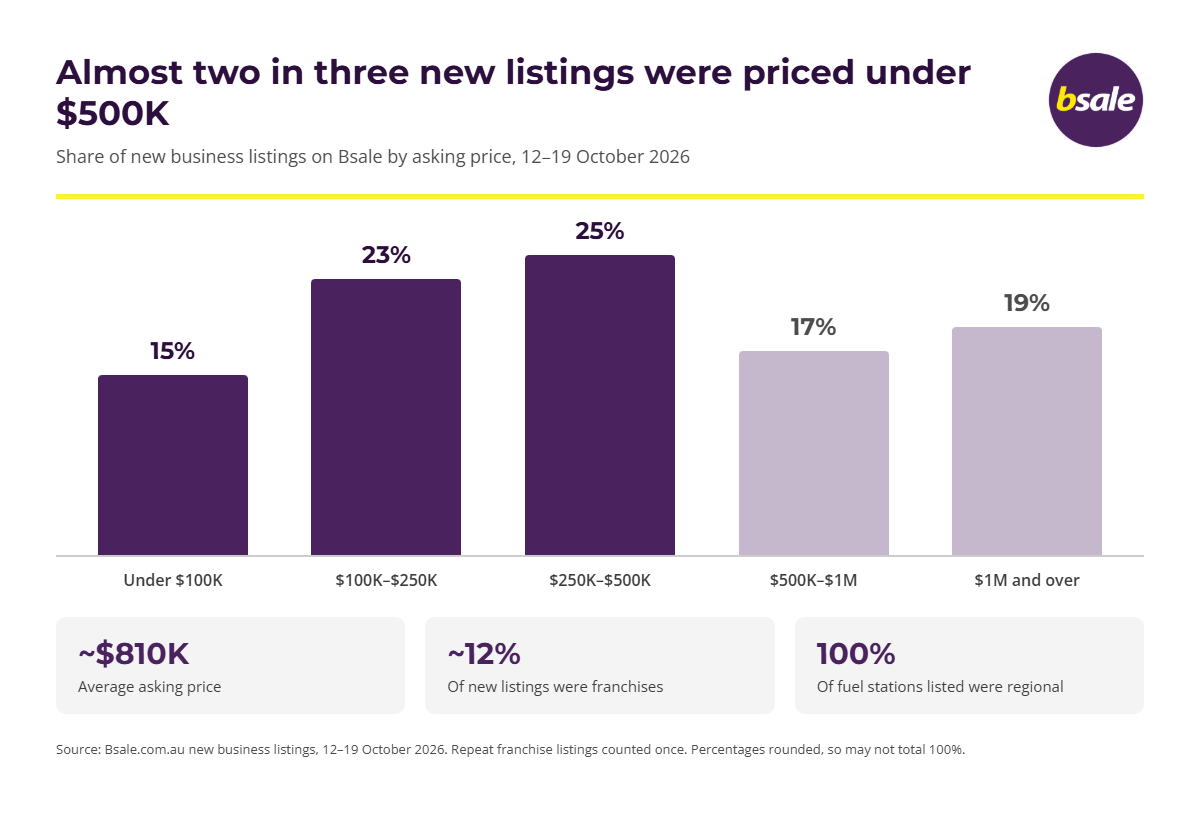
Around 95% of new listings showed a clear asking price, with the rest priced on application or by expressions of interest. The average asking price was around $810,000, lifted by a small number of high-value listings, while almost two in three were priced under $500,000.
- Around 15% were priced under $100,000
- Around 23% sat between $100,000 and $250,000
- Around a quarter sat between $250,000 and $500,000, the busiest band
- Around 17% sat between $500,000 and $1 million
- Around 19% were priced at $1 million or more
At the top end, a small number of listings were priced above $10 million.
1. Franchises Offered a Lower Entry Point
Once repeat listings are counted only once, franchise opportunities made up around 12% of new listings. They covered a broad spread of sectors, from bakeries, cafes and ice cream to tutoring, business coaching, marketing, freight, cleaning, vending and in-home care.
Many were new sites or territories rather than established businesses. That usually means a proven brand, structured training and ongoing support, but no trading history of their own to review. It also tends to mean a lower entry point: the average asking price for franchise listings was around $385,000, compared with around $855,000 for independent businesses.
For buyers, the real question is whether they're paying for an existing income stream or for a system to build one. Both have merit, but they call for different due diligence. An established business is judged largely on its financials, while a new territory is judged on the franchisor, the fees, the territory and the support behind it.
2. Cafes and Quick Food Still Lead the Independents
Among independent businesses, food remains the biggest single category, making up around three in ten listings across cafes, restaurants and bars, and takeaway shops.
The steady supply reflects how hospitality works. Food businesses are accessible to buy into but demanding to run, so ownership changes often, whether owners are moving on, retiring or simply ready for a different pace. That turnover gives buyers plenty to compare, and it also means prices vary widely. A small chattel sale and a high-turnover, fully staffed venue can both sit under "cafe," with very different price tags and very different workloads.
The details that matter most here tend to be the lease, the rent relative to turnover and the trading hours. Several listings this week leaned on limited trading hours as a selling point, a sign of how many buyers are now weighing lifestyle alongside income.
3. Regional Fuel Stations Came to Market
Every petrol station and truck stop listed this week was in regional Australia, with asking prices ranging from a few hundred thousand dollars to well over $2 million.
Regional fuel sites often do much more than sell fuel. Many combine a convenience store, food and, in some cases, truck facilities, serving both locals and passing highway traffic. That mix can make them steady businesses, but it also makes them more complex to assess than the asking price alone suggests.
One distinction is especially important, whether a site is independent or a branded commission site.
Independent operators generally set their own prices and keep the fuel margin, while commission sites are supplied by the brand and earn a commission on fuel sales, with much of their income coming from the shop. Two sites with similar asking prices can have very different earning potential, so buyers should understand which model they're looking at before comparing them.
4. Fitness Is Getting More Specialised
Gyms and fitness studios came to market in a wide range of formats, and the mix shows how the industry has split. At one end are large 24/7 gyms built on memberships and round-the-clock access. At the other are boutique studios focused on a single discipline, such as Pilates or functional training, with smaller spaces and class-based pricing.
The two models suit different buyers. Larger gyms tend to involve significant equipment, bigger leases and a membership base that drives most of the value. Boutique studios are often cheaper to enter but rely more heavily on instructors, class schedules and a sense of community.
In both cases, membership numbers, churn and the share of revenue that's recurring are the figures that tell the real story.
5. Manufacturers and Fabricators Were Out in Force
Manufacturing and fabrication businesses made up around 6% of independent listings, and most sell to trade and commercial customers rather than the public. Joinery, cabinetry, windows and doors, steel, stone and specialised fabrication were all represented, alongside smaller niche manufacturers.
These businesses are typically priced higher than retail or hospitality, reflecting the plant, equipment and skilled teams they depend on. Many are closely tied to the building and construction cycle, so order books and customer concentration deserve careful attention. They also tend to be built on long-standing trade relationships, which makes the handover period, and who holds those relationships, particularly important.
6. Health, Care and Education Made a Strong Showing
Health, care and education businesses featured strongly this week, from medical practices and allied health to NDIS and in-home care providers, childcare centres, training organisations and tutoring franchises.
What these sectors share is demand that isn't tied to the economic cycle in the same way as hospitality or retail. People still need medical care, support services and childcare whatever the conditions.
The trade-off is regulation.
Many of these businesses depend on registrations, licences, accreditations or funding arrangements, so buyers need to understand what transfers with the sale, what has to be applied for again, and how much of the income relies on government funding.
What This Week Tells Buyers
Taken together, this week's listings point to a market with plenty of choice at the accessible end, with almost two in three businesses priced under $500,000, and strong variety across hospitality, trades, fitness, health and regional businesses.
For buyers, the key is knowing what kind of opportunity you're looking at. A new franchise territory, an established independent cafe and a regional business with freehold can sit at similar price points, but they carry very different risks, levels of support and trading histories.
Explore more businesses for sale across Australia on Bsale, or register for alerts to be notified when new listings match your search.
Disclaimer: Statistics are based on Bsale.com.au marketplace data and do not represent the entire Australian business sales market. Listing information is supplied by advertisers and is not independently verified by Bsale. Data may contain errors, duplicates or outdated information. Listings and asking prices may not be directly comparable, including those advertised as WIWO, plus SAV or including freehold property. Asking prices are not confirmed sale prices, and listings marked as sold do not verify completed transactions. Figures are indicative only. This article is general information, not professional advice. Readers should conduct independent due diligence before making business or investment decisions.
Tags: listicle market insights
About the author

Catherine Mangana
Customer Support
Catherine enjoys generating articles that highlight some of the opportunities that are now available for purchase on Bsale. She hails from a family of ...


