What You Need to Know Before Buying a Hotel in Australia

What You Need to Know Before Buying a Hotel in Australia
In Australia, buying a hotel can mean many different things. It might be a country pub with rooms upstairs, a suburban hotel with a bistro and bottle shop, a hotel-motel on a highway, or an accommodation hotel in a tourist town. Each one brings together hospitality, liquor licensing, property and staff, and often gaming and accommodation as well.
The hotels for sale on Bsale range from leasehold country hotels to freehold properties with accommodation, tavern complexes and short-term accommodation businesses. This guide explains how hotels make money, how they are sold, and what to check before you buy one.
Buyer demand in the sector has been steadier than in the wider market. According to Bsale's September 2026 quarter market report, enquiries across all businesses for sale rose 28% year on year, while enquiries for pubs fell 12% and Accommodation and Tourism was one of only two industries to record fewer enquiries than a year earlier. For buyers ready to act, that can mean fewer competing enquiries than in faster-moving categories.

What a hotel becomes depends heavily on who runs it. Phil Mammolito of CRE Brokers, who owned and operated hotels and motels before selling them, has seen venues grow many times over in the right hands. “There’s no such thing as a bad pub really,” he said. “It’s all about the management.”
How Hotels Make Money
Most hotels earn income from several sources, and the mix shapes how the business runs and what it is worth. Common revenue streams include:
- the bar, often the core of a licensed hotel's trade
- the bistro or kitchen, run in-house or leased to an operator
- accommodation, from a few rooms upstairs to a full motel wing
- a bottle shop operating under the hotel's licence
- gaming machines and TAB, where the state and licence allow
- functions, events, live music and community groups
Each stream carries different margins, staffing needs and regulation. A hotel that relies heavily on one stream is exposed if that stream weakens, while one with several can be more complex to manage. For more on pub-focused hotels, read Bsale's guide to buying a pub in Australia.

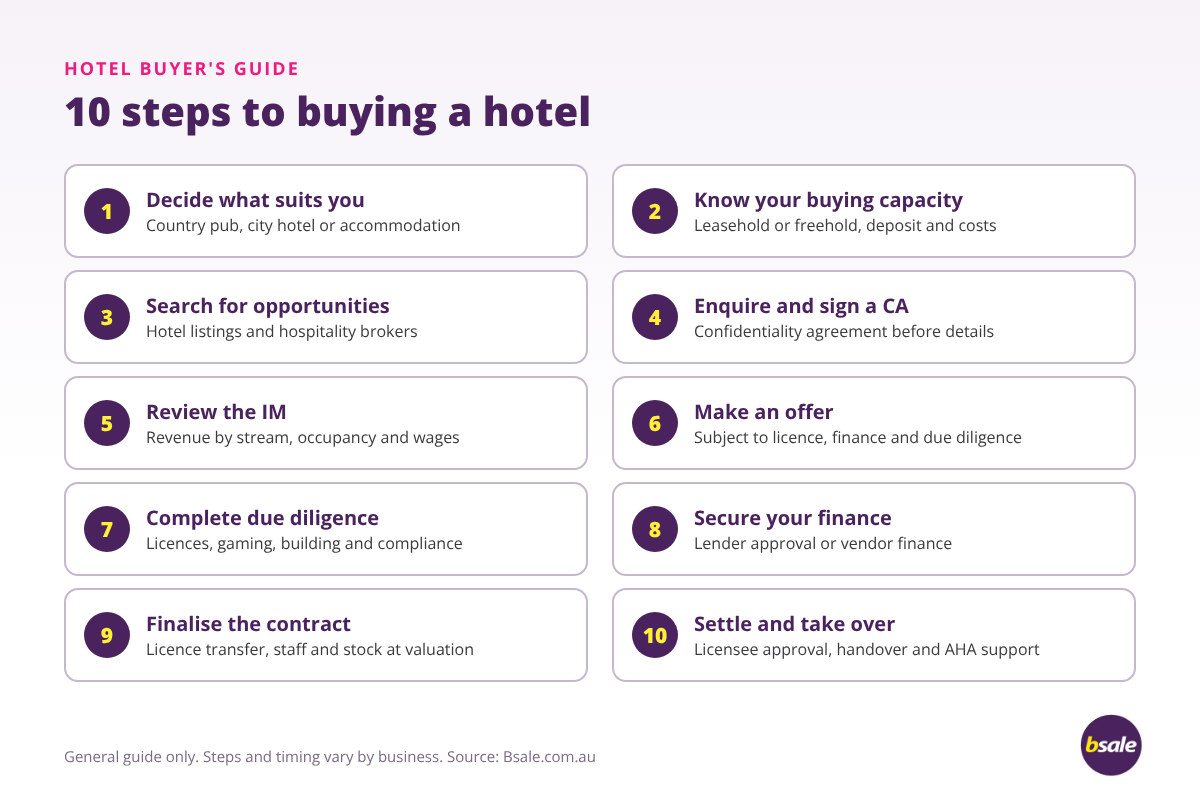
1. Decide What Type of Hotel Suits You
Start by deciding what kind of hotel you want to run. A country hotel is often the social centre of its town and may need a hands-on publican. A metropolitan hotel may rely more on food, functions and gaming. A hotel-motel or accommodation hotel depends more on room bookings, tourism and travellers. If accommodation is your main interest, Bsale's guide to buying a motel covers motels in more detail.
Think about the hours involved. Hotels often trade seven days, late into the night and through public holidays. Consider whether you plan to live on site, as many country hotels include owner's accommodation.
2. Know Your Buying Capacity
Hotels are sold in three main ways, and the structure has a large effect on the price.
- Leasehold means you buy the business, licence and usually the equipment, and pay rent to the owner of the building.
- Freehold only means you buy the property with an operator in place as the tenant.
- Freehold going concern means you buy both the business and the property together.
Freehold going concern sales usually require far more capital, while leasehold sales put more weight on the lease. Beyond the purchase price, budget for legal and accounting costs, stock at valuation, licence transfer fees, any stamp duty that applies in your state, and working capital. The sale of a going concern can be GST-free if certain conditions are met, so ask your accountant how the ATO's rules apply to your purchase.
3. Search for Opportunities
Search hotels for sale on Bsale, or widen your search to pubs and accommodation and tourism businesses. For examples of what is available, see Bsale's roundup of 10 hotels and accommodation businesses for sale worth a look.
Talk to business brokers who specialise in hospitality. Many hotels are sold through specialist brokers, who know which hotels may be coming to market, what buyers are paying attention to and how hotel sales are usually structured. Let them know what you are looking for and your budget, so they can contact you when something suitable comes up. You can find hospitality brokers through Bsale's business broker directory.
Rohan Pertzel of CRE Brokers, who owned and ran hotels for around 20 years before broking them, handles everything from metropolitan hotels worth millions to small country leaseholds. “We’re the bridge between the bloke that wants to buy the pub and the bloke that wants to sell the pub,” he said. “We’re hopefully guiding them in the right direction to make it as easy as we can.”
Compare listings carefully. A leasehold price and a freehold price are not directly comparable, and some prices include stock, gaming or accommodation while others do not.

4. Enquire and Sign a Confidentiality Agreement
Most sellers and brokers will ask you to sign a confidentiality agreement before sharing the hotel's name, financials and other details. Hotels are often well known in their communities, so sellers can be particularly careful about confidentiality to protect staff and regular customers.
Where a broker is handling the sale, they will usually manage enquiries, arrange inspections and pass on your questions to the seller. The broker is normally engaged and paid by the seller, so their role is to represent the seller's interests. A good broker will still be a useful source of information, but your own accountant and solicitor are the people who act for you.
5. Review the Information Memorandum
The information memorandum should show how the hotel trades. For a hotel, look for:
- revenue broken down by bar, food, bottle shop, gaming, accommodation and functions
- gross margins on beverages and food
- wages as a share of revenue, and how the hotel is staffed across the week
- for accommodation, occupancy rates, average room rates and revenue per available room
- how bookings are made, including any reliance on online booking platforms
- seasonal patterns and the effect of local events, tourism and trade
6. Make an Offer
Once you are interested, make a written offer. Where a broker is involved, the offer usually goes through them, and they will present it to the seller and manage the negotiation. Make the offer conditional on finance, satisfactory due diligence, the landlord's consent to assign the lease where it is a leasehold sale, and approval of you as the licensee. Bsale's article on the difference between a business appraisal and a business valuation explains how value is assessed.
7. Complete Due Diligence
The period after an offer is accepted is where much of the work happens. Kevin Connolly, who has spent more than four decades selling hotels, motels and caravan parks at CRE Brokers, sees it as the stage where experience counts. “Once you’ve got an accepted offer, the broker usually needs to guide both parties through the due diligence period,” he said. “Being able to provide sound advice to buyers and sellers comes from experience.”
Hotel due diligence covers the business, the licences and the building. Work through:
- financial statements, tax returns, BAS and point-of-sale reports, compared with what the seller has presented
- the liquor licence, its conditions and trading hours, and any history of breaches
- gaming machines and entitlements, how they are held and whether they transfer, as this varies between states
- the lease, including term, options, rent reviews and who is responsible for repairs and capital works
- the building's condition, fire safety and other compliance, particularly for older hotels and accommodation
- kitchen equipment, cool rooms, beer systems and accommodation fit-out
- employment records, awards and staff entitlements
- supplier agreements and any arrangements with breweries or other suppliers
Licensing and gaming rules are set by each state and territory, so get advice from someone who knows the rules where the hotel is located. The Australian Business Licence and Information Service lets you check licence requirements for a particular location. Bsale's guide to due diligence in a business sale explains the process in more detail.
8. Secure Your Finance
Lenders will usually want to see a reliable trading history, licence details and, for a freehold purchase, information about the property. Freehold going concern purchases can involve both business and property lending. Some sellers offer vendor finance, which can help bridge part of the purchase price. Bsale's article on vendor finance and buy-out options explains how these arrangements work.
9. Negotiate and Finalise the Contract
Your solicitor should review the sale contract before you sign or pay a deposit. Make sure it covers the assets and stock included in the price, how stock will be valued at settlement, conditions for licence approval and finance, the handover period, and how staff entitlements will be dealt with if employees transfer to you. The Fair Work Ombudsman provides information on awards, pay rates and employer obligations for hospitality businesses.
10. Settle and Take Over
At settlement, the balance is paid, the lease or property transfers, and the business passes to you. Make sure the liquor licence and any gaming approvals are in your name or your approved manager's name before you trade. Work through the handover with the seller, including introductions to staff, suppliers, booking platforms and regular customers.
Industry support is available once you take over. The Australian Hotels Association represents more than 5,000 businesses, from country pubs to five-star resorts, through branches in every state and territory. State branches such as AHA NSW offer members services including legal and industrial affairs advice and support on liquor and policing matters.
Ready to Start?
Start by deciding what kind of hotel you want to run and whether you want leasehold or freehold, then compare listings against those criteria. If you would rather not work in the business full time, read Bsale's guide to buying a business under management.
Browse hotels for sale in Australia on Bsale
This article provides general information only and is not legal, financial or professional advice. Requirements may vary depending on the business, industry and location. Buyers should conduct independent due diligence and obtain professional advice relevant to their circumstances. Market statistics relate to Bsale marketplace activity in the September 2026 quarter and do not represent the entire Australian business sales market. Asking prices are advertised prices only and are not confirmed sale prices.
Originally published: 2016
Updated: 23 November 2026
Tags: hotel hospitality guide
About the author

Catherine Mangana
Customer Support
Catherine enjoys generating articles that highlight some of the opportunities that are now available for purchase on Bsale. She hails from a family of ...


