Why Western Australia is Still One of the Strongest Markets to Buy a Business in 2026
Why Western Australia is Still One of the Strongest Markets to Buy a Business in 2026
Western Australia continues to stand out as one of the most resilient and opportunity-driven business markets in Australia.
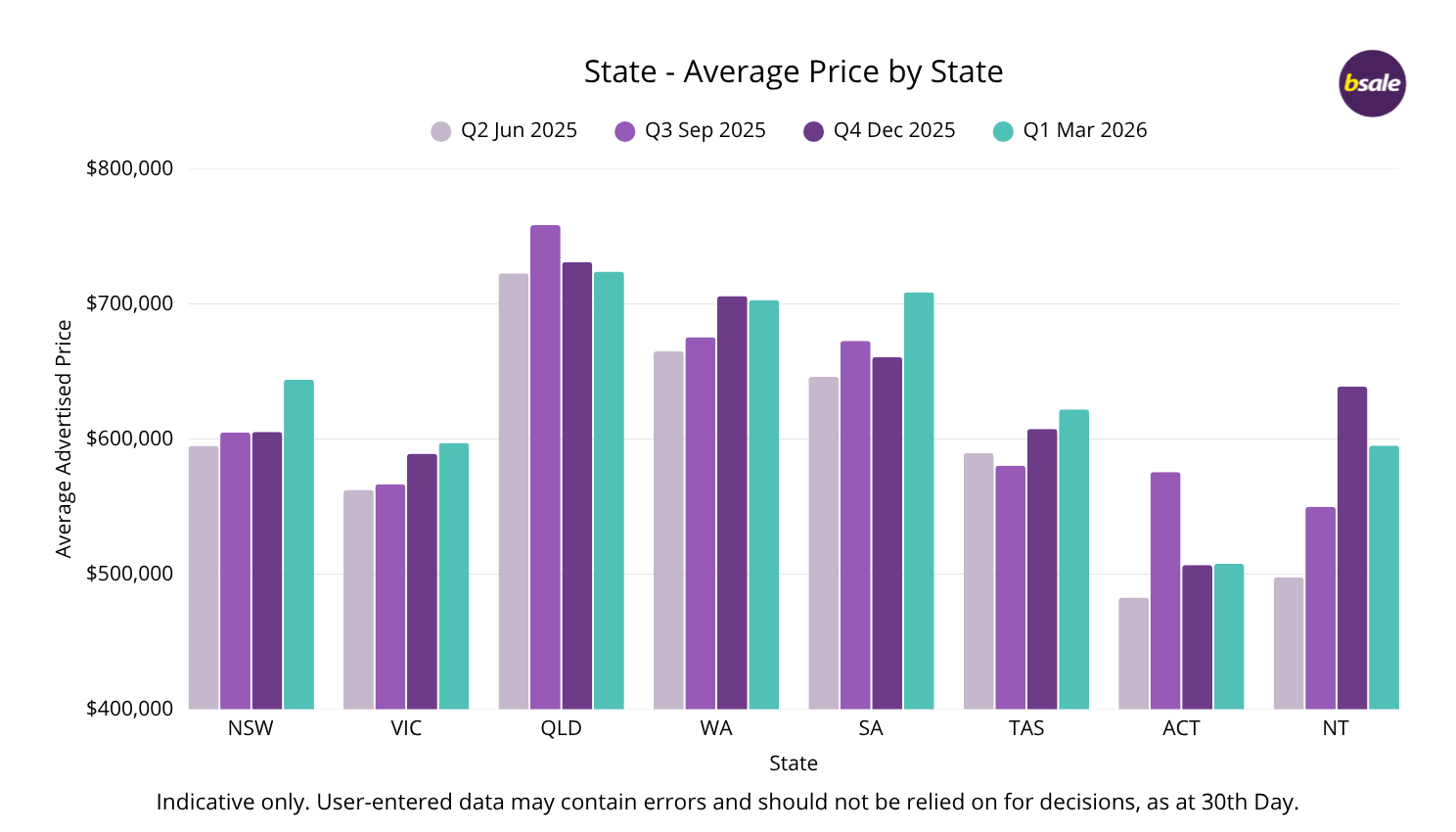
According to Bsale’s Q1 2026 Market Insights, there are 1,897 businesses for sale in WA with a combined value of $1.33 billion. The average asking price sits at $702,801, placing Western Australia third nationally and above the national average of $673,124.
But the story in Western Australia is not just about pricing or volume. It is about consistency, and increasingly, about quality.
“The business sales market here is fairly consistent,” said Rajiv Rajan. “We’re still working on the backdrop of a robust but moderating state economy.”
That sense of balance is echoed across the state. While some markets nationally have experienced sharper shifts, Western Australia has settled into a more measured pace, supported by population growth, infrastructure investment and the continued strength of the resources sector.
For buyers, that stability is a key part of the appeal. But it is not the only factor shaping the market.
Growth, Migration and a Changing Buyer Pool
Western Australia’s population growth continues to reshape both demand and the type of buyers entering the market.
The state is currently the fastest growing in Australia, with population growth of around 2.2% over the past year, pushing the total population beyond 3 million. This growth is being driven largely by migration, both from overseas and interstate, as workers are drawn to employment opportunities across mining, construction, healthcare and infrastructure.
“Ever since COVID, there’s been a huge upswing in people moving to the state,” said Jonathon Parker, who has been “flat out” managing increased deal activity.
This migration is not just adding numbers. It is bringing capital, experience and a different mindset to business ownership.
Rajiv has seen this play out through real transactions. Buyers from the eastern states are selling property at significantly higher prices and relocating west, often purchasing both a home and a business outright.
“He moved to Serpentine… bought himself a business, escaped corporate life, and paid off his house,” Rajiv explained of one recent buyer.
But the decision is not always straightforward.
“The basic salary might be $90,000 a year, and with overtime they can get another 30 or 40 per cent on top… They look at that and think, ‘Why take on the responsibility of a commercial lease, staff, and everything else?’” Rajiv said, referring to the broader decision-making process between employment and ownership.
That tension is becoming a defining feature of the WA market. On one hand, population growth is expanding the buyer pool. On the other, strong wages, particularly in mining and government roles, are raising the benchmark for what makes a business acquisition worthwhile.
At the same time, Bowen Li points to the strength of the broader economic environment supporting that demand.
“I believe we do have a very, very strong economy at this moment,” he said, noting the combination of population growth, mining activity and ongoing demand for local businesses.
This is translating into a more sophisticated buyer base. Many are not first-time operators, but experienced professionals or business owners looking to transition into more flexible, lifestyle-driven ventures, or scale existing operations.
For the market overall, the impact is clear. Population growth is no longer just increasing demand for businesses, it is changing the expectations, financial capacity and decision-making behaviour of the buyers themselves.
High Value Regional Western Australia
While Perth remains the centre of listing activity, some of the most interesting developments are happening outside the metropolitan area.
For Nigel Gill, whose work focuses on larger transactions, this shift reflects the depth of opportunity within Western Australia’s resource-driven economy.
“The interesting part is I could just stay in this space, and there’s plenty to do… There are literally hundreds of niche categories… many of them are quite massive in their own right,” he said.
By focusing on mining services, engineering, and specialised industries, Nigel operates in a segment where scale, capital investment and long-term demand support higher valuations. Rather than competing in smaller, high-volume markets, his work sits within industries where fewer businesses exist, but those that do often operate at significant size.
That dynamic is increasingly visible across regional Western Australia.
According to Bsale Market Insights, the Perth region currently has 1,509 businesses for sale with a combined advertised value of $1.03 billion, representing the majority of listings across the state. The average asking price sits at $681,664, slightly below the state average of $702,801, reflecting the composition of the metropolitan market, which is largely made up of small to mid-sized businesses across hospitality, retail and service-based industries.
Compared to regional Western Australia, where fewer listings often drive higher average prices, Perth offers a broader mix of opportunities across multiple price points, giving buyers greater choice and accessibility while maintaining a steady flow of new listings and enquiry.
“I’ve got quite a few clients now in places like Bunbury, Busselton, and Albany,” Rajiv said. “In all these areas, I see a marked increase in business.”
He added that “the businesses that I see in the regional areas are showing double-digit growth versus 2023 and 2024,” highlighting the strength of these markets.
This is reflected in the data. Several regional areas in Western Australia now rank among the highest in the country for average asking prices, with Broome and the Kimberley leading nationally.
According to Bsale Market Insights, the Broome and Kimberley region is currently averaging $1,615,625 across 12 listings, making it the highest-ranked region in Australia by average asking price. The Coral Coast and Mid West follows at $1,325,037 across 46 listings, while the Pilbara sits at $1,270,917, reinforcing the strength of resource-linked economies.
Even traditionally more lifestyle-driven regions are holding firm. Albany and the Southern region is averaging $628,557, while Bunbury and the South West, one of the more active regional markets with 201 listings, is averaging $612,486.
While Perth remains the centre of activity, many regional markets are commanding significantly higher valuations, driven by industry concentration, limited competition, and strong underlying demand.
For buyers, regional Western Australia offers access to larger, more established businesses tied to critical industries, where the opportunity lies not in volume, but in scale.
A Market That Rewards Strength, Not Just Entry
While Western Australia remains active, brokers consistently point to a shift in what buyers are looking for.
“The mum-and-dad buyers we used to see putting $100,000 or $200,000 into a cafe are much rarer now,” Rajiv said. “The demand is for businesses making $600,000 or $700,000 EBIT and above.”
This reflects a broader change in the market. Buyers are no longer simply looking to create a job for themselves. They are looking for businesses that offer returns, scalability and operational structure.
Catherine Screaigh sees this clearly in the types of enquiries coming through. “We are finding there is really strong demand from buyers for established businesses that have consistent profits and strong management teams,” she said.
At the same time, strong wages in the mining and resources sector are influencing buyer decisions. For some, employment offers a more predictable alternative to business ownership unless the opportunity is compelling.
This is where pricing, presentation and positioning become critical.
Harry Kalligeros has built his approach around that reality. “Honesty sells,” he said. “We go to market for a fair price and aim for a win-win.”
His experience highlights a key shift in the market. Buyers are still active, but they are more disciplined, and they expect transparency from the outset.
Growth Through Expansion, Not Just First-Time Buyers
Another trend emerging in Western Australia is the rise of experienced buyers expanding their operations.
“I’m seeing clients establishing their third or fourth outlet,” Jonathon said.
Rather than entering new industries, many buyers are scaling within sectors they already understand, building multi-site businesses and leveraging existing systems.
This shift is changing the competitive landscape. When the right business comes to market, particularly in sectors with strong cashflow, competition can be intense.
“We had five competing offers,” Jonathon said of one recent transaction. “I’d never seen that sort of competition for a business before.”
The final sale price significantly exceeded expectations, demonstrating the strength of demand for high-quality assets.
Succession is Creating a New Wave of Listings
While buyer demand remains strong, supply is increasingly being shaped by succession.
“The grandson is running the business now, and he’s in his 70s,” Rajiv said of one business. “But his children have no interest in going into retail. So the business is on the market for the first time in 100 years.”
Stories like this are becoming more common across Western Australia, as long-term owners begin to consider retirement.
Tony Romano sees this regularly in his work, often dealing with owners who have spent decades building their businesses.
“I was really determined to get a great outcome,” he said of one recent sale, reflecting the personal weight these transactions can carry. “It had that sort of human element.”
For many sellers, this is not just a financial decision. It is the culmination of years, sometimes decades, of work.

A Small Market Where Relationships Matter
Despite the scale of transactions taking place, Western Australia remains a relatively small and tightly connected broking market.
With around 30 AIBB business brokers, 27 active brokers on Bsale, and additional agents operating through commercial real estate networks, the total number of active brokers across the state is estimated to sit between 50 and 100.
In a market of this size, relationships and reputation play a central role.
Bowen Li believes accessibility is critical. “You have to be available most of the days of the week,” he said.
Jonathon Parker reinforces the importance of trust. “Act with your client’s best interests and never chase a quick sale,” he said.
For Catherine Screaigh, guiding clients through the process is just as important as the transaction itself. “We often say to our clients, ‘it’s a bit of a rollercoaster ride’,” she said.
These perspectives reflect an industry where technical expertise matters, but relationships ultimately drive outcomes.
WA is Market Defined by Quality
Western Australia’s business sales market is not slowing down. It is evolving.
Supported by population growth, infrastructure investment and the strength of the resources sector, the state continues to offer strong opportunities for both buyers and sellers.
But the nature of those opportunities has shifted.
Buyers are looking for stronger earnings, better systems and businesses that can operate beyond the owner. Sellers with well-prepared, profitable businesses are achieving strong outcomes. Others may find the process more challenging.
As Nigel Gill’s experience demonstrates, opportunity in Western Australia is not limited. But increasingly, it sits with those who understand the market, the sectors, and the level of quality now required to succeed.
----
Disclaimer: The information contained in this article is based on listing data published on Bsale and reflects asking prices and business listings at the time of reporting. As listings are user-generated, information may be incomplete, inaccurate, duplicated, amended, withdrawn, or sold prior to publication. Asking prices do not necessarily reflect final sale prices or business valuations. This article is provided for general information purposes only and should not be relied upon as financial, investment, business, legal, taxation, or professional advice. Readers should undertake their own independent research and seek appropriate professional advice before making any business or investment decisions.
Tags: western australia perth wa market insights
About the author
Vanessa Lovie-Yousaf
CEO Bsale Australia
Vanessa Lovie-Yousaf is the CEO and manager of Bsale.com.au, one of Australia’s most trusted business for sale marketplaces since 2000. With 15 ...


