Five Top Business Brokers Share the Lessons Behind Their Success
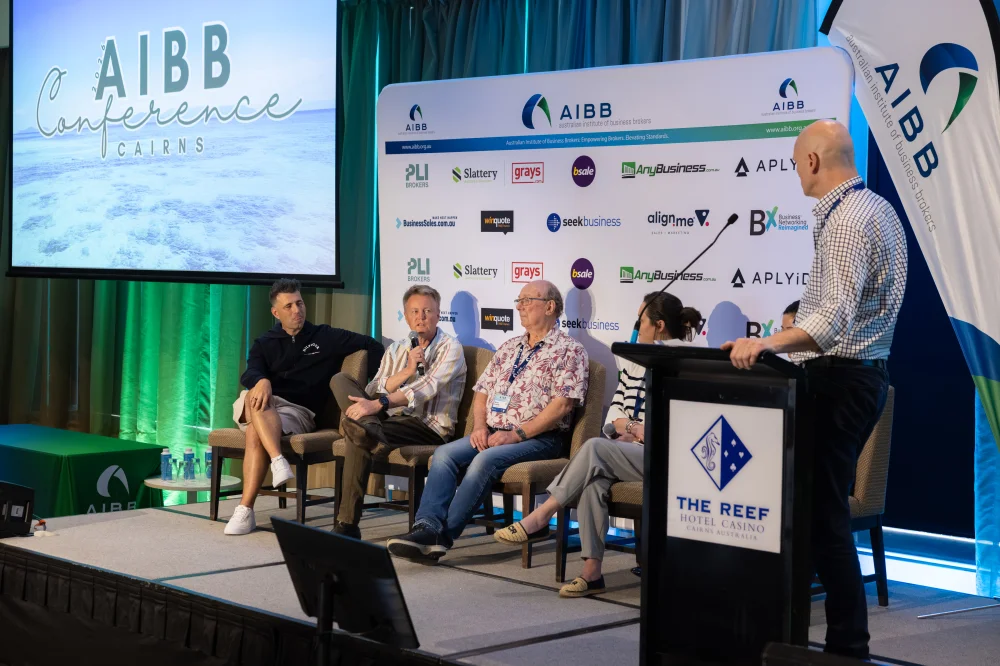
At the recent Australian Institute of Business Brokers (AIBB) National Conference in Cairns, five of the finalists for the 2026 National Business Broker of the Year Award came together to speak candidly about what it takes to build a successful career in business broking.
John Kasapi, Brad Potter, Brian Sander, Jennifer Angsiting and Sabrina Xia took part in a wide-ranging panel discussion hosted by AIBB National Chair Simon Bedard.
It was an accomplished group, with significant AIBB recognition already behind them. Kasapi was named the 2026 AIBB National Business Broker of the Year, while Potter is a two-time former winner of the national title. Sander has also received multiple AIBB awards recognising his contribution to education, training and the wider profession. Angsiting has twice been named the AIBB Emerging Talent Award winner, while Xia has been a National Business Broker of the Year finalist multiple times.
The conversation went behind the deals into the difficult first years, failed transactions, prospecting, referrals, mentors, financial pressure and the resilience it takes.

Image: John Kasapi, Brad Potter, Brian Sanders, Jennifer Angsiting, Sabrina Xia, Simon Bedard
There is no single path into business broking
One of the most revealing parts of the discussion was hearing how different the finalists’ first years looked.
Brad Potter came into business broking with an established network from his previous career in finance for medical professionals. He already knew many of the people operating in the sector he would eventually specialise in.
“I was pretty fortunate,” Potter said. “Being in a good niche, everyone already knew who I was, I was just wearing a different hat.”
John Kasapi started from the opposite position.
“I started from zero... set up an Excel sheet, put one name down, and just started calling.”
Kasapi recalled completing only around two deals in his first year while continuing to work another job on weekends.
Sabrina Xia went all in from the beginning, but said the financial pressure was very real.
“I was 100% focus, all in, full time,” she said.
Even after securing six or seven listings in her first year, she said the uncertainty remained difficult and warned new brokers to be prepared for the financial pressure that comes with the profession.
Jennifer Angsiting faced a different challenge again.
After completing the required licensing, she found herself technically qualified but unsure how to actually operate as a business broker.
“I did my license, got my registration, and still knew nothing about it,” she said, crediting much of her early education to the AIBB.
There was no single formula for getting started, only a willingness to keep learning, keep building relationships and find an approach that suited the individual broker.
You need something to sell
When the panel was asked what a new broker should focus on in their first year, Brian Sander did not hesitate.
“Appraisals, appraisals, appraisals.”
His approach was very structured
"Two phone calls a day, one at morning coffee, one at afternoon coffee. That's 10 calls a week, 500 a year"
“It doesn’t matter how good a broker you are if you’ve got nothing to sell, you’ve got nothing to sell,” Sander said.
“Our lifeblood is listings, and you don’t get listings without doing the work.”
Kasapi encouraged newer brokers to learn their chosen industry, build their database and put good systems around themselves from the beginning.
Xia was equally direct.
“Listing, listing, listing,” she said. “It’s boring, but it’s the most important thing. Without a listing, you’ve got nothing to sell.”
Angsiting, however, offered an important alternative.
Cold calling and door knocking did not suit her, so she decided not to build her business that way. Instead, she gave herself a goal of becoming 100 per cent referral-based within 12 months.
“I think you have to find what works for you,” she said.
She spent her first six months developing relationships with accountants, lawyers, bookkeepers and other professionals who already worked with business owners.
Different methods, with the same objective to build a pipeline before you need it.

Image: John Kasapi, Brad Potter, Brian Sanders
Referrals are earned over time
Sander, now around four decades into his career, said he has not needed to cold-call or door-knock a vendor for roughly 20 years.
His business now comes largely from people he has dealt with in the past.
“It’s a referral business based on performance,” he said. “People have to know you’re honest, straightforward, and that you’ll do the job, and they’ll send people your way.”
Xia’s referral business took a very different route.
Early in her career, she would walk through Westfield shopping centres targeting franchise businesses, identify the owner, introduce herself and leave a business card.
There was no instant payoff.
It took around three years before people began calling her back.
But once she sold one business, word began travelling among other owners and referrals followed. She now specialises in childcare centres, with much of her work coming through referrals.
Angsiting deliberately built her business around the same principle from the beginning, stressing that she wanted genuine referrals rather than paid introductions.
Their experiences reinforced an important point, that the conversation you have today may not result in a listing for years.
“It’s never personal”
If referrals were about the long game, resilience was about surviving it.
Sander summed up rejection simply.
“More people knock us back than accept us,” he said. “I’ve always felt just the ability to never take it personal. From my point of view, it’s just.... next.”
Kasapi said some of his biggest lessons came through the deals he lost.
He recalled transactions falling apart at crucial moments, including one just before going away on holiday.
“It was an absolute disaster,” he said.
But the experience forced him to reflect on what he could do differently next time.
Potter, after 28 years in the industry, spoke about longevity, knowing your own value and learning when to hold your ground.
He also stressed the importance of continuing to show up at industry events, community functions and trade shows year after year.
“If you don’t, someone else comes in and takes your patch.”
Staying established still requires staying visible.

Image: Jennifer Angsiting, Sabrina Xia
When a deal falls over, what next?
An audience member eventually asked the question every broker could relate to, when you have taken a deal as far as you can and it still collapses, how do you get ready for the next one?
Xia’s response was characteristic.
“I try to never give up.”
Angsiting’s recovery process included a little more humour.
“First, it’s a bottle of red wine, and then I move on pretty quickly,” she said.
Sander takes a more analytical approach.
His first question is whether he could have done something differently.
“Was it my fault?”
If there is something to learn, he wants to identify it. If the answer is no, he moves on.
“People don’t always want to sell, or don’t always want to buy. Next.”
Potter was equally pragmatic.
“At the end of the day, the sun comes up tomorrow.”
He also offered another lesson that comes with experience, not every problem needs to be solved immediately.
Sometimes the better strategy is to park the issue, leave the angry email unsent and look at the situation again the following day.
Nobody gets there alone
For all the focus on individual performance, mentoring was another strong theme.
Sander credited mentors with helping shape his career, including the late Ron Jones, whom he described as the “godfather of business broking in South Australia”.
Kasapi was equally clear about the value of learning from someone who had already experienced the industry’s pitfalls.
“He’s gone through years of the pitfalls, and he’s told me about them, so I’ve avoided a lot and saved a heap of time,” he said of one of his mentors.
Angsiting’s experience was less about having one formal mentor and more about being willing to ask for help.
“I haven't been shy to ask for help,” she said.
Xia also recalled advice given to her early in her career by one of the AIBB’s founders, who challenged her to consider the difference between being an average broker and an extraordinary one.
The details differed, but the lesson was the same, experience can be earned through your own mistakes or accelerated by learning from people who have already made them.

Image: Brad Potter, Brian Sanders
Specialise, adapt and know your market
As the discussion shifted towards the changing industry, specialisation emerged strongly.
Xia began as a generalist but now believes having a clear niche gives brokers a clearer target market for both buyers and sellers.
Potter, who works heavily in healthcare, agreed.
“If you specialise, you know exactly where the sellers are and what businesses you’re selling.”
His depth in the sector has also changed the way he works with buyers. Rather than waiting until a listing arrives, Potter now spends more time understanding exactly what buyers want so he already knows who to approach when the right opportunity appears.
But adapting did not only mean specialising.
Kasapi is increasing his focus on branding, industry media and video content.
Potter is becoming more selective about the businesses and clients he takes on.
“The more selective I am, the more the phone rings,” he said.
Sander is exploring artificial intelligence, not because he expects it to replace brokers, but because he wants to understand how it can make the job easier.
Angsiting continues to invest in education and test new approaches.
The message was not to chase every new idea. It was to keep evolving without losing sight of the fundamentals.
The long game
Perhaps the strongest takeaway from the session was that there is no single formula for becoming a successful business broker.
One finalist started with an established professional network. Another started with an empty Excel spreadsheet.
One built a business through cold prospecting. Another deliberately chose not to cold-call at all.
Some specialised early. Others found their niche over time. Some stayed as generalised brokers.
The appraisal made today can become next year’s listing. The owner you meet today may call three years later. Today’s buyer may become tomorrow’s vendor. A failed deal becomes experience carried into the next one.
For five brokers recognised among the best in the country, there was surprisingly little talk of shortcuts.
Instead, their message was much simpler. Do the work, learn from the difficult deals, get a mentor, build relationships before you need them and, when something falls apart, keep going.
Tags: aibb aibb conference 2026 business broking business brokers
About the author
Vanessa Lovie-Yousaf
CEO Bsale Australia
Vanessa Lovie-Yousaf is the CEO and manager of Bsale.com.au, one of Australia’s most trusted business for sale marketplaces since 2000. With 15 ...


