How to Buy a Bakery Business in Australia

How to Buy a Bakery Business in Australia
Buying an established bakery offers a head start with an existing customer base, equipped premises, supplier relationships and a proven trading history. It provides a foundation to build on, whether through introducing new product lines, expanding wholesale supply or growing customer loyalty. Understanding production schedules, ingredient costs, staffing and profit margins can help buyers assess the business and identify opportunities for growth.
Bakeries also come in very different forms, from suburban hot bread shops and country pie shops to patisseries, bakery cafes, franchise outlets and wholesale production kitchens. You can compare them among the bakeries for sale on Bsale.
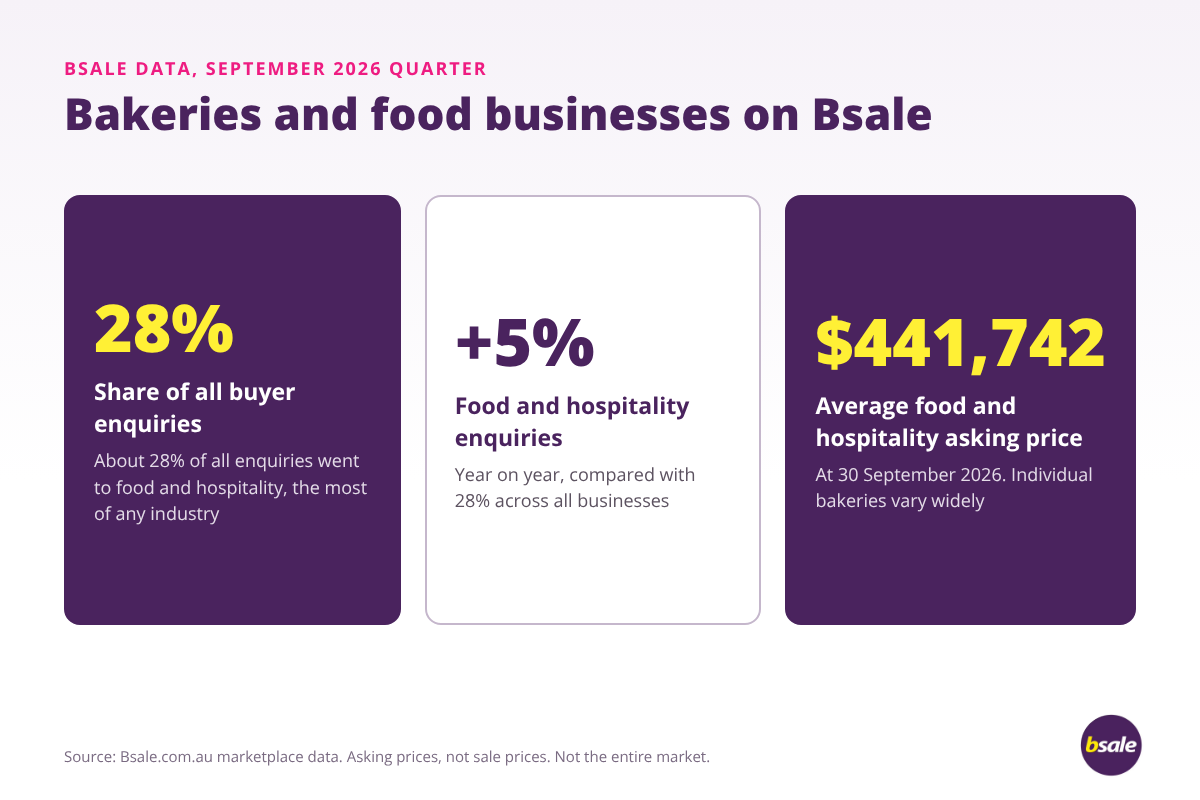
Food and hospitality was the most-enquired industry on Bsale in the September 2026 quarter, attracting about 28% of all buyer enquiries, according to Bsale's latest market report. Enquiries in the industry rose about 5% year on year, well below the 28% increase across all businesses on Bsale, and bakeries made up about 8% of food and hospitality listings marked as sold. The average advertised asking price for food and hospitality businesses was $441,742 at 30 September 2026. Bakeries are only part of that category, so treat the figure as context rather than a benchmark.
Strong sales are not the same as a healthy business. Olivia Casson of GSE Hospitality Brokers recalled a bakery cafe with “an incredibly successful top line. Beautifully presented, great social following. But barely breaking even.” Changes to the roster, the kitchen team and productivity turned it around before it went to market.
For buyers, the lesson is that turnover shows how busy a bakery is, not how much it earns. This guide explains how bakeries make and spend money, what affects their value and what to check before you buy one.
In this Guide
Types of Bakery Business
How Much Does It Cost to Buy a Bakery?
Where a Bakery's Revenue Comes From
Bakery Operating Expenses
Bakery Profit and the Owner's Role
How Bakeries Are Valued
Risks and Red Flags When Buying a Bakery
Bakery Due Diligence
Growing a Bakery's Revenue
10 Steps to Buying a Bakery
Thinking of Selling Your Bakery?
Types of Bakery Business
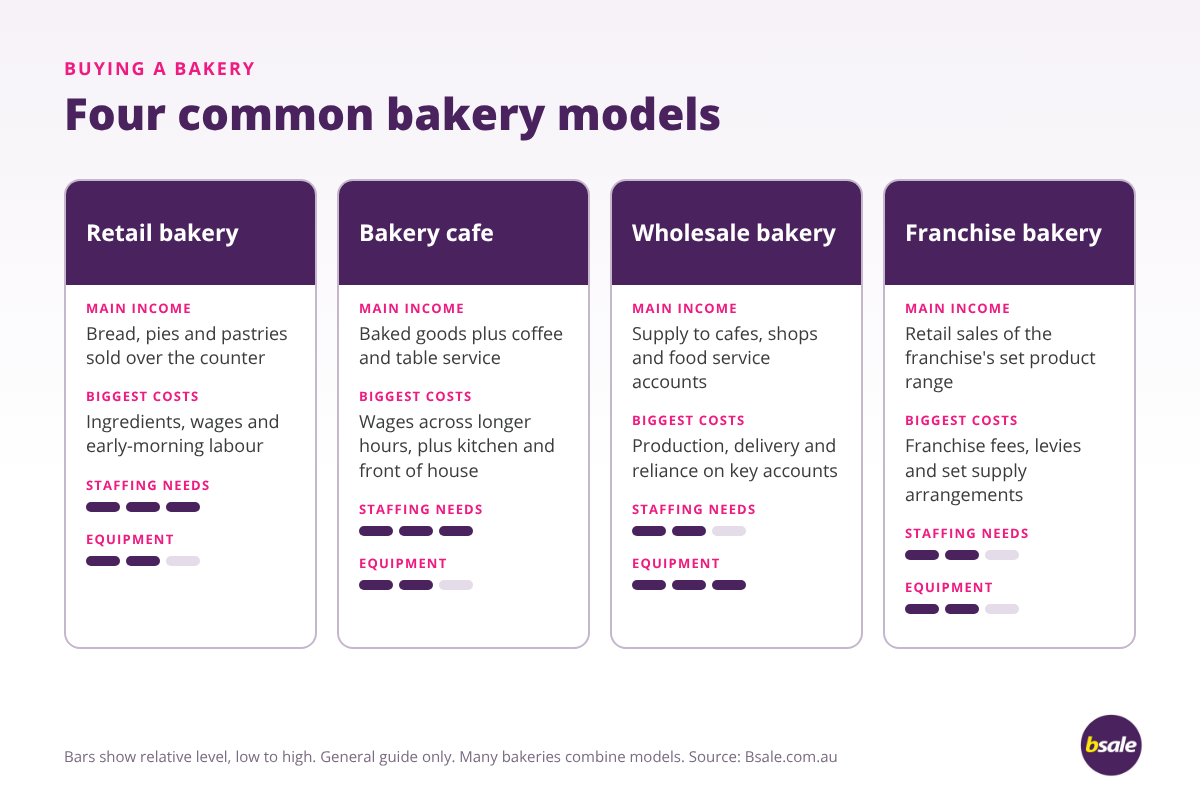
Most bakeries fall into a few models, and many combine more than one. The model shapes the hours, the staff you need, the equipment involved and where the money comes from.
- A retail bakery sells bread, pies, pastries and cakes over the counter, with most production done before opening.
- An artisan bakery or patisserie focuses on specialty breads, pastries or cakes, often at higher prices and in smaller volumes.
- A bakery cafe adds coffee, meals and seating, bringing longer hours and front-of-house staff.
- A wholesale bakery supplies cafes, shops and food service customers, with larger production runs, delivery and a reliance on key accounts.
- A franchise bakery offers a known brand and systems in return for fees, marketing levies and set supply arrangements.
Think about whether you will do the baking yourself. A bakery run by a qualified baker-owner has a very different cost base from one that relies on employed bakers. If you are considering a franchised bakery, read Bsale's article on buying a franchise business.
How Much Does It Cost to Buy a Bakery?
The cost of buying a bakery depends on its profit, location, lease, equipment and how much it relies on the current owner. In Bsale's November 2026 roundup of bakery businesses for buyers who bake and buyers who don't, advertised asking prices ranged from $79,000 for an established bakery and patisserie in Perth's suburbs to $450,000 for a shopping centre bakery in Melbourne's south-east. In between were coastal Queensland bakeries, franchise outlets and businesses advertised as fully under management.
When comparing prices, check what each asking price includes.
- WIWO (walk in, walk out) generally means the agreed business assets and stock are included. Confirm exactly what is covered.
- Plus SAV means stock at valuation, such as flour, ingredients and packaging, is added at settlement.
- Equipment that is leased or financed may not be included, even if it is in the bakery.
- A bakery with wholesale accounts may be priced on income that depends on a few customers.
Bsale's explainer on WIWO, SAV and other business sale terms covers these in more detail. Two bakeries at a similar price can represent very different outlays and very different assets.
Where a Bakery's Revenue Comes From
A bakery's income usually comes from a mix of everyday lines and higher-value products. Bread, rolls, pies and sausage rolls drive volume and repeat visits. Cakes, pastries, slices and specialty breads often sell at higher prices. Many bakeries also earn income from coffee and drinks, catering orders, celebration cakes and wholesale supply.
Ask for sales broken down by product group and channel. A bakery that relies heavily on a few low-margin lines may be more exposed to rising costs, while one with strong wholesale or catering income may depend on a small number of customers.
Bakery Operating Expenses
Bakery costs can move quickly, so understand each one before you buy.
- Ingredients such as flour, butter, eggs, sugar and fillings can change in price with seasons and supply.
- Wastage from unsold stock is a real cost, especially for products baked fresh each day.
- Energy for ovens, provers and refrigeration can be significant, particularly for larger production kitchens.
- Wages include early-morning production, weekend trading and penalty rates.
- Rent and outgoings are fixed costs that apply whatever the day's trade.
- Packaging, delivery vehicles and fuel matter more for bakeries with wholesale or catering work.
Compare ingredient purchases with sales over several months. A sudden change in that relationship can point to wastage, pricing problems or figures that do not reconcile.
Bakery Profit and the Owner's Role
Turnover is total sales. Profit is what remains after ingredients, wages, rent, energy and other costs. A busy bakery can turn over a large amount and still produce a modest return.
Many bakeries are advertised on adjusted figures that add back the owner's wage. If the owner does the baking without drawing a wage, deduct a realistic wage for that work, or for the baker you would need to employ. If you are a qualified baker who plans to work in the business, your own wage still has a value, so separate the return on your investment from the pay for your labour.
How Bakeries Are Valued
Bakeries are generally valued on their maintainable earnings, adjusted for the owner's role and any unusual items, together with the value of equipment and stock. Factors that can lift value include a secure lease, a reliable team of bakers, diversified income and well-maintained equipment. Factors that can reduce it include heavy reliance on the owner, a short lease, ageing ovens or dependence on a few wholesale accounts.
An advertised asking price is the seller's starting point, not a valuation. Bsale's article on the difference between a business appraisal and a business valuation explains how value is assessed, and an accountant can help you test whether the price reflects the bakery's earnings.
Risks and Red Flags When Buying a Bakery
Buyers who look closely at a bakery's risks are in a stronger position to negotiate. Shreyansh Shah of Xcllusive Business Sales described the buyer of a regional bakery he sold as someone who “wanted reassurance around sustainability of revenue, staffing structure, and supplier relationships.”
Watch for these warning signs.
- Profit that depends on the owner baking unpaid, with no plan to replace that work
- Sales figures that do not match ingredient purchases or bank deposits
- A large share of income from one or two wholesale customers without written agreements
- Ovens, mixers or refrigeration near the end of their working life
- A lease with little time remaining or no option to renew
- High staff turnover or difficulty covering early-morning shifts
- Recent food safety issues or inspection findings
Bakery Due Diligence
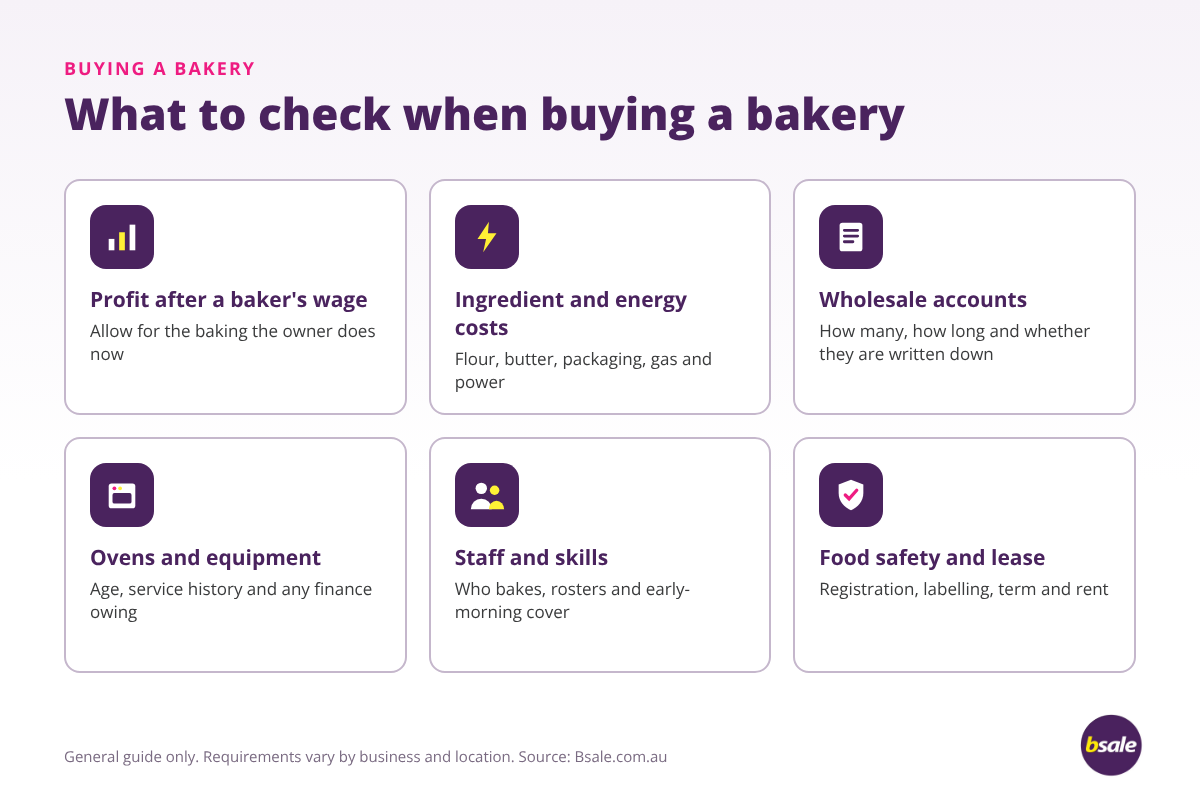
Due diligence is where you test what the seller has told you. Jan Forsyth of LINK Business Brokers has noticed that hospitality buyers are more careful than they used to be. “They’re taking longer with due diligence and making sure the numbers and the lease stack up,” she said.
Financial Records
Ask for profit and loss statements, tax returns and BAS for the past two to three years, along with point-of-sale reports, and check them against bank statements. Many sellers provide an information memorandum with this detail once a confidentiality agreement is signed.
Wholesale Accounts
Check how many wholesale customers the bakery supplies, how much each contributes to revenue, how long they have been customers and whether the arrangements are written down. Find out whether any account depends on a personal relationship with the current owner.
Ovens and Equipment
Ovens, mixers, provers, sheeters and refrigeration are costly to replace. Ask for their age, service history and whether they are owned, leased or financed. A search of the Personal Property Securities Register shows whether anyone has a security interest over equipment. The PPSR explains how in its guidance on buying second-hand machinery or equipment.
Staff and Skills
Find out who does the baking, what qualifications they hold and whether key staff plan to stay after the sale. Review rosters, pay records and leave balances. The modern award that applies depends on what the bakery does, so check with the Fair Work Ombudsman which one covers the staff.
Food Safety and Labelling
Under Food Standards Australia New Zealand's Standard 3.2.2A, food businesses such as bakeries generally need a certified food safety supervisor and trained food handlers. Bakeries that package products must also meet allergen labelling requirements. Check the council food business registration and any recent inspection reports.
The Lease
Check the remaining term and options, rent reviews, outgoings and make good obligations, and whether the premises suit early-morning production. A bakery's fit-out is costly to move, so the lease matters to its value. Bsale's article on how a lease agreement can affect a business sale price explains why.
For a full overview of the process, read Bsale's guide to due diligence in a business sale.
Growing a Bakery's Revenue
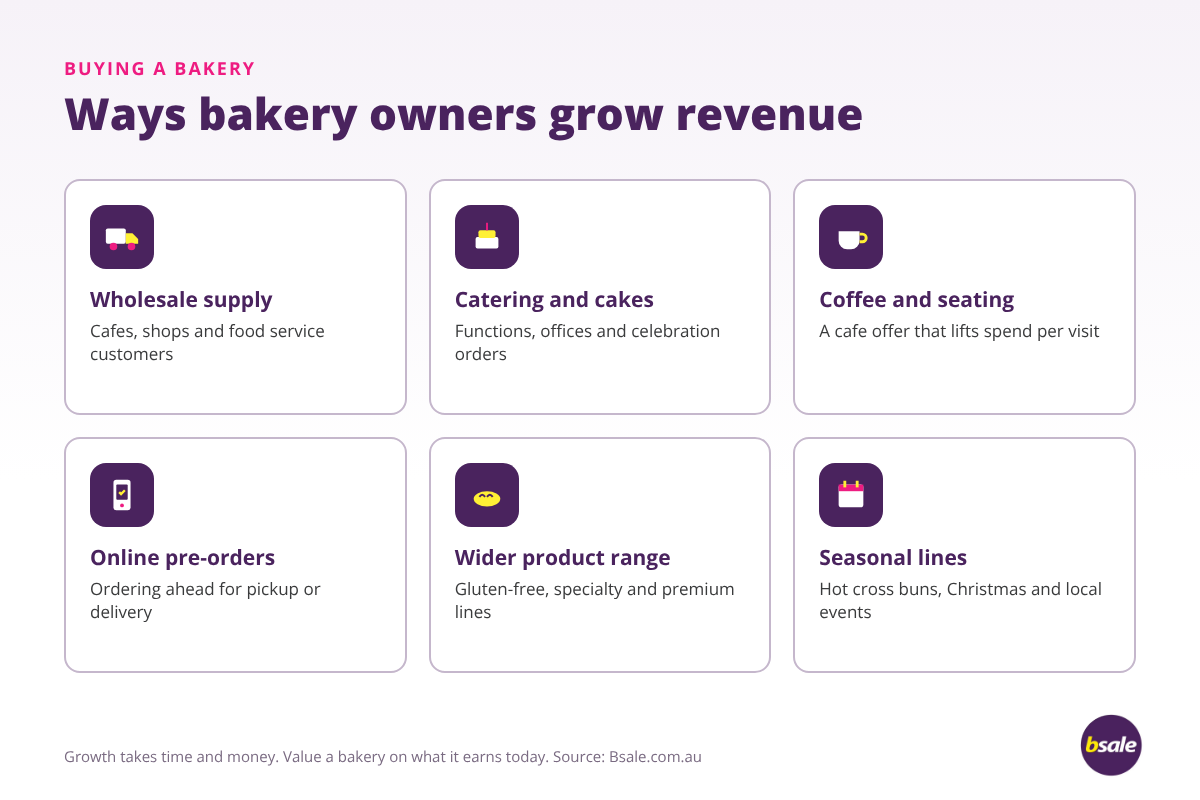
Many bakery listings point to room for a new owner to grow the business. Common approaches include adding wholesale customers, building catering and celebration cake orders, introducing coffee and seating, taking online pre-orders, widening the product range with gluten-free or specialty lines, and promoting seasonal products such as hot cross buns and Christmas lines.
Each of these takes time, money and often extra staff or equipment. Check whether the kitchen has the capacity to produce more, and value the bakery on what it earns today rather than what it might earn under a new owner.
10 Steps to Buying a Bakery
The steps below follow Bsale's essential guide to buying a business, adapted for bakeries.
- Decide what type of business suits you. Choose between retail, artisan, bakery cafe, wholesale and franchise models, and decide whether you will do the baking yourself.
- Know your buying capacity. Budget for the asking price, stock at valuation, legal and accounting costs, any equipment upgrades and working capital.
- Search for opportunities. Compare bakeries by location, model and price, and talk to local brokers through Bsale's business broker directory so they can contact you when a suitable bakery comes up.
- Enquire and sign a confidentiality agreement. Ask early who does the baking, how many hours the owner works and why the bakery is being sold. Remember that a broker normally acts for the seller.
- Review the information memorandum. Look at profit after a realistic baker's wage, ingredient and energy costs, and how much income comes from wholesale accounts.
- Make an offer. Make it conditional on finance, due diligence and lease assignment, and ask for a handover period in which the seller passes on recipes and processes.
- Complete due diligence. Check the financial records against bank statements, inspect the ovens and equipment, review wholesale arrangements, food safety records and the lease.
- Secure your finance. Lenders will usually want trading history, the lease and equipment details. Bsale's article on how to source finance to buy a business covers the options.
- Negotiate and finalise the contract. Make sure it covers equipment, stock, recipes and trading names, the seller's restraint of trade, the handover period and staff entitlements.
- Settle and take over. Transfer the food business registration, have a food safety supervisor in place, and keep core products consistent while you learn the business.
Thinking of Selling Your Bakery?
The checks buyers make are a useful guide for owners preparing to sell. Buyers will look closely at profit after a realistic baker's wage, the reliability of wholesale income, the condition of the ovens and equipment, the lease and the strength of the team.
You can prepare by keeping clean financial records that reconcile with bank statements, documenting recipes and production processes so the bakery does not depend on you alone, putting wholesale arrangements in writing, keeping equipment serviced and securing a lease with enough time remaining for a buyer. A bakery that can run without the owner baking every morning will usually appeal to a wider range of buyers.
When you are ready, Bsale's guide on how to sell a business in Australia in 10 steps walks through the process from preparation to settlement.
Disclaimer: This article provides general information only and does not constitute financial or legal advice. Listing information is supplied by advertisers and has not been independently verified by Bsale. Market figures reflect Bsale marketplace activity and do not represent the entire Australian business sales market. Asking prices are advertised prices, not confirmed sale prices, and listings marked as sold do not necessarily represent completed transactions. Buyers should conduct their own due diligence and obtain independent professional advice before purchasing a business.
Originally published: 3 May 2025
Updated: 25 November 2026
Tags: bakery hospitality guide
About the author

Catherine Mangana
Customer Support
Catherine enjoys generating articles that highlight some of the opportunities that are now available for purchase on Bsale. She hails from a family of ...


