How to Buy a Business in Victoria
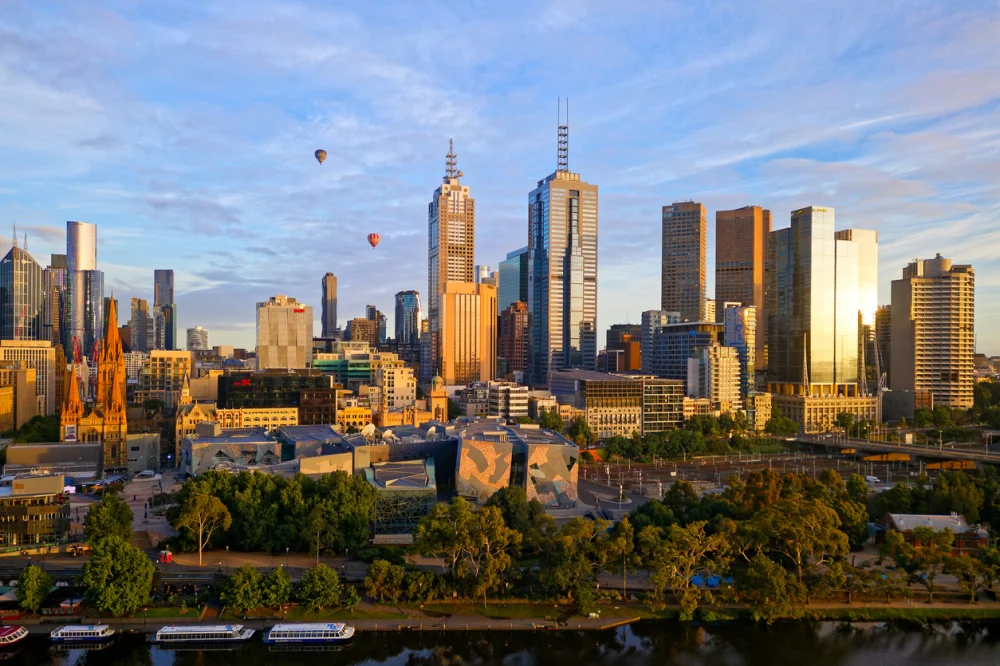
Buying a Business in Victoria. Image: Melbourne Skyline.
Victoria gives business buyers more choice than almost anywhere in Australia.
Melbourne is one of the two largest business for sale markets on Bsale, and regional centres such as Geelong, Ballarat, Bendigo, Gippsland and Shepparton offer a deep pool of established, higher-value businesses.
That choice comes with decisions. Do you buy in Melbourne or the regions? What does the asking price include? Which Victorian rules apply to leases, licences, staff and stamp duty?
This guide walks through how to buy a business in Victoria, from setting your budget to settlement. It draws on Bsale marketplace data and on the experience of brokers who sell businesses across Melbourne and regional Victoria every week.
If you are new to buying a business, start with our guide to buying a business in Australia, then use this guide for the Victorian detail. When you are ready to look, browse businesses for sale in Victoria.
Victoria's Business Market at a Glance
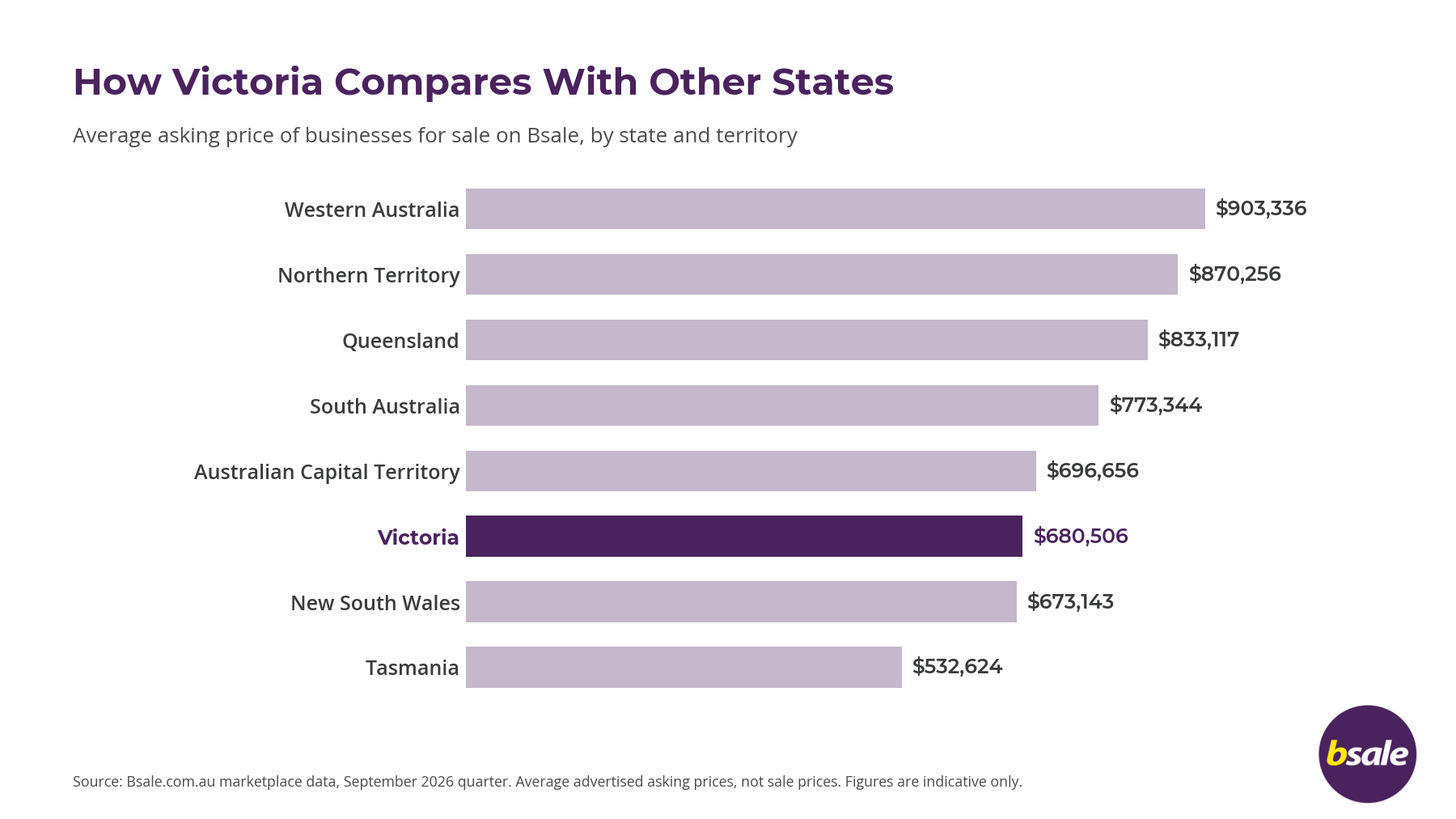
According to Bsale marketplace data for the September 2026 quarter, businesses for sale in Victoria carried an average asking price of $680,506. That sits close to New South Wales ($673,143) and below Queensland, South Australia and Western Australia.
The state average hides two quite different markets.
Melbourne has Volume and Choice
Melbourne averaged $610,978. Together with Sydney, it accounts for more than four in ten businesses for sale on Bsale, with many cafes, restaurants and smaller service businesses in the mix.
Melbourne was also the busiest city for businesses marked as sold on Bsale in the September quarter, with 125, up from 78 a year earlier. Victoria accounted for one in three businesses marked as sold nationally. Melbourne's sold listings carried the lowest average asking price of the major capitals at $359,631, reflecting turnover among cafes, restaurants and smaller service businesses.
For buyers, that means plenty of entry-level opportunities and a market where businesses do change hands. It also means more competing listings, so comparing several similar businesses before making an offer is worthwhile.
Regional Victoria has Established, Higher-Value Businesses
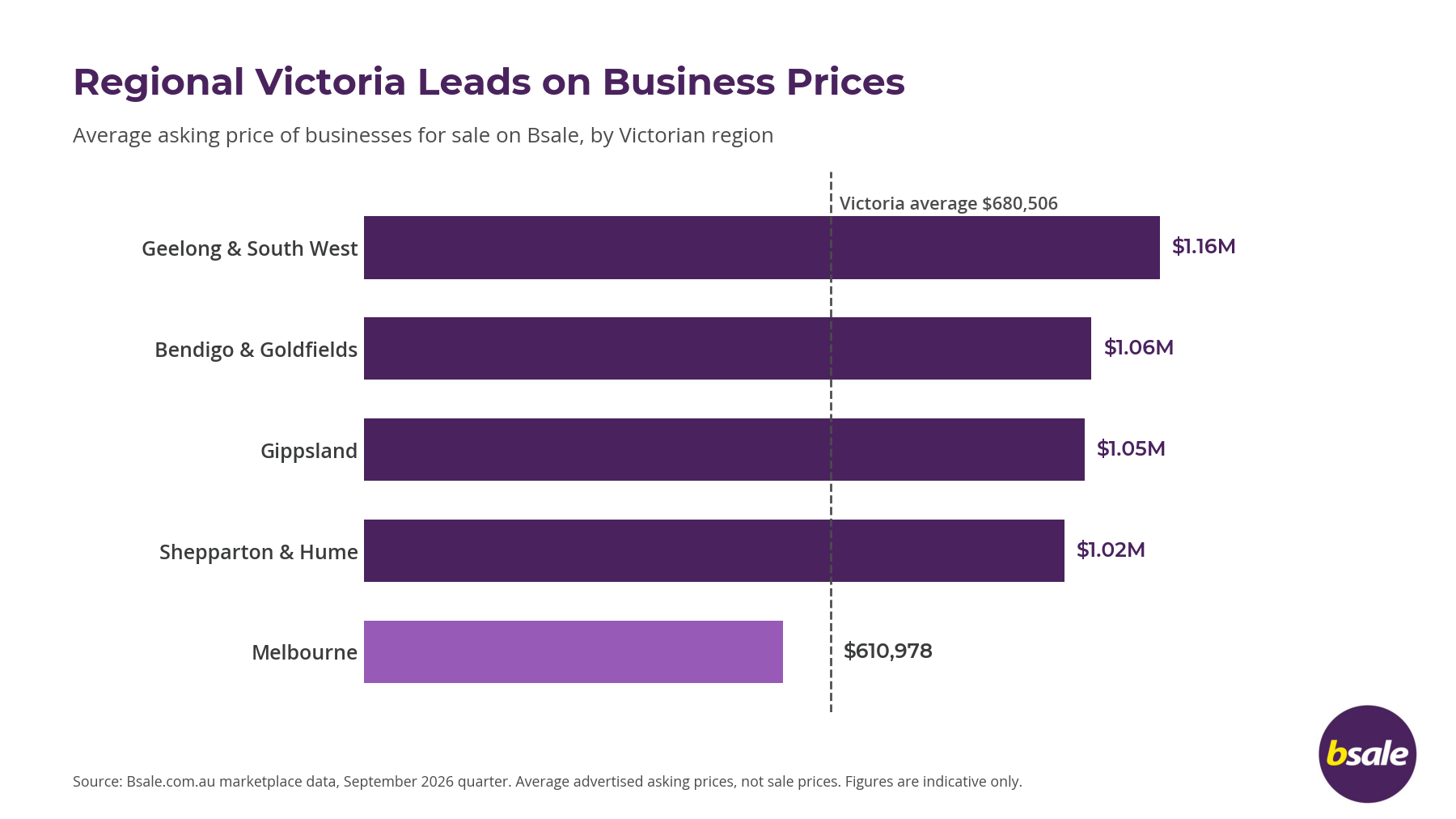
Regional Victoria is one of the deepest pools of established, higher-value businesses on Bsale. Four regions averaged more than $1 million in the September quarter, each across more than 100 listings.
|
Region |
Average asking price (Sep 2026 quarter) |
|---|---|
|
$1.16 million |
|
|
$1.06 million |
|
|
$1.05 million |
|
|
$1.02 million |
|
|
$610,978 |
At the more accessible end, the Mornington Peninsula was among the lower-priced regional markets nationally. Buyers looking around Ballarat & Grampians can browse that region separately.
Higher regional averages may partly reflect what the asking price includes, such as plant, machinery, vehicles, stock or freehold property. Always check what a price covers before comparing businesses.
Where Buyers Are Looking
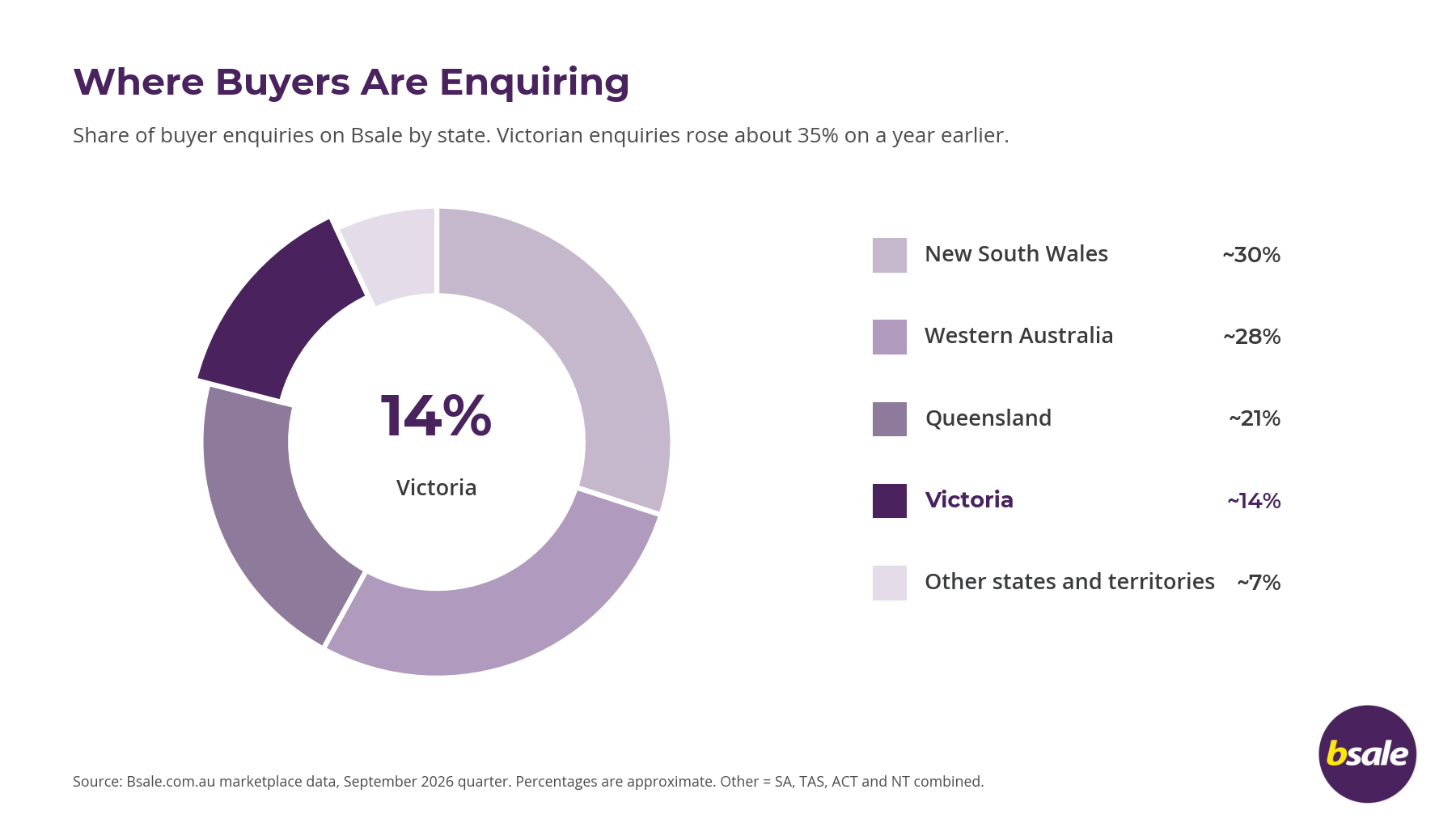
Victoria attracted about 14% of buyer enquiries on Bsale in the September quarter, with enquiries up about 35% on a year earlier. Geelong was one of the suburban and regional areas with strong buyer interest.
Nationally, buyers showed a clear preference for businesses that do not need a full-time owner. Listings advertised as under management drew around 30% more enquiries than average. For more on the state's regional trends, read Regional Victoria Outpaces Melbourne as Business Asking Prices Rise.
How to Buy a Business in Victoria, Step by Step
The buying process in Victoria follows the same broad path as the rest of Australia, and business.gov.au has a general overview of buying an existing business. The differences sit mostly in the state rules covered in the next section.

- Set your budget and criteria.
Work out how much you can invest, how much finance you may need and how involved you want to be. Decide whether you are looking at Melbourne, a regional centre or a lifestyle area such as the Mornington Peninsula or the Surf Coast.
- Get your finance conversation started early.
Speak to your bank or a finance broker before you start making offers. Buyers on Bsale are increasingly asking about finance and vendor finance in their enquiries, and sellers take prepared buyers more seriously.
- Search listings and set up alerts.
Browse businesses for sale in Victoria by region and industry, and set up Bsale buyer alerts so new listings come to you.
- Register with local brokers.
Some businesses sell before they are publicly advertised. Letting Victorian brokers in your target area or industry know what you want can put you in front of those opportunities.
- Review the information memorandum.
Most brokers will ask you to sign a confidentiality agreement before releasing the information memorandum and financials.
- Inspect the business and ask questions.
Visit more than once if you can, at different times of the day and week.
- Make a conditional offer.
Offers are usually made subject to finance, due diligence, lease assignment and any licence transfers.
- Complete due diligence.
Have your accountant and solicitor review the financials, lease, contracts, staff and licences. More on this below.
- Sign the contract.
A sale of business contract sets out the price, what is included, the training period, any restraint of trade and the conditions to be met before settlement.
- Settle and take over.
At settlement, the price is paid (usually adjusted for stock), the keys are handed over and the training or handover period begins.
It also helps to understand common sale terms. A price advertised as WIWO (walk in, walk out) usually includes stock, while a price plus SAV means stock at valuation is added at settlement.
Victorian Rules Buyers Should Know
Several parts of a business purchase are governed by Victorian law. Business Victoria's guide to buying an existing business in Victoria is a useful starting point, and LegalVision outlines the legal requirements for purchasing a small business in Victoria. Your solicitor and accountant should confirm how each applies to the business you are buying, as rules and thresholds change.
Business Broker Licensing
Business brokers selling businesses in Victoria need to hold an estate agent's licence. Consumer Affairs Victoria keeps a public register you can search. See how to tell if a business broker is licensed in Victoria.
Remember that the broker is usually engaged by the seller. They can help you through the process, but you should rely on your own advisers for independent advice.
Stamp Duty
Victoria does not generally charge stamp duty on business assets such as goodwill, plant and equipment. Duty can apply where the purchase includes land, such as a freehold pub, motel or caravan park, and on vehicles transferred into your name.
Victoria has also changed how commercial and industrial property is taxed, moving from stamp duty to an annual tax over time. If you are buying a freehold going concern, ask your solicitor how these rules apply. Read more: Is there stamp duty on the sale of a business in VIC?
Retail and Commercial Leases
For most businesses that do not own their premises, the lease is one of the most important documents in the sale. Many shop leases in Victoria are covered by the Retail Leases Act 2003 (Vic), which sets rules on disclosure, minimum terms and assignment.
The lease usually needs to be assigned to you with the landlord's consent. Check the remaining term, options to renew, rent reviews, outgoings and any make-good obligations. The Victorian Small Business Commission can help with some retail lease disputes. See 6 ways a lease agreement can impact your business sale price.
Licences and Registrations
Licences rarely transfer automatically. Allow time in your contract for transfers or new applications.
- Food businesses: cafes, restaurants, takeaways and bakeries must be registered with the local council under the Food Act 1984 (Vic). Contact the council early about transferring or applying for registration.
- Licensed venues and liquor stores: liquor licences are managed by Liquor Control Victoria. Venues with gaming machines also deal with the Victorian Gambling and Casino Control Commission.
- Other regulated businesses: childcare, health, transport, security and trade businesses can need specific licences or accreditations. Check what applies before you commit.
Business Victoria's online tools can help you find the licences a particular business type needs.
Staff and Employer Obligations
If you take on existing employees, ask how their leave entitlements are treated in the contract. Under Victoria's long service leave laws, service with the previous owner can count towards a transferring employee's long service leave, so the buyer may inherit that liability.
As a new employer, you will also need WorkSafe Victoria insurance, and payroll tax may apply if your wages exceed the Victorian threshold. Your accountant can confirm the current threshold with the State Revenue Office.
Due Diligence and Finance
What to Check During Due Diligence
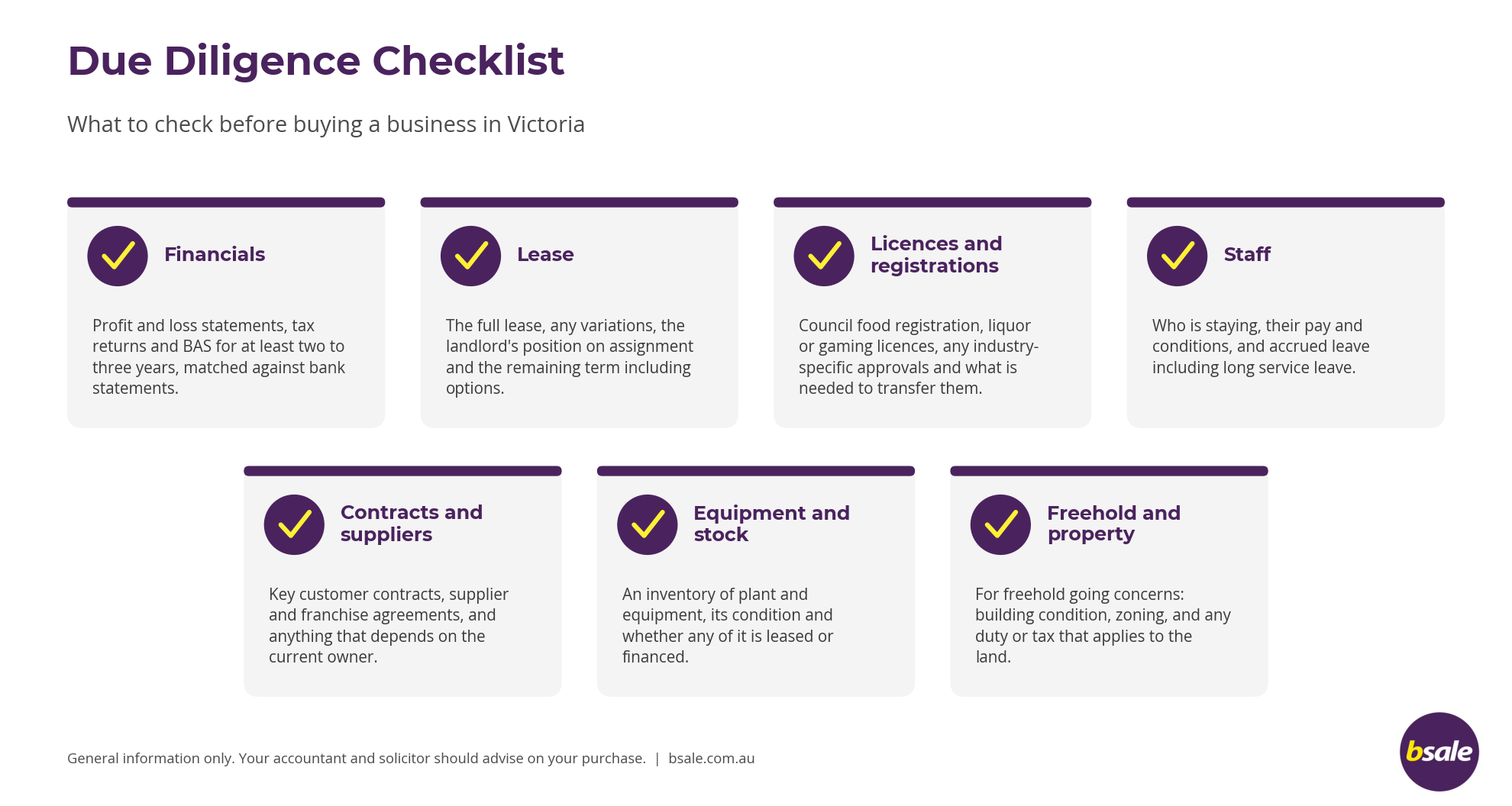
Due diligence is where you confirm the business is what the seller says it is. In Victoria, it usually covers:
- Financials: profit and loss statements, tax returns and BAS for at least two to three years, matched against bank statements.
- Lease: the full lease, any variations, the landlord's position on assignment and the remaining term including options.
- Licences and registrations: council food registration, liquor or gaming licences and any industry-specific approvals, plus what is needed to transfer them.
- Staff: who is staying, their pay and conditions, and accrued leave including long service leave.
- Contracts and suppliers: key customer contracts, supplier agreements, franchise agreements and anything that depends on the current owner.
- Equipment and stock: an inventory of plant and equipment, its condition and whether any of it is leased or financed.
- Freehold and property: for freehold going concerns, building condition, zoning, and any duty or tax that applies to the land.
Buyers on Bsale are asking about this earlier. In the September 2026 quarter, almost one in four buyers who wrote a message asked for the financials or information memorandum, up from about one in six a year earlier.
For help putting your team together, read the 5 experts every business buyer needs on their team. For a legal perspective on the Victorian process, see this complete guide to buying a business in Victoria.
Financing Your Purchase
Most buyers combine their own funds with a business loan, and lenders will look closely at the business's financial records and your experience. Larger regional businesses, especially those including freehold, can require significant equity.
Vendor finance is another option some buyers explore, where the seller allows part of the price to be paid over time. Nearly one in five buyers who wrote a message on Bsale in the September quarter asked about finance or vendor finance, up from 13% a year earlier. Read more about why vendor finance and buy-out options are increasing.
What Victorian Brokers Are Seeing
Bsale speaks regularly with brokers working across Melbourne and regional Victoria. Several specialise in hospitality and accommodation, one of the state's most active sectors, and their experience offers useful lessons for buyers in any industry.
Some Businesses Sell Before They Are Advertised
Melbourne-based Phil Mammolito of CRE Brokers sells motels, hotels, pubs and caravan parks across Victoria. He sold the Lealow Caravan Park at Lakes Entrance within 24 hours, before it was publicly listed.
“We do a few like that, but you've got to know your buyer. Because I've been doing it for so long, I often know a suitable buyer for the business,” Phil explained.
For buyers, the lesson is simple. Watch the listings, but also make sure the brokers working in your area and industry know who you are and what you are looking for.
Competition Is Strong in Some Sectors
Daniel McDonald runs McDonald Hospitality Brokers (MHB) from Albury, with brokers across Victoria and the Riverina, including Melbourne, Mildura, Rutherglen, and around Harrietville, Bright and the snowfields. He sees strong competition in certain parts of the market.
“At the moment, accommodation is absolutely a seller's market,” he said. He also sees strong interest in coffee shops, breakfast spaces and lunchtime eateries, as well as under-management operations.
In western Victoria, Rohan Pertzel of CRE Brokers manages listings from Geelong and Ballarat across to the South Australian border. He has seen larger corporate groups increasingly buying hotels and caravan parks alongside independent “mum and dad” operators.
“Down the track, it'll probably be groups taking over the big ones and then a few independents scattered in between along the coast,” Rohan said.
If you are competing in a busy sector, having finance arranged and advisers ready can make the difference.
The Operator Makes the Business
A business that is underperforming is not always a poor buy. Phil believes the operator is what matters most, particularly with pubs.
“There's no such thing as a bad pub really. It's all about the management,” he said. “I've got some great success stories where we've sold pubs turning over $300,000 or $400,000 a year. With the right operator in place, within a couple of years they're turning over ten times that.”
The reverse also applies. Buyers should look at whether current results depend on the skills or hours of the existing owner, and whether they can realistically match or improve on them.
Buying on the Border
Along the Murray, the market does not stop at the state line. Rod Devlin, Director and Business Broker for the Murray and Riverina region at CRE Brokers, works from Albury across northern Victoria and southern New South Wales and is licensed in both states.
He describes caravan parks as “a bit of a sleeper”. “From the outside you probably wouldn't think they're as strong a business as what they are, but they're underpinned by the fundamentals of real estate and they're good cash-flow businesses.”
If you are looking at towns such as Wodonga, Echuca or Mildura, you may also find businesses across the river in New South Wales. Check which state's rules apply to the lease, licences, staff and any duty.
Expect Your Broker to Manage the Process
Rohan sees the broker's role as keeping everyone moving in the same direction. “Our role is to make sure we're the conduit between the buyer, the seller and the solicitor, because there can be some egos involved and some issues along the way.”
A good broker will keep information flowing and help manage expectations on both sides, but your own accountant and solicitor are there to protect your interests.
Frequently Asked Questions
1. Is there stamp duty on buying a business in Victoria?
Victoria does not generally charge stamp duty on business assets such as goodwill and equipment. Duty or other property taxes can apply if the purchase includes land or buildings, and vehicles attract duty when transferred. Confirm your situation with your solicitor.
2. Is it cheaper to buy a business in Melbourne or regional Victoria?
On Bsale in the September 2026 quarter, Melbourne's average asking price ($610,978) was lower than several large regional markets, including Geelong & South West ($1.16 million) and Bendigo & Goldfields ($1.06 million). Regional prices may include freehold, plant or vehicles, so compare what each price includes.
3. Do I need a broker to buy a business in Victoria?
No, but many businesses are sold through brokers, and some sell before they are publicly advertised. Registering with brokers in your target area can give you access to more opportunities.
4. How long does it take to buy a business?
It depends on finance, due diligence, lease assignment and licence transfers. On Bsale, the median time between a business being listed and marked as sold is 202 days, though that reflects the full selling process rather than the buyer's timeframe.
Start Your Search
Browse businesses for sale in Victoria, or narrow your search to Melbourne, Geelong & South West, Ballarat & Grampians, Bendigo & Goldfields, Gippsland, Shepparton & Hume or the Mornington Peninsula. You can also find a broker through Bsale's business brokers directory.
Disclaimer: Statistics are based on Bsale.com.au marketplace data and do not represent the entire Australian business sales market. Listing information is supplied by advertisers and is not independently verified by Bsale. Data may contain errors, duplicates or outdated information. Listings and asking prices may not be directly comparable, including those advertised as WIWO, plus SAV or including freehold property. Asking prices are not confirmed sale prices, and listings marked as sold do not verify completed transactions. Figures are indicative only. This article is general information, not professional advice. Readers should conduct independent due diligence before making business or investment decisions.
Tags: guide melbourne victoria buying a business
About the author
Vanessa Lovie-Yousaf
CEO Bsale Australia
Vanessa Lovie-Yousaf is the CEO and manager of Bsale.com.au, one of Australia’s most trusted business for sale marketplaces since 2000. With 15 ...


