How to Buy a Business in Australia. 10-Step Checklist and Insights From Business Brokers

How to Buy a Business in Australia
Buying a business can be a faster route to ownership than starting from scratch. You take on existing customers, staff and cash flow from day one. But the buyers who succeed are usually the ones who understand the process before they start enquiring.
In business sales, buyers who waste a seller’s time are known as tyre kickers. Sellers and brokers quickly learn to spot them. The aim of this guide is to help you be the opposite so you are a prepared, well-informed buyer who knows what they want and can show they have the means to buy it.
There is plenty of competition. On Bsale, buyer enquiries in the September 2026 quarter were about 28% higher than a year earlier, and the number of individual buyers making enquiries rose by around 23%. Buyers are also doing more homework. Among buyers who wrote a message with their enquiry, nearly one in four asked for financials or an information memorandum, up from about one in six a year earlier.
Two of the most common reasons purchases fall over are problems uncovered in due diligence and buyers struggling to fund the price, stock, equipment or lease bond. Working through the steps below in order will help you avoid both.
1. Decide what type of business suits you
2. Know your buying capacity
3. Search for opportunities
4. Enquire and sign a confidentiality agreement
5. Review the information memorandum
6. Make an offer
7. Complete due diligence
8. Secure your finance
9. Negotiate and finalise the contract
10. Settle and take over
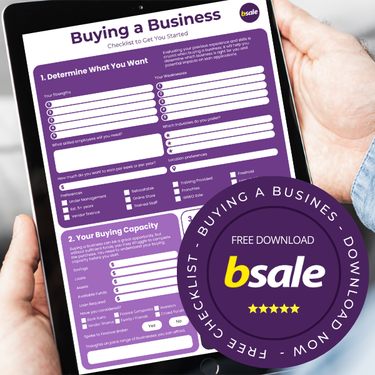
You can download our free buyer checklist to work through each step as you go.
1. Decide What Type of Business Suits You

Before you start enquiring, take an honest look at your skills, experience and lifestyle. Buying a business you understand is far less risky than buying one you don’t. If you have never worked in a cafe, for example, spend time learning how a good one operates before you invest in one.
Sukhdeep Mangat of LINK Business Brokers in Sydney ran a 7-Eleven for 20 years before moving into broking. Her advice is to work through the practical questions first: how much money is available, how many hours you can commit and how much family time you can realistically give up.
“If your attitude is right and you put in the work, that’s the way to go,” she said.
The buyer checklist will help you work out:
- Your strengths and weaknesses. What you bring, and where you would need help.
- Who you may need to hire. If you are buying a cafe, you may need a barista or chef.
- Which businesses suit your background. Industries where your experience gives you an advantage.
- Your money. How much you have, how much you need to borrow and how much you want to invest.
- Your income. What you need the business to pay you each week.
- Your location. Where you are willing to live and work.
Think about how involved you want to be, too. On Bsale, listings described as remote, home-based, automated or under management are attracting well above the average number of enquiries, so expect more competition for businesses that don’t need a full-time owner.
More: Who Are Today’s Business Buyers? and Buying a Business Under Management? Here’s What to Consider
2. Know Your Buying Capacity

Work out your finances before you find a business, not after. Buyers who leave finance until they have an accepted offer often find they can’t borrow what they need, which disappoints both sides.
Lenders look at the business you want to buy and at your own position, including your savings, assets and credit history. You may also need separate funding for different parts of the purchase, such as the business itself, stock, equipment and the lease bond.
Roy Levy of Core Business Brokers, who has more than 30 years in business broking, says banks can be difficult to navigate, particularly when lending decisions are made away from the local manager. He often directs buyers to finance brokers who understand which lenders are actively lending to particular types of business.
Common ways buyers fund a purchase include:
- Personal savings. The simplest option, and it shows sellers and lenders you are committed. For most buyers it covers only part of the price.
- Business loans. Banks and other lenders usually want to see your financial position, a business plan and the business’s financial records. They generally expect you to contribute a significant share of the price yourself, and many prefer the loan to be supported by assets such as property or equipment.
- Vendor finance. The seller agrees to receive part of the price later. It can make a deal possible, but the terms, interest and repayment schedule need careful negotiation and professional advice.
- Equity partners. An investor provides capital in exchange for a share of the business. Make sure everyone’s role and ownership are clearly documented.
- Family and friends. Formalise any loan with a written agreement and clear repayment terms.
- Asset or equipment finance. The business’s equipment or receivables can support part of the funding, though usually not all of it.
- Franchise finance. If you are buying a franchise, the franchisor may have preferred lenders who understand the system.
Buyers are thinking about this earlier. On Bsale, nearly one in five buyers who wrote a message with their enquiry asked about finance or vendor finance, up from 13% a year earlier.
Speak to a finance broker experienced in business lending before you start your search, so you know what price range is realistic. Of course is business loans, the borrowing capacity is based on the business you are buying, your experience and assets you currently own. Unsecured finance is getting harder to obtain for business sales.
More: Why Vendor Finance and Buy-Out Options Are Increasing and Can You Buy a Business With No Money Down?
3. Search for Opportunities

Once you know what you are looking for and what you can afford, start searching. Cast a wide net, because good businesses don’t always come through one channel.
- Online marketplaces. Businesses for sale on Bsale are listed by brokers, franchise groups and private sellers who are actively looking for buyers. Filter by industry, location and price, and set up Bsale alerts so you hear about new listings first.
- Business brokers. Get to know brokers in your area and tell them what you are looking for. Many businesses are matched with buyers from a broker’s database before they are widely advertised.
- Approaching owners directly. Some owners are thinking about selling but haven’t listed. If you approach one, expect the business may not be sale-ready and be prepared to negotiate.
- Networking. Local business groups and industry contacts can lead to opportunities that never reach the open market.
Location affects how much competition you will face. On Bsale, Western Australia attracted around three times as many enquiries as its share of listings in the September 2026 quarter. Victoria held about a quarter of listings but drew only 14% of enquiries, which can mean more choice and potentially more room to negotiate.
More: What Can $500,000 Actually Buy You in Today’s Business Market? and Australia’s 9 Most Affordable Regions to Buy a Business in 2026
4. Enquire and Sign a Confidentiality Agreement

When you find a business that interests you, use the enquiry form or contact details on the listing. A short message about who you are, your experience and your funding will get a better response than a one-line “please send info”.
The Sept 2026 Business Sales Insight report from Bsale showed 23% of enquiries asked for an IM or financials upfront, as opposed to 17% a year ago. Buyers are getting more educated and know what they want.

Expect the seller or broker to ask a few questions of their own. Shane Fox of Merchant Business Brokers in Newcastle sees qualifying buyers as part of protecting the seller’s confidentiality and making sure the match is right.
“I want to make sure it’s a good fit for you,” he said. “I want to make sure that I’m sharing a business that’s not going to waste your time.”
Before sharing detailed information, most sellers will ask you to sign a confidentiality agreement, also called a non-disclosure agreement or NDA. It protects sensitive information about the business and helps sellers filter out people who aren’t serious. Read it, sign it and return it promptly.
More: How to Screen Potential Buyers and Avoid Time-Wasting Tyre Kickers shows what sellers look for, from the other side of the table.
5. Review the Information Memorandum

Once the seller has your signed confidentiality agreement, they will usually send an information memorandum (IM). Some sellers send a formal document, while others send a collection of files.
An IM typically covers how the business operates, its customers and staff, the premises and lease, and its recent financial performance. You may receive profit and loss statements and balance sheets at this stage. More sensitive records, such as tax returns and bank statements, are often held back until you have made an offer and paid a deposit.
That can feel frustrating, but it is normal. Sellers are cautious about sharing too much early, particularly when competitors might be among the people enquiring. The IM should give you enough to decide whether the business is worth pursuing.
As you read it, note the questions you will want answered later, such as how the owner’s salary is treated, what is included in the price and how secure the lease is.
If the business still looks right, arrange a site visit and meet the owner. Seeing it in operation will tell you a lot that the numbers can’t.
More: What Is an Information Memorandum in a Business Sale?
6. Make an Offer

In business sales, you usually make an offer before you have seen everything. It can feel premature, but it is common practice, because most sellers won’t release their most sensitive information until a buyer has committed.
Your offer should be in writing, to the seller or their broker. Once it is accepted, you will usually pay a deposit, often around 10% of the price, which is held in trust by a solicitor or broker. The agreed terms are set out in a term sheet or heads of agreement. These cover the proposed price, payment terms and conditions of the sale.
Make your offer conditional on the things you still need to confirm. The most common conditions are satisfactory due diligence and securing finance, and your solicitor may suggest others, such as the landlord agreeing to transfer the lease.
Price isn’t the only thing a seller weighs up. Payment terms, how quickly you can settle and how long you want the owner to stay on for the handover can all make your offer more or less attractive.
Get professional advice before you submit an offer, so you understand your options and what you are committing to.
7. Complete Due Diligence

Due diligence is where you check that the business is what it appears to be. It is the most important step for a buyer, and it is often where price and terms are renegotiated.
Dione Mauric of Advantage Business Sales & Valuations in Queensland describes how her husband and business partner, Stephen Wolff, approaches the detail.
“Stephen’s the detailed guy,” she said. “He makes sure everything is perfect because surprises kill deals.”
The same applies from the buyer’s side. It is far better to find a problem now than after settlement. Build a team to help you review the business: an accountant, a solicitor experienced in business purchases, a finance broker and, if you need one, a business adviser.
Due diligence usually covers:
- Financial. Profit and loss statements, balance sheets, wages and superannuation, add-backs, and the real profit the business makes for its owner. Your accountant should confirm the business is up to date with its tax and has no unexpected debts.
- Operational. Customers, suppliers, stock, equipment, staff, systems and procedures, the website and marketing channels, and how much the business relies on the current owner.
- Legal. The premises lease and whether it can be transferred, supplier and customer contracts, employment contracts, trademarks and intellectual property, and any disputes or claims. Your solicitor should confirm who owns the business and its assets.
- Market. The competition, the business’s position in its market and its realistic growth potential.
Take your time and ask questions. A seller with nothing to hide will expect them.
More: What Is Due Diligence in a Business Sale? and The 5 Experts Every Business Buyer Needs on Their Team
8. Secure Your Finance

While due diligence is underway, lock in your funding. If you worked out your buying capacity at Step 2, this should be a matter of turning pre-approval into a formal loan rather than starting from scratch.
Start the application as soon as your offer is accepted. Lenders will usually want a business plan, a cash flow forecast showing how you will meet repayments, and the business’s financial records. Approval can take weeks, and the finance condition in your offer will have a deadline.
Remember to budget for more than the purchase price. Stock, equipment, the lease bond, working capital for the first few months and your professional fees can add up quickly.
If finance becomes difficult, talk to the seller or broker early. Options such as vendor finance or a longer settlement may be possible, but only if they know in time.
9. Negotiate and Finalise the Contract

Due diligence often turns up items you want to change, add to the contract or reflect in the price. Expect some back-and-forth with the seller until you reach agreement.
Negotiations commonly cover:
- Price. Any adjustment based on what due diligence found.
- What is included. Stock, equipment, vehicles, intellectual property and training.
- The lease. Its remaining term, options to renew and the landlord’s consent to transfer it.
- Payment terms. Whether any of the price will be paid later through vendor finance or an earn-out.
- Handover. How long the seller will stay on to train you and introduce you to staff, suppliers and customers.
- Restraint of trade. How long, and how far away, the seller can’t open a competing business.
- Conditions. Anything that must happen before settlement.
Once terms are agreed, the seller’s solicitor usually drafts the contract of sale, based on the term sheet or heads of agreement. Your solicitor should review it carefully before you sign. Once both parties sign, the sale is binding and a settlement date is set.
More: Essential Negotiation Skills for Selling a Business shows how sellers approach the same negotiation.
10. Settle and Take Over

At settlement, you pay the balance according to the contract and the business becomes yours. The seller hands over keys, logins, passwords, supplier and customer contacts, operating procedures and anything else you need to run the business from day one. Your solicitor and accountant will help make sure everything that needs to move into your name does.
- The Handover Period. Most contracts include a handover or training period, which can range from about two weeks to 12 months depending on the business. Make the most of it. Learn how the owner runs the business day to day, and ask them to introduce you to staff, suppliers and key customers.
- If Part of the Price Is Paid Later. Many buyers pay the full price at settlement. If your deal includes vendor finance, an earn-out or a staged buy-out, keep up your payments and the reporting the contract requires, and speak to your solicitor early if anything changes.
In your first few months resist the urge to change everything at once. Get to know the team and customers first, then make improvements once you understand why things are done the way they are.
Frequently Asked Questions
- How long does it take to buy a business? It depends on how long your search takes. Once an offer is accepted, due diligence, finance and the contract commonly take several weeks to a few months.
- How much deposit do I need to buy a business? The deposit paid when an offer is accepted is often around 10% of the price. The amount you need to contribute to get a loan is a separate question. Lenders generally expect a significant contribution, so speak to a finance broker early.
- Do I need a business broker to buy a business? No. Brokers usually act for the seller, but they can be a useful source of opportunities. Your own accountant and solicitor are the advisers who work for you. You can get an independent business broker to assist if you need advice.
- What are the warning signs when buying a business? Financial records that don’t reconcile, a lease that is short or can’t be transferred, heavy reliance on the owner or one customer, and a seller who won’t answer questions during due diligence.
Ready to Start?
Download the buyer checklist to work through each step, browse businesses for sale on Bsale, or set up buyer alerts so you hear about new listings first.
Disclaimer: Statistics are based on Bsale.com.au marketplace data and do not represent the entire Australian business sales market. Listing information is supplied by advertisers and is not independently verified by Bsale. Data may contain errors, duplicates or outdated information. Listings and asking prices may not be directly comparable, including those advertised as WIWO, plus SAV or including freehold property. Asking prices are not confirmed sale prices, and listings marked as sold do not verify completed transactions. Figures are indicative only. This article is general information, not professional advice. Readers should conduct independent due diligence before making business or investment decisions.
Originally published 2021. Updated October 2026.
Tags: buying buying a business guide
About the author

Vanessa Lovie-Yousaf
CEO Bsale Australia
Vanessa Lovie-Yousaf is the CEO and manager of Bsale.com.au, one of Australia’s most trusted business for sale marketplaces since 2000. With 15 ...


